
TL;DR:
- Lasting transformation requires understanding subconscious fears and restructuring identity, not just motivation.
- Science shows multi-strategy systems and relapse mapping outperform willpower alone for behavior change.
- Relapses are normal; non-linear progress is expected, and addressing fears prevents predictable setbacks.
You've done this before. You set the intention, feel the fire, build momentum for a few weeks, then something triggers a collapse and you're back where you started, feeling worse than before you tried. That cycle isn't a character flaw. It's a predictable psychological pattern, and science has mapped it in detail. Real personal transformation isn't about grinding harder on willpower. It's about understanding the mechanics of how minds actually change, identifying the subconscious fears that keep pulling you back, and layering strategies that hold up when motivation disappears. This guide breaks down what actually works and why most conventional advice keeps men stuck.
Table of Contents
- Understanding personal transformation
- The real science: How transformation unfolds
- What actually works: Willpower vs. multi-strategy approach
- Practical steps for lasting personal transformation
- Why the conventional approach to change sets men up to fail
- Ready for evidence-based transformation?
- Frequently asked questions
Key Takeaways
| Point | Details |
|---|---|
| Transformation is non-linear | Slipping up is expected—lasting change means responding to relapse, not avoiding it entirely. |
| Multi-strategy beats willpower | Stacking strategies like situation modification and reminders works better than relying on self-control alone. |
| Identity drives habits | Addressing subconscious fears and self-image is the linchpin for permanent transformation. |
| Science shows the way | Following proven models like TTM and data-driven methods leads to real, repeatable success. |
Understanding personal transformation
Personal transformation means lasting change in how you think, behave, and see yourself. Not a two-week productivity sprint. Not a motivational high that fades by Thursday. We're talking about a genuine shift in identity, the kind where the old version of you feels like a stranger.
Here's where most men go wrong: they confuse motivation with transformation. Motivation is a feeling. It comes and goes like weather. Transformation is structural. It rewires what feels natural, what you reach for automatically, and who you believe you are.
Self-sabotage sits right at the center of this problem. It's not laziness or weakness. Self-sabotage protects identity and familiarity, requiring explicit fear identification before real change can happen. Your subconscious treats a new identity as a threat. The harder you push toward change, the louder that inner resistance gets.
"The greatest obstacle to transformation isn't lack of effort. It's the identity you haven't examined yet."
Common myths that keep men stuck include:
- Willpower alone is enough if you want it badly enough
- Relapse means you failed and should start over
- Motivation needs to be present before you take action
- More information automatically produces better behavior
- Discipline is a fixed trait you either have or you don't
Understanding why men self-sabotage at a psychological level is the first step toward doing something permanent about it. And breaking self-sabotage for good requires tools that go deeper than motivational hacks.
With this foundation, let's see how science maps the real path of change.
The real science: How transformation unfolds
The Transtheoretical Model, or TTM, is one of the most well-validated frameworks in behavioral psychology. It doesn't describe change as a switch you flip. It describes five stages of change: Precontemplation, Contemplation, Preparation, Action, and Maintenance, with specific processes like consciousness raising and stimulus control driving progress between stages.
Here's what those stages actually look like in practice:
| Stage | What it feels like | Key process |
|---|---|---|
| Precontemplation | Denial or unawareness of the problem | Consciousness raising |
| Contemplation | Weighing pros and cons, stuck in your head | Self-reevaluation |
| Preparation | Planning, building small commitments | Self-liberation |
| Action | Actively changing behavior (0 to 6 months) | Stimulus control |
| Maintenance | Sustaining change beyond 6 months | Helping relationships |
Most men jump straight to the Action stage without doing the internal work required in Contemplation and Preparation. That's why the collapse hits so predictably. You're trying to run a race without building the base.
Relapse is also part of the model. Non-linear progress is expected, not a sign of failure. The science doesn't treat going backward as losing. It treats it as data.
Here's how to use the TTM practically:
- Honestly identify which stage you're currently in, not which stage you want to be in
- Focus on the process specific to that stage before moving forward
- Track your self-awareness using a simple journal or reflection habit with self-reflection structure
- Expect and plan for friction between stages, not just during action
- Build support systems before you need them, not after a collapse
Pro Tip: If you keep relapsing at the same point, you're probably still in Contemplation while acting like you're in Action. The fix isn't more discipline. It's going back and resolving the fear or belief driving the resistance.
Understanding the phases is only part of the journey. Now let's address strategies that actually work.
What actually works: Willpower vs. multi-strategy approach
Willpower is real. It helps. But relying on it alone is like trying to hold back a river with your hands. It works briefly, then the pressure wins.

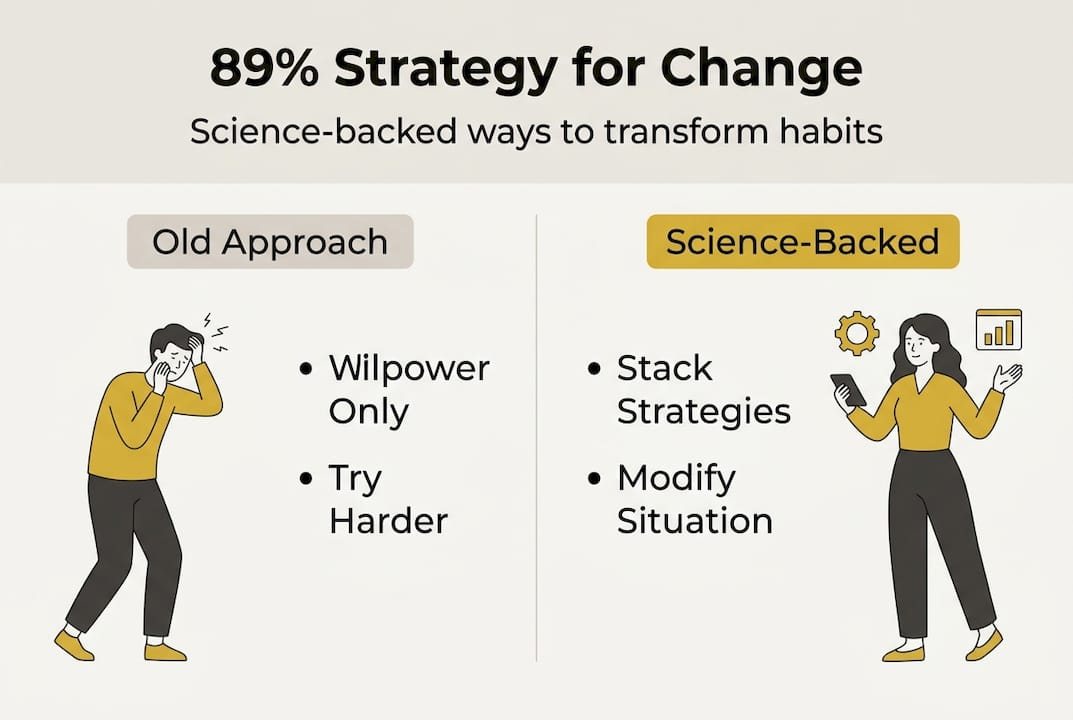
Here's a number that should shift your entire approach: 89% of the time, people successfully resist desires not through pure willpower, but by using strategies like situation modification, distraction, goal reminders, and multiple combined tactics. Willpower alone is a minority strategy, and a less effective one.
| Approach | Short-term effectiveness | Long-term effectiveness |
|---|---|---|
| Willpower only | Moderate | Low |
| Situation modification | Moderate | High |
| Goal reminders | High | High |
| Multiple strategies stacked | High | Very High |
What does this look like on the ground?
- Situation modification: Remove the trigger before it becomes a battle. Delete the app. Don't keep the junk food in the house. Change your route home.
- Goal reminders: Put a physical cue in your environment. A note on your mirror. A phone wallpaper. Something that pulls your attention back to what you decided.
- Distraction: When a craving hits, have a pre-decided redirect. Go for a walk. Do pushups. Call someone. The urge needs to go somewhere.
- Stacking strategies: Don't pick one. Use two or three together, every time, especially during high-risk windows.
Building evidence-based strategies for self-discipline into your daily structure reduces the cognitive load of making good decisions in the moment. And when you build that structure around lasting self-discipline, the system carries you when motivation doesn't show up.
Pro Tip: Before any high-risk situation, spend two minutes mentally running through which strategies you'll use. Proactive stacking works. Reactive willpower doesn't.
Next, let's put these science-backed methods into daily action for permanent transformation.
Practical steps for lasting personal transformation
Knowing the theory doesn't move the needle. Application does. Here's a grounded method that men can actually follow without needing perfect conditions.
- Anchor new habits to existing ones (habit stacking). Link the behavior you want to build directly after something you already do consistently. Morning coffee becomes a cue for five minutes of journaling or planning.
- Create identity cues in your environment. Lay out gym clothes the night before. Set your desk up for focused work before bed. Small physical signals tell your brain who you're being today.
- Map your relapse triggers by writing down the last three times you fell off track. Look for patterns: time of day, emotional state, social context. You'll find a pattern within two cycles.
- Collect small wins daily. Positive habits build identity reinforcement. Every small win is a vote for the version of you you're becoming. Don't underestimate tiny actions.
- Exercise consistently. Exercise builds persistent self-control, and transformation is often non-linear with expected relapses. Physical discipline spills over into mental discipline more reliably than almost any other intervention.
- Review and reframe every relapse. When you slip, ask: what triggered it, what stage was I actually in, and what strategy was missing? This turns a setback into a system upgrade.
Building an identity-based improvement approach means your habits stop being things you do and start being expressions of who you are. That's when habits drive success at a level motivation never could.
For men serious about ending self-sabotage, the shift from "I failed again" to "I found another trigger" is not a soft reframe. It's the actual cognitive move that separates men who change permanently from men who cycle forever.
Pro Tip: Make relapse part of your protocol, not the end of it. Build a written "relapse response plan" before you need it. Decide in advance what you'll do in the first 24 hours after a slip. That plan is more valuable than any streak.
By applying these, men can shift from frustration to real, permanent growth.
Why the conventional approach to change sets men up to fail
Conventional self-improvement advice runs on one core message: try harder. More grit. More discipline. More grinding through discomfort until the new habit sticks. That message sells well because it sounds like what strength looks like.
But it's missing the entire psychological layer where self-sabotage actually lives.
Self-sabotage protects identity and familiar patterns, requiring explicit fear identification before real change can occur. That's not motivational language. That's a behavioral science finding. If you don't name the fear your brain is protecting, more effort just creates more friction and faster burnout.
The men who change permanently aren't the ones with the most willpower. They're the ones who build systems that fit their actual psychology, who own their relapses without shame spiraling, and who layer strategies instead of betting everything on discipline alone.
Developing the right skills to beat self-sabotage means understanding that your patterns make sense given where you've come from. They were adaptations. Now they're liabilities. The move isn't to fight them harder. It's to replace the identity they were protecting with one that actually serves you.
Owning your relapses is progress. Not a sign you're weak. A sign you're paying attention.
Ready for evidence-based transformation?
If you've read this far, you already know that willpower alone won't cut it. The science is clear: multi-strategy systems, identity work, and honest relapse mapping are what produce permanent change.

Your Last Excuse is built specifically for men who are done running the same cycle. The Identity Shift System gives you the psychological framework, the Forge Protocol, and the tools to dismantle the subconscious patterns keeping you stuck. No fluff. No motivational filler. Just a structured, science-backed system designed to help you stop self-sabotaging and start building an identity that holds. If you're committed to making this the last time you start over, this is your next step.
Frequently asked questions
What is the first sign of personal transformation?
The earliest sign is increased self-awareness and recognition of underlying habits and fears, not just motivation or visible action. Consciousness raising is the key early process in the Transtheoretical Model, meaning noticing what drives your behavior matters more than pushing through it.
Why do most men relapse after starting change?
Relapse usually happens because identity-level fears and self-sabotage patterns were never addressed, leaving willpower as the only defense. Self-sabotage protects identity and familiar patterns, so without identifying those fears explicitly, collapse is predictable.
Which science-backed strategies help overcome self-sabotage?
Situation modification, goal reminders, distraction, and stacking multiple strategies consistently outperform willpower alone for resisting desires and sustaining long-term behavior change.
Is relapse normal in personal transformation?
Yes. TTM recognizes non-linear progress and relapse as an expected part of the change process, not a signal to quit. Treating a slip as data rather than failure is what separates men who eventually succeed from those who stay stuck.