
TL;DR:
- Self-sabotage is driven by identity patterns, not character flaws, and can be broken with awareness.
- Building lasting habits relies on reshaping self-identity and designing environments that support new behaviors.
- Willpower is finite; sustainable change depends on systems, identity, and adaptive strategies rather than motivation alone.
Self-sabotage is not a character flaw. It is a predictable pattern, and most men repeat it because they chase outcomes instead of changing who they are. You set a goal, push hard for two weeks, hit friction, collapse, and feel shame. Then the cycle restarts. The research is clear: identity-based habits form the core methodology for lasting self-improvement, not willpower sprints or motivational hype. This guide breaks down exactly how to shift your self-concept, interrupt sabotage patterns, and build systems that hold even when motivation disappears.
Table of Contents
- Start with identity: The foundation of lasting change
- Overcoming self-sabotage: Recognize and break hidden patterns
- Building discipline: Systems, habits, and environmental design
- Edge cases: Persistent self-control, setbacks, and adapting methods
- Why the willpower myth misses the point: What actually fuels lasting change
- Ready to transform? Find proven self-improvement support
- Frequently asked questions
Key Takeaways
| Point | Details |
|---|---|
| Identity builds habits | Lasting self-improvement starts with changing your self-concept, not just your goals. |
| Break self-sabotage cycles | Recognizing hidden patterns is key to stopping behaviors that undermine your progress. |
| Systems over willpower | Reliable discipline comes from routines and environment, not just mental effort. |
| Plan for setbacks | Adaptive strategies help you recover quickly and keep momentum when challenges arise. |
Start with identity: The foundation of lasting change
Most men approach self-improvement backwards. They focus on what they want to achieve, then try to build habits around that goal. When the goal is hit or abandoned, the habits disappear too. That is the outcome-based trap, and it is why so many cycles end in collapse.
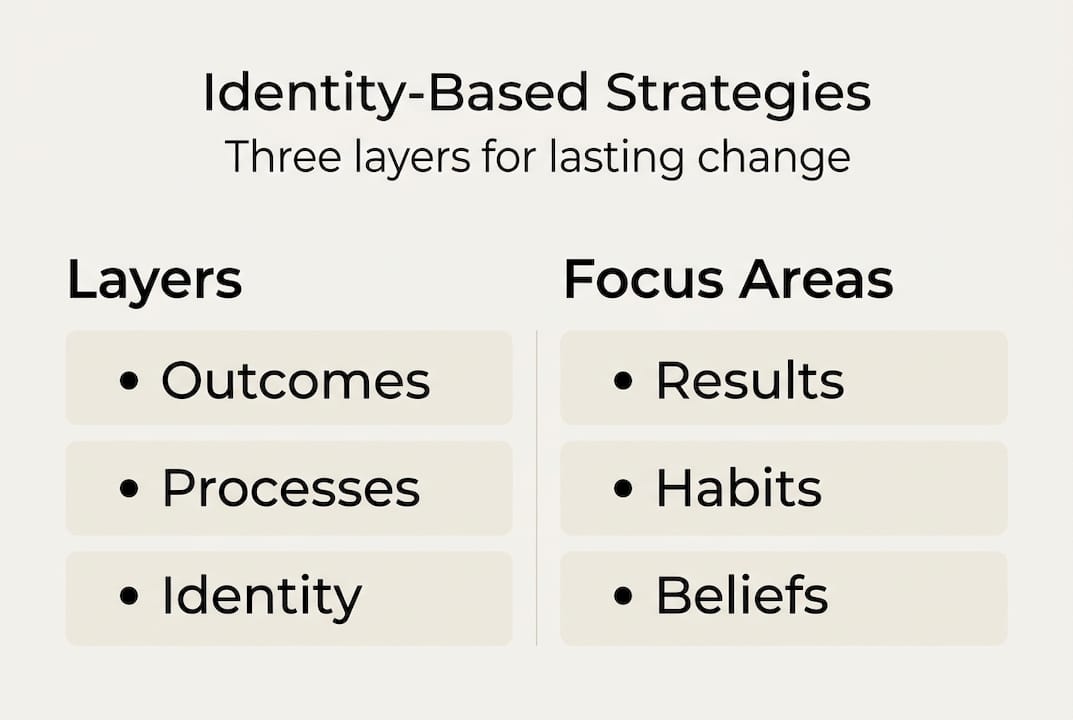
The more effective approach works from the inside out. There are three layers of behavioral change: outcomes (what you get), processes (what you do), and identity (who you are). Most advice targets the first two. But identity-based habits are what actually make change stick, because your behavior naturally aligns with your self-concept over time.
Here is the key insight: every action you take is a vote for the kind of person you are becoming. Skip the gym once and you vote against the identity of someone who trains. Show up when you do not feel like it and you cast a vote for a disciplined man. Over time, those votes accumulate into a new self-image, and that self-image becomes the engine of your behavior.
This also explains why cognitive dissonance is your ally, not your enemy. When your actions contradict your stated identity, your brain creates discomfort. You can use that discomfort as a signal to realign, rather than a reason to quit.
Outcome-based vs. identity-based approaches
| Approach | Focus | What happens after the goal | Durability |
|---|---|---|---|
| Outcome-based | Achieve X | Habits fade | Low |
| Identity-based | Become X | Habits reinforce self-concept | High |
The self-improvement cycles most men get stuck in are outcome-driven. Switching to identity-driven thinking is the first real step toward personal reinvention.
Key shifts to make now:
- Replace "I want to get fit" with "I am someone who trains consistently"
- Replace "I need to stop wasting time" with "I am someone who protects his focus"
- Replace "I should eat better" with "I am someone who fuels his body with intention"
Pro Tip: Start every morning by asking "Who do I want to become?" instead of "What do I want to achieve?" That single reframe rewires how your brain evaluates every decision throughout the day.
Overcoming self-sabotage: Recognize and break hidden patterns
With identity formation in progress, the next step is dealing with self-sabotage, the invisible roadblocks to change. Most men know they are doing it. Few understand why.

The psychology behind self-sabotage runs deeper than laziness or lack of motivation. Common roots include childhood conditioning around worthiness, fear of failure (and sometimes fear of success), and traditional masculinity norms that discourage vulnerability or asking for help. When these roots go unexamined, they operate on autopilot.
Research confirms that patterns rooted in childhood and fear drive self-sabotage in ways most men never consciously register. One critical mechanism is thought suppression, the attempt to push unwanted thoughts out of awareness, which paradoxically keeps those thoughts active and feeds destructive behavior.
"Thought suppression mediates self-sabotage. Addressing what you are trying not to think about is essential to breaking the cycle."
The self-reflection methods that work best are structured, not vague. Journaling with specific prompts cuts through the noise faster than open-ended reflection.
5-step action sequence for breaking sabotage cycles:
- Raise awareness by tracking when you derail, what time, what triggered it, and what you were feeling
- Connect emotionally by asking what fear or belief was driving that behavior
- Reflect without judgment on whether that belief is actually true or just inherited
- Recognize the unconscious play by naming the pattern out loud or in writing
- Take deliberate action that directly contradicts the old pattern, even a small one
Common self-sabotage triggers:
- Overcommitting to avoid confronting real priorities
- Procrastinating on high-stakes tasks to avoid the risk of failure
- Burning out intentionally to justify quitting
- Seeking conflict to derail progress during vulnerable growth periods
Pro Tip: Use structured journaling with a self-control psychology lens. Ask yourself: "What am I avoiding by doing this?" That one question surfaces hidden triggers faster than any other method.
The work of breaking sabotage cycles is not glamorous, but it is the only path to real traction.
Building discipline: Systems, habits, and environmental design
After breaking self-sabotage patterns, it is crucial to lock in discipline. This section shows how. The biggest mistake men make here is treating discipline like a character trait you either have or you do not. Discipline is a design problem.
Lasting discipline is achieved through habits and systems, not willpower alone. Willpower is a depleting resource. Every decision you make draws from the same pool. By the time you hit the evening, that pool is nearly empty, and that is when most men relapse into old patterns.
Environmental design solves this. When your surroundings make the right behavior easier and the wrong behavior harder, you stop needing willpower to choose correctly. Put your training gear by the door. Delete social apps from your phone's home screen. Meal prep on Sunday so there is no decision to make at 7pm.
A UCL study on habit formation found it takes an average of 66 days for a new behavior to become automatic. That is longer than the popular 21-day myth, but it also means that if you survive the first two months, the habit starts carrying itself.
Discipline-building data
| Strategy | Willpower required | Long-term effectiveness |
|---|---|---|
| Willpower alone | Very high | Low |
| Goal reminders | Moderate | Moderate |
| Environmental design | Low | High |
| Identity-based systems | Very low | Very high |
Steps to build a system that holds:
- Choose one routine for discipline to anchor your day, morning or evening
- Attach new habits to existing triggers using the "after I do X, I will do Y" format
- Track your streak visually, because seeing progress builds identity reinforcement
- Use digital discipline tools to reduce friction and automate accountability
- Review weekly and adjust, not to judge yourself, but to optimize the system
Pro Tip: Start with micro-habits so small they feel embarrassing. Two pushups. One page. Five minutes. Consistency over intensity is not a cliche, it is the actual mechanism of self-discipline for lasting success. When you stop making excuses for skipping, the system compounds fast.
Edge cases: Persistent self-control, setbacks, and adapting methods
With systems built, it is time to prepare for inevitable setbacks and edge cases. No system survives contact with real life without adaptation. Knowing this in advance is what separates men who sustain change from men who restart the cycle.
One important distinction is between persistent self-control (maintaining effort over time) and inhibitory self-control (stopping an impulse in the moment). These are different skills. Exercise improves persistent self-control but does not significantly affect inhibitory control. That means training your body helps you stay the course, but stopping a craving in real time requires a different approach, like implementation intentions.
For more detail on the science-backed steps behind breaking these cycles, the research is worth reviewing. It reframes setbacks from failures into data points.
Common setbacks and how to address them:
- Relapse into old habits: Do not restart from zero. Acknowledge the slip, identify the trigger, and resume the system the same day
- Plateau in motivation: This is normal around weeks 3 to 5. Shrink the habit temporarily and focus on showing up, not performing
- Emotional triggers: Stress, rejection, and conflict are the top three relapse drivers. Build a specific response protocol for each
- External pressure: Family skepticism, social environments, and work stress can erode new patterns. Limit exposure where possible and reinforce your identity narrative daily
- Thought suppression backfire: Trying not to think about a craving amplifies it. Redirect attention to a competing behavior instead
Pro Tip: Use "if-then" planning for your highest-risk moments. "If I feel the urge to skip my routine, then I will do just the first two minutes." Research on exercise and self-control confirms that implementation intentions dramatically reduce relapse rates by removing in-the-moment decision-making.
Adapting your methods is not weakness. It is what disciplined men actually do.
Why the willpower myth misses the point: What actually fuels lasting change
Here is the uncomfortable truth most self-improvement content will not say out loud: the entire willpower narrative is a distraction. It keeps men in a cycle of grinding, burning out, and blaming themselves for lacking discipline. The real problem is not effort. It is architecture.
Willpower is finite, and designing your habits preserves it. Men who appear to have iron discipline are not grinding harder. They have built environments and identities that make the right choices automatic. They do not rely on motivation because their systems do not require it.
Outcome-based approaches also fail after the goal is reached. You hit the target weight, finish the course, or land the promotion, and suddenly the habits that got you there have no anchor. Identity-based methods solve this because the goal was never the destination. The goal was to become a certain kind of man, and that does not have a finish line.
The identity-driven improvement cycles that actually hold are built on a simple truth: consistent change is about who you repeatedly are, not what you occasionally do. That shift in framing changes everything.
Ready to transform? Find proven self-improvement support
You now have the framework. Identity first, then systems, then adaptation. But knowing the theory and actually rewiring years of self-sabotage are two different things. Most men need a structured process to make the shift stick.

That is exactly what Your Last Excuse is built for. The Identity Shift System gives you a step-by-step protocol designed specifically for men who are done with the Fluctuation Cycle and ready to build an identity that holds under pressure. It is not motivational content. It is a psychological framework backed by behavioral science, with tools that work when motivation runs out. If you are serious about lasting change, this is where you start.
Frequently asked questions
How long does it take to build a lasting habit?
Research shows new habits take an average of 66 days to become automatic for most people, significantly longer than the popular 21-day claim.
Can self-sabotage be permanently eliminated?
Patterns can be recognized and interrupted through consistent awareness and adaptive strategies, but ongoing awareness remains essential because triggers can resurface under stress.
Is willpower enough for self-discipline?
No. Willpower is finite and depletes throughout the day, making identity-based habits and environmental design the reliable path to lasting discipline.
Does exercise help with self-control in men?
Yes, but specifically for persistence. Exercise improves persistent self-control but does not significantly affect inhibitory control, which requires separate strategies like implementation intentions.