
You've probably started strong before. New routine, real motivation, genuine commitment. Then life hits, you miss a day, and somehow that one miss turns into a full collapse. The frustrating part isn't the failure itself. It's that it keeps happening the same way, every time. The problem isn't your character or your willpower. It's that you're using the wrong engine. Self-improvement cycles are repeating feedback loops of trigger, small action, reward, and feedback that build habits, discipline, and identity over time without relying on motivation. That's the framework this guide breaks down, step by step.
Table of Contents
- What are self-improvement cycles?
- How self-improvement cycles break the self-sabotage trap
- The critical role of growth mindset for lasting transformation
- From cycle to identity: How habits become who you are
- Practical steps to start your own self-improvement cycle
- Start your transformation with evidence-based guidance
- Frequently asked questions
Key Takeaways
| Point | Details |
|---|---|
| Cycle structure matters | Lasting growth comes from creating trigger-action-reward-feedback loops, not just using willpower. |
| Mindset change is essential | Believing you can improve transforms setbacks into opportunities for growth and consistency. |
| Habits shift identity | Small, repeated actions become part of who you are, making discipline feel natural over time. |
| Start small, win big | Focusing on one repeatable behavior and tracking wins builds fast momentum and breaks sabotage cycles. |
What are self-improvement cycles?
Most men approach discipline like a sprint. They go hard, burn out, crash, and then feel ashamed. The cycle repeats. Self-improvement cycles work differently because they're designed to be sustainable, not spectacular.
At their core, self-improvement cycles are repeating feedback loops built on four stages: trigger, action, reward, and feedback. The trigger is a cue that prompts behavior. The action is the small, repeatable behavior itself. The reward reinforces it. The feedback tells you what to adjust. That's it. No heroics required.
Here's how cycles compare to the typical willpower approach:
| Approach | Fuel source | Sustainability | Identity impact |
|---|---|---|---|
| Willpower-based | Motivation and emotion | Low, burns out fast | Fragile, collapses under stress |
| Self-improvement cycles | Triggers and feedback loops | High, self-reinforcing | Strong, builds over time |
| Habit stacking | Existing routines | Medium | Moderate |
Why do cycles work especially well for men who are busy, stressed, and distracted? Because they don't require you to feel ready. They require a cue. That's a critical difference.
Here's what makes cycles psychologically powerful:
- They reduce decision fatigue by automating behavior
- They create neurological grooves through repetition
- They build momentum even on low-energy days
- They separate identity from performance, so one bad day doesn't erase progress
"Discipline isn't about being perfect. It's about having a system that keeps pulling you back in."
If you want to understand how to build self-improvement routines that actually stick, the cycle framework is where it starts.
How self-improvement cycles break the self-sabotage trap
Self-sabotage isn't random. It follows a pattern. You get motivated, you push hard, friction builds, you collapse, and then shame sets in. That shame becomes the trigger for the next collapse. It's a loop, just a destructive one.

Self-improvement cycles interrupt that pattern by replacing the shame trigger with a feedback trigger. Instead of "I failed again," the question becomes "What does this tell me about my system?" That single reframe changes everything.
Here's a practical example. Say you keep missing your morning workouts after late nights at work. The old response is guilt and a vow to do better. The cycle-based response is different:
- Identify the trigger that caused the miss (late night, no prep, alarm ignored)
- Adjust the action to something smaller and more realistic for that context
- Reward the attempt, not just the perfect execution
- Use the feedback to redesign the trigger for next time
This is how ending self-sabotage actually works in practice. Not through more willpower, but through smarter system design.
A growth mindset is essential here. Research shows it turns failure into learning, builds persistence, and improves self-efficacy over time. Without it, every setback feels like proof you're broken. With it, every setback becomes data.
Pro Tip: After any missed day, write one sentence: "What would make this easier tomorrow?" That single habit shifts your brain from shame mode into problem-solving mode instantly.
The right digital self-help tools can also support this process by helping you track patterns and spot where your cycle is breaking down.
The critical role of growth mindset for lasting transformation
Your mindset isn't just a motivational concept. It's the operating system running underneath every habit you try to build.
A fixed mindset says your abilities are set. You're either disciplined or you're not. When you miss a workout or break a streak, a fixed mindset reads that as confirmation of who you are. A growth mindset, backed by Dweck's research, says abilities develop through effort and strategy. Failure is information, not identity.
Here's why this matters for self-improvement cycles specifically. Cycles depend on feedback. If your mindset treats feedback as judgment, you'll avoid it. You'll stop tracking, stop reflecting, and eventually stop trying. But if your mindset treats feedback as a tool, you'll use it to sharpen the cycle.
"Men who see effort as the path to mastery don't just build better habits. They build a better version of themselves with every rep."
Consider a real scenario. You're building a morning routine. Week one goes well. Week two, you travel for work and the whole thing falls apart. A fixed mindset says "I knew I couldn't do this." A growth mindset says "Travel is a variable I haven't accounted for yet. What's the minimum version of this routine I can run anywhere?"
That question is the difference between quitting and adapting. And adapting is what self-discipline research consistently identifies as the core skill of men who achieve lasting transformation.
Pro Tip: Replace "I failed" with "My system failed." It's not just semantics. It shifts accountability from your identity to your process, which is something you can actually fix.
From cycle to identity: How habits become who you are
Here's where things get genuinely powerful. When you repeat a self-improvement cycle consistently, something shifts. The behavior stops feeling like something you do and starts feeling like something you are.
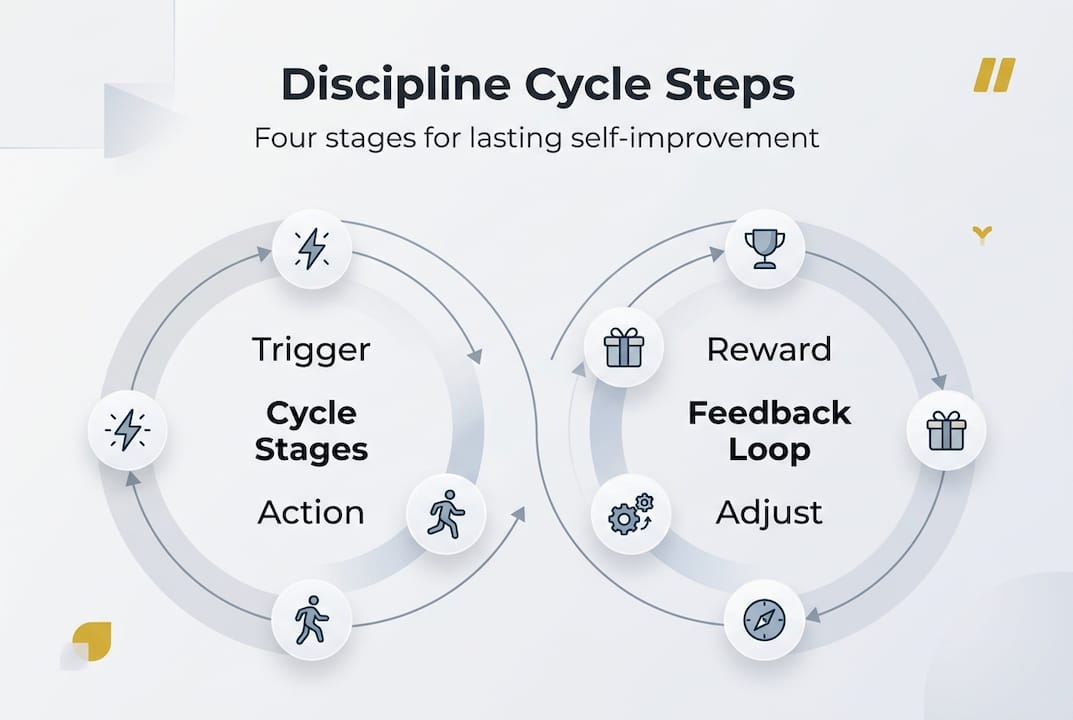
That's identity change. And it's not mystical. It's the natural result of repeated feedback loops that accumulate evidence about who you are. Every time you complete the cycle, you cast a vote for a new identity.
Here's how that progression looks in practice:
| Repeated action | Emerging belief | Identity shift |
|---|---|---|
| Go to the gym 3x per week | "I show up for myself" | "I am someone who trains" |
| Read 10 pages every night | "I invest in my mind" | "I am a learner" |
| Wake up at 6am consistently | "I control my mornings" | "I am disciplined" |
| Eat clean 80% of the time | "I respect my body" | "I am someone who takes care of himself" |
The key insight is that identity doesn't come first. It comes from the accumulation of small, consistent actions. You don't decide to become disciplined and then act accordingly. You act consistently and then realize you've become disciplined.
What happens when you slip up? Here's what actually works:
- Never miss twice. One miss is a blip. Two misses is the start of a new pattern.
- Shrink the action, not the commitment. If you can't do the full version, do 10% of it.
- Reconnect to the feedback loop. Ask what the slip tells you about your trigger setup.
- Protect the identity statement. "I'm someone who trains" survives one missed session. It doesn't survive a story that says you've quit.
Building lasting positive changes requires this identity layer. Without it, habits are fragile. With it, they become self-reinforcing. You can also explore habit building examples to see how other men have made this shift in real life.
Practical steps to start your own self-improvement cycle
Enough theory. Here's exactly how to build your first cycle starting today.
The most common mistake is trying to overhaul everything at once. Don't. Pick one behavior. Just one. The feedback loop framework works best when it's simple enough to repeat without thinking.
Follow these steps:
- Choose one small, repeatable action. Not "get fit." Something like "do 10 pushups after brushing my teeth."
- Identify your trigger. What existing habit or time of day will cue the new action? Attach it to something already automatic.
- Define a micro-reward. It doesn't need to be big. A checkmark, a fist pump, 30 seconds of satisfaction. The brain needs a signal that the loop closed.
- Build in a weekly feedback check. Every Sunday, ask: Did I complete the action? What made it easier or harder? What's one adjustment for next week?
- Stack cycles slowly. Once the first cycle feels automatic (usually 4 to 6 weeks), add a second one.
Tools that support this process:
- A simple habit tracker app (Streaks, Habitica, or even a paper calendar)
- A weekly review journal with just three questions: What worked? What didn't? What changes?
- A body double or accountability partner for high-friction habits
The right tools for discipline don't replace the cycle. They make the feedback loop more visible, which makes it easier to maintain and improve.
Celebrate tiny wins without irony. Seriously. The reward stage of the cycle is not optional. Your brain needs to register that the loop closed successfully. Skip the reward and the cycle weakens. Honor it and the cycle strengthens.
Start your transformation with evidence-based guidance
Everything in this guide points to one truth: lasting discipline isn't built on motivation. It's built on systems, identity, and cycles that keep pulling you back in even when life gets hard.
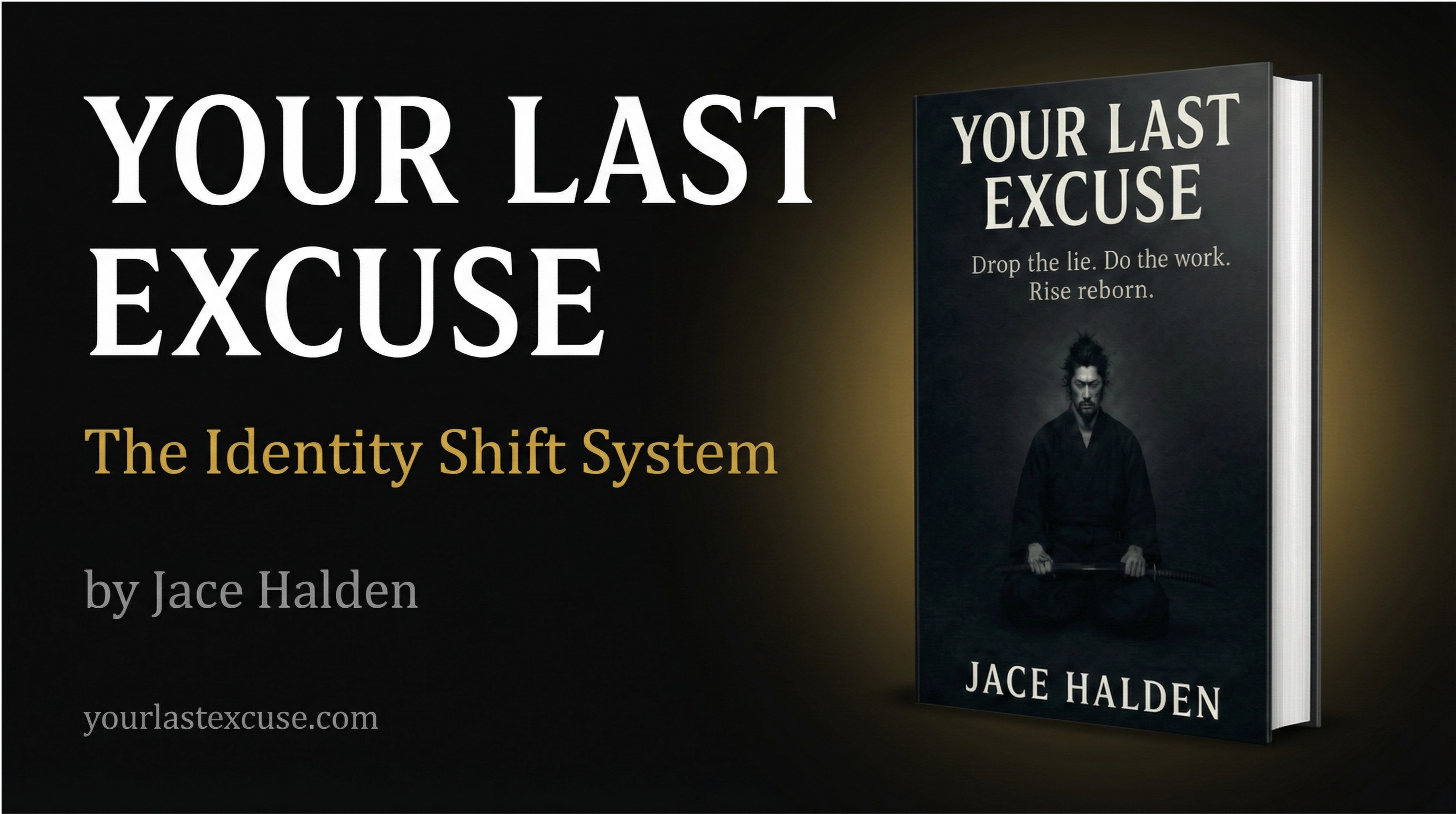
If you're ready to go deeper than habit tips and actually rewire the beliefs driving your self-sabotage, Your Last Excuse offers the Identity Shift System, a structured protocol built specifically for men who are done cycling through the same failures. It combines the psychology of identity change with practical frameworks like The Forge Protocol to help you build the kind of discipline that doesn't collapse under pressure. If this article gave you clarity, share it with a man in your life who's stuck in the same loop. Sometimes the right framework at the right moment changes everything.
Frequently asked questions
Why do most self-improvement efforts fail?
Most fail because they rely on bursts of motivation and willpower instead of structured cycles. Habits and discipline are built through feedback loops, not emotional highs.
How do I start a self-improvement cycle if I keep sabotaging myself?
Begin with one small, consistent action and focus on building the feedback loop rather than chasing perfection. Feedback loops break self-sabotage by replacing shame with data.
Can I change my identity by repeating small habits?
Yes. Repeated small actions within a cycle accumulate evidence that reshapes how you see yourself. Cycles build both habit and identity change over time.
What is the difference between a fixed mindset and a growth mindset?
A fixed mindset treats abilities as permanent; a growth mindset sees failure as learning and believes effort builds skill. Growth mindset supports lasting change while a fixed mindset keeps you stuck.
Recommended
- Self-improvement routines for men: Build discipline fast
- Self-discipline: The real key to lasting success in 2026
- Evidence-based digital self-help for discipline in men
- How to end self-sabotage: science-backed steps for men
- Personal Coaching - Esențial Impact – Bunăstare cu doTERRA
- Basketball Habits Building: Coaching for Lasting Impact – Hoop Mentality