
Most men between 25 and 45 don't lack motivation. They lack a system that survives contact with real life. Research shows that digital self-help interventions achieve response rates up to 65% for conditions tied to self-sabotage, including depression and insomnia. That's not a small number. Yet most men still cycle through the same pattern: fire up, fall off, feel ashamed, repeat. This guide breaks down exactly why that cycle exists, what the evidence says about digital tools that actually interrupt it, and how you can apply these strategies to build discipline that sticks.
Table of Contents
- Why self-sabotage happens and its digital disruption
- Core mechanics of effective digital self-help tools
- CBT principles and gamification: How digital tools break cycles
- Short-term wins vs long-term discipline: What the data reveals
- Overcoming tech overuse and self-sabotage with digital control tools
- Next steps: Building lasting discipline with expert guidance
- Frequently asked questions
Key Takeaways
| Point | Details |
|---|---|
| CBT frameworks drive results | Digital tools using CBT principles are proven to help men break self-sabotage cycles and build lasting discipline. |
| Engagement mechanics matter | Optimized interfaces, reminders, and self-monitoring features are key to maintaining motivation and progress. |
| Long-term discipline needs iteration | Repeated interventions and hybrid strategies are necessary for sustainable change and avoiding relapse. |
| Control tech habits digitally | Digital tools for self-control significantly reduce technology overuse, supporting broader discipline goals. |
Why self-sabotage happens and its digital disruption
Self-sabotage isn't a character flaw. It's a predictable psychological pattern. For men in the 25 to 45 range, it often shows up as shadow rejection, which is the unconscious refusal to acknowledge parts of yourself that conflict with your self-image, combined with poor inhibitory control. You know what you should do. You just can't make yourself do it consistently.
Shadow rejection and poor routines are among the most common drivers of self-sabotage in men aged 25 to 45. The pattern looks like this:
- A trigger hits (stress, failure, rejection)
- Motivation spikes briefly
- Friction builds as the novelty fades
- Collapse follows, usually quietly
- Shame locks in the cycle
Traditional self-help books give you static advice. They can't adapt to your specific triggers or catch you mid-spiral. That's where digital self-help changes the game. CBT digital interventions are built to respond dynamically, delivering the right nudge at the right moment instead of waiting for you to remember chapter seven.
"The shift from passive reading to active, personalized digital engagement is what separates men who break the cycle from men who just understand it."
If you want a deeper look at the psychological mechanics behind this, the research on ending self-sabotage lays out the science clearly.
Core mechanics of effective digital self-help tools
Not all apps are created equal. The ones that actually move the needle share specific design features backed by behavioral science. Understanding these mechanics helps you choose tools that work instead of ones that just feel productive.
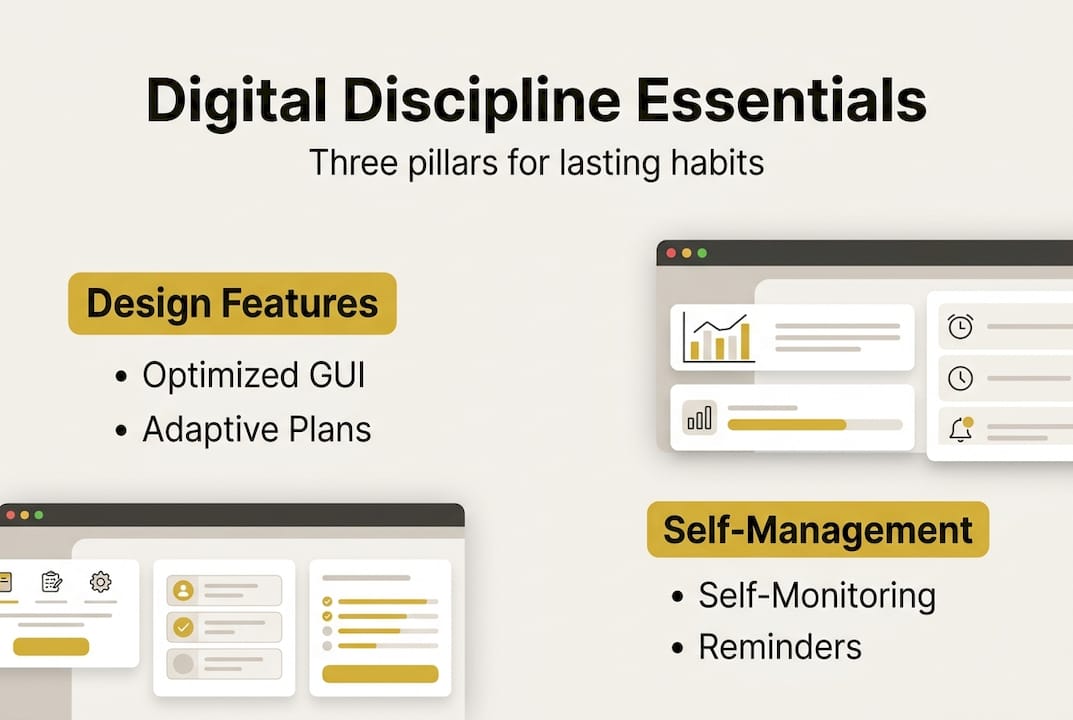
Optimized GUI, adaptive strategies, and self-monitoring are the three pillars that consistently boost engagement in digital self-help platforms. Here's how they stack up:
| Mechanic | What it does | Evidence strength |
|---|---|---|
| Optimized GUI | Reduces friction to take action | High |
| Adaptive reminders | Delivers prompts based on behavior patterns | High |
| Self-monitoring | Tracks progress and surfaces patterns | Moderate to high |
| Just-in-time interventions | Triggers support at peak vulnerability | Emerging |
| Automated goal-setting | Breaks large goals into daily actions | Moderate |
The most effective platforms layer these mechanics together. A clean interface gets you in the door. Adaptive reminders keep you showing up. Self-monitoring makes your progress visible, which is a powerful motivator on its own.
Here's the order in which these mechanics tend to build on each other:
- Start with a low-friction interface that removes barriers to daily use
- Add self-monitoring to create awareness of your patterns
- Introduce adaptive reminders tied to your actual behavior data
- Layer in just-in-time interventions for high-risk moments
- Use automated goal-setting to maintain forward momentum
Research on self-regulated learning confirms that men who actively monitor their own behavior and adjust their strategies outperform those who rely on willpower alone.
Pro Tip: Don't try to use every feature at once. Pick one mechanic, build the habit around it for two weeks, then stack the next one. Discipline compounds the same way interest does.
For a broader framework on what lasting self-discipline actually requires, the evidence points to systems over motivation every time.
CBT principles and gamification: How digital tools break cycles
Cognitive behavioral therapy (CBT) is the gold standard for changing thought patterns that drive destructive behavior. When you put CBT inside a digital platform, you get something that scales without needing a therapist in the room.
CBT-based digital interventions show high response rates and measurable reductions in binge eating, depression, and insomnia, all of which are behaviors closely linked to self-sabotage cycles in men. The core CBT tools that translate best to digital formats include:
- Behavioral activation: Scheduling small, achievable actions to break avoidance patterns
- Cognitive restructuring: Identifying and replacing self-defeating thoughts in real time
- Problem-solving protocols: Structured approaches to obstacles instead of emotional reactions
- Self-monitoring logs: Daily check-ins that surface patterns you'd otherwise miss
Gameification adds another layer. Neurotraining apps use points, streaks, and feedback loops to trigger dopamine responses that reinforce positive behavior. This isn't manipulation. It's using your brain's reward system intentionally.
65% response rate. That's what CBT-based digital tools achieve for conditions directly tied to self-sabotage. That number rivals many in-person interventions.
The binge eating outcomes data is particularly striking because binge eating is a classic self-sabotage behavior. Men who used digital CBT tools showed significant symptom reduction without weekly therapy sessions. The same principles apply to procrastination, avoidance, and emotional shutdown.

For a step-by-step breakdown of how to apply these science-backed steps to your own patterns, the research is clear on where to start.
Short-term wins vs long-term discipline: What the data reveals
Here's the uncomfortable truth most self-help content skips: digital tools produce strong short-term results, but long-term discipline is a different challenge entirely.
12-month digital interventions are effective for weight loss and behavior change, but weight regain is common by the five-year mark, and engagement decays significantly over time. That's not a reason to avoid digital tools. It's a reason to use them strategically.
"Short-term wins are real. The mistake is treating them as the finish line instead of the foundation."
Here's what the data actually recommends for sustaining discipline beyond the initial momentum:
- Treat the first 90 days as a proof-of-concept phase, not a permanent solution
- Schedule deliberate re-engagement points every three to four months
- Use just-in-time affirmations during high-stress periods to prevent collapse
- Combine digital tools with minimal human coaching for significantly better long-term outcomes
- Build identity-level change, not just habit-level change, so the behavior becomes who you are
Hybrid self-help approaches that combine digital platforms with occasional coaching sessions consistently outperform purely self-directed digital programs. The coaching doesn't need to be intensive. Even monthly check-ins dramatically improve retention.
Pro Tip: Set a calendar reminder every 90 days to audit your digital tools. Ask yourself: is this still challenging me, or have I plateaued? Swap out or upgrade your approach before engagement drops.
Building lasting self-discipline means treating your system like a living thing that needs periodic updates, not a one-time setup.
Overcoming tech overuse and self-sabotage with digital control tools
There's an irony in using technology to fix problems that technology often creates. Excessive app use, doomscrolling, and notification addiction are modern self-sabotage behaviors that drain the mental bandwidth you need for discipline.
The good news is that digital self-control tools are specifically designed to address this. TypeOut reduced app usage by over 50% and cut session frequency and duration by more than 25%. That's a significant behavioral shift achieved through the phone itself.
The strategies these tools use include:
- Habit suspension: Introducing a brief pause before opening a target app, breaking the automatic loop
- Self-affirmation prompts: Reminding you of your values before you engage with distracting content
- Usage dashboards: Making your screen time visible so avoidance becomes harder to rationalize
- Friction by design: Adding small barriers that interrupt mindless behavior without blocking access entirely
Just-in-time affirmations are particularly effective because they catch you at the moment of temptation, not after the fact. A two-second prompt that reconnects you to your goals is often enough to redirect behavior.
Pro Tip: Use a digital self-control app for your top two time-wasting apps for 30 days. Track the hours you reclaim. Then redirect that time into one of the CBT-based discipline tools covered earlier in this guide.
The connection between tech overuse and self-sabotage is direct. Every hour lost to mindless scrolling is an hour not spent building the identity you're trying to create. The research on ending self-sabotage consistently points to attention management as a foundational skill.
Next steps: Building lasting discipline with expert guidance
The evidence is clear. Digital self-help tools work, especially when they're built on CBT principles, adaptive mechanics, and identity-level frameworks. But tools alone don't close the gap between knowing and doing. That's where structured guidance makes the difference.

If you're ready to move beyond generic apps and into a system designed specifically for men who are serious about breaking self-sabotage cycles, expert digital self-help is where that work happens. The Identity Shift System combines the evidence-based mechanics covered in this guide with a step-by-step protocol built for men who've already tried the motivation-only approach and know it doesn't last. This is the structured, psychologically grounded next step that turns short-term wins into permanent identity change.
Frequently asked questions
How effective are digital self-help tools for breaking self-sabotage habits in men?
CBT-based apps show strong short-term efficacy, with response rates up to 65% for conditions like OCD, binge eating, and depression, all of which are closely tied to self-sabotage patterns in men.
What digital features help sustain discipline over time?
Optimized GUI and automated reminders are proven to boost engagement metrics, and combining them with self-monitoring creates a feedback loop that supports sustained behavior change.
Are digital self-help strategies as effective as traditional coaching?
Hybrid self-help that pairs digital tools with minimal coaching consistently yields better outcomes than either approach alone, without requiring significant clinician time.
How can men overcome technology overuse with digital tools?
Apps like TypeOut use habit suspension and self-affirmation to interrupt automatic tech use, with usage reductions over 50% documented in controlled studies.