
You set the goal, you start strong, and then somewhere between week one and week three, you blow it. Procrastination creeps in, distractions multiply, and suddenly you're back at square one wondering what's wrong with you. Nothing is wrong with you. Self-sabotage isn't a character flaw. It's a survival pattern your brain learned, and science has mapped exactly how to break it. This guide walks you through four concrete steps, grounded in behavioral psychology, to stop the cycle and build the discipline that actually sticks.
Table of Contents
- Understanding self-sabotage: The hidden loop
- Step 1: Identify your self-sabotage patterns
- Step 2: Uncover your underlying fears and beliefs
- Step 3: Break the loop and practice new habits with repetition
- Step 4: Audit your track record and course correct
- What to expect: Edge cases, relapses, and realistic results
- Science versus willpower: Rethinking discipline
- Transform your discipline: Next steps for men who want real change
- Frequently asked questions
Key Takeaways
| Point | Details |
|---|---|
| Spot patterns | Recognize and track your sabotage triggers and behaviors to break the cycle. |
| Challenge core beliefs | Identify and address underlying fears that drive destructive habits. |
| Change habits with science | Use evidence-based strategies like CBT, DBT, and ACT practiced over time. |
| Audit and adapt | Regularly review progress, celebrate wins, and update your approach. |
| Focus beyond willpower | Combine values, environment, and science-backed tactics for real change. |
Understanding self-sabotage: The hidden loop
To truly stop sabotaging yourself, you need to see the hidden pattern behind your own roadblocks.
Self-sabotage runs on a predictable loop. Habit loops work like this: a trigger fires, anxiety spikes, you avoid the discomfort, you feel temporary relief, and that relief reinforces the avoidance. Repeat that cycle enough times and your brain treats it as the default response. It's not laziness. It's your nervous system doing exactly what it was trained to do.
Men face a specific version of this problem. Men show higher rates of behavioral self-handicapping and lower self-control compared to women, according to multiple studies. Ego protection, status anxiety, and the pressure to appear competent all push men toward avoidance rather than honest engagement with failure. The reasons people self-sabotage are more layered than most men realize.
Common patterns include chronic procrastination, blame-shifting, picking fights before a big opportunity, and deliberately underperforming to lower expectations. These aren't random. They're predictable responses to perceived threat.
| Scenario | Male pattern | Female pattern |
|---|---|---|
| Job interview coming up | Stops preparing, claims he "doesn't care" | Overprepares, then freezes |
| Relationship conflict | Withdraws or deflects blame | Ruminates or seeks reassurance |
| Fitness goal set | Starts hard, burns out, quits | Starts cautiously, loses momentum |
| Creative project | Delays until deadline kills it | Seeks approval before starting |
Key finding: Men who chronically self-handicap report lower psychological adjustment and are rated more negatively by peers than those who engage honestly with challenges.
Step 1: Identify your self-sabotage patterns
Now that you know the cycle, it's time to shine a spotlight on your specific patterns and catch yourself in the act.
Naming and labeling self-sabotage as it happens is the essential first step, backed by neuroscience. When you put a label on a feeling or behavior, you activate the prefrontal cortex and reduce the emotional charge driving the avoidance. You're not just journaling for therapy. You're literally rewiring your brain's response.
Here's how to watch your own patterns in real time:
- Notice the moment discomfort hits. That restless, "I'll do it later" feeling is your trigger signal.
- Name the behavior out loud or in writing. "I just avoided opening my email because I'm scared of rejection."
- Trace it back to the trigger. Was it a deadline, a comparison to someone else, or a memory of past failure?
- Log the time and context. Patterns become visible when you track them across days and weeks.
- Look for repetition. If the same trigger fires three times in a week, that's your primary loop to target.
Common male triggers include fear of failure, fear of success (which feels counterintuitive but is real), social comparison, and situations that threaten status or competence. Most men don't recognize fear of success as a trigger, but it shows up as self-destruction right before a breakthrough.
Pro Tip: Use your phone's notes app to log sabotage moments the second they happen. A one-line entry is enough. "Avoided gym, felt overwhelmed at work." Over two weeks, the pattern will be impossible to ignore.
Step 2: Uncover your underlying fears and beliefs
When you spot your patterns, the next step is to ask why. What fear or belief is really running the show?

Low self-esteem, fear of failure or success, and past trauma are the most frequent drivers of self-sabotage in men. These aren't abstract concepts. They show up as specific thoughts: "I don't deserve this," "If I succeed, people will expect more and I'll disappoint them," or "I've failed before, so why try."
Use these questions to surface what's underneath your patterns:
- What does failure mean about me as a man?
- What would change in my life if I actually succeeded?
- What am I protecting myself from by staying stuck?
- Whose voice do I hear when I tell myself I can't do this?
- What's the worst realistic outcome, and could I handle it?
The goal here is not to shame yourself into change. Self-compassion, not self-criticism, is what the research supports. Shame activates the same avoidance loop you're trying to break. Curiosity and honest reflection are the tools that actually work.
Pro Tip: Share what you find with a trusted friend or therapist. Saying it out loud to another person breaks the secrecy that keeps these beliefs powerful. You don't need a full therapy program to get value from one honest conversation.
Step 3: Break the loop and practice new habits with repetition
Identifying fears makes them less powerful. Now you'll build brain muscle for better responses, day by day.
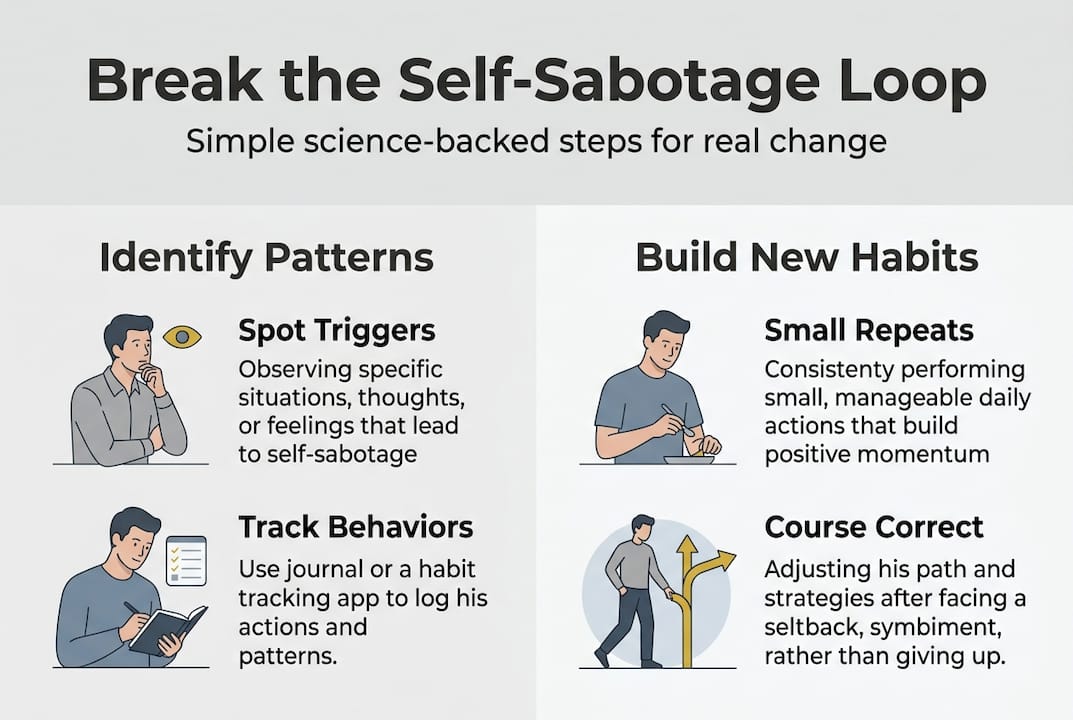
CBT, ACT, and DBT are all effective at breaking negative habit loops, and habit change requires weeks to months of consistent repetition. These aren't just therapy tools. They're frameworks you can apply yourself, right now.
| Approach | What it does | Best for |
|---|---|---|
| CBT (Cognitive Behavioral Therapy) | Challenges distorted thoughts and replaces them | Overthinking, perfectionism, cognitive distortions |
| ACT (Acceptance and Commitment Therapy) | Builds psychological flexibility around discomfort | Avoidance, fear of failure, values misalignment |
| DBT (Dialectical Behavior Therapy) | Regulates emotional responses and impulses | Emotional reactivity, self-harm patterns, therapy-based approaches |
Here's a practical sequence to start breaking your loop:
- Pick one trigger from your pattern log. Start small.
- Expose yourself to it deliberately in a low-stakes setting. If you avoid emails, open one today.
- Sit with the discomfort for 60 seconds without acting on the avoidance urge.
- Replace the old response with a pre-decided action. "When I feel the urge to procrastinate, I will write one sentence."
- Repeat daily for at least six weeks. Neuroplasticity requires repetition, not intensity.
The science of neuroplasticity confirms that small, repeated actions physically reshape neural pathways. You're not fighting your brain. You're retraining it.
Pro Tip: Set a phone alarm labeled with your new habit cue. "11am: open the thing you've been avoiding." Environmental cues are more reliable than motivation.
Step 4: Audit your track record and course correct
Breaking old habits isn't an overnight win. Tracking progress and correcting course keeps you on target.
Men are prone to blame avoidance and rigging circumstances to excuse failure. Self-handicapping, setting yourself up to fail so you have a ready excuse, backfires badly. It damages your reputation and your own self-concept over time.
A pattern audit is a simple, honest review of the last 30 days. Ask yourself: Where did I follow through? Where did I manufacture an excuse? Where did I blame someone else for an outcome I controlled?
Signs you're still self-sabotaging through blame or rigged failure:
- You consistently start strong and fade without external cause
- You pick fights or create drama right before important events
- You tell yourself you "would have" succeeded if circumstances were different
- You feel relieved when something cancels a goal you set
- You attribute setbacks entirely to other people or bad luck
The shift you're building is called an internal locus of control. It means you see your outcomes as primarily driven by your own choices, not by fate or other people. This isn't toxic positivity. It's the mindset that research consistently links to better outcomes, higher resilience, and lower rates of self-sabotage.
Research finding: Chronic self-handicappers show poorer psychological adjustment and are rated more negatively by peers, making the short-term ego protection a long-term liability.
What to expect: Edge cases, relapses, and realistic results
Persistent change means being ready for tough moments, setbacks, and messy middles along the way.
Self-sabotage spikes during high-stakes periods and overlaps significantly with ADHD and depression. If you notice that your self-sabotage is constant rather than situational, or that it's accompanied by persistent low mood or inability to focus, that's a signal to get professional support, not a reason to push harder alone.
Common setbacks and what to do:
- Plateau: Progress stalls after early wins. Revisit your trigger log and look for a new pattern that emerged.
- Relapse: You fall back into the old loop. Treat it as data, not failure. What triggered it this time?
- Doubt spiral: You start questioning whether change is possible. This is normal at weeks 3 to 5. It means the old identity is resisting.
- Shame flood: You feel disgusted with yourself after a setback. Shame accelerates the loop. Self-compassion interrupts it.
Understanding self-sabotage basics makes it clear that improvement, not perfection, is the realistic target. Small wins compounded over months beat dramatic overhauls that collapse under pressure.
Science versus willpower: Rethinking discipline
Finally, here's why brute force alone isn't the answer, and what works better for lasting self-mastery.
Willpower is a finite resource. Willpower depletes under stress, and science recommends values focus and implementation intentions over raw discipline. DBT also outperforms CBT for certain self-sabotaging behaviors, particularly those tied to emotional dysregulation. Telling yourself to "just try harder" is like telling a car with no fuel to drive faster.
What actually works instead:
- Clarify your values. Discipline built on identity ("I'm the kind of man who follows through") outlasts discipline built on motivation.
- Shape your environment. Remove friction from good behaviors and add friction to bad ones. Your environment is more powerful than your willpower.
- Use implementation intentions. "When X happens, I will do Y." This pre-decides your response before the trigger fires.
- Track streaks, not perfection. A visible record of consistency builds identity faster than any motivational speech.
Expert consensus: The most effective approach to breaking self-sabotage combines environmental design, values-based identity work, and evidence-based therapeutic frameworks. Willpower alone is not a strategy.
Discipline isn't something you have or don't have. It's something you build, systematically, using the right tools.
Transform your discipline: Next steps for men who want real change
If you're committed to ending self-sabotage for good, you don't have to go it alone.
Knowing the science is a strong start. But knowledge without a structured system tends to fade when life gets hard and the old loops pull you back. The gap between understanding self-sabotage and actually breaking it is where most men get stuck.

The Your Last Excuse program was built specifically for men who are done cycling through motivation and collapse. It combines identity-based change, cognitive restructuring, and a step-by-step protocol designed to make discipline automatic rather than effortful. If you're ready to stop reading about change and start living it, this is the structured next step that makes the difference.
Frequently asked questions
What is the first step to stop self-sabotage?
The first step is to label and track your sabotage patterns as they happen. Awareness is foundational because naming the behavior activates the prefrontal cortex and reduces the emotional charge driving avoidance.
Why do men struggle more with self-sabotage?
Men face higher social pressure around competence and status, which drives ego-protective avoidance. Men show higher rates of behavioral self-handicapping and lower self-control, making the cycle harder to break without deliberate strategy.
How long does it take to break a self-sabotage habit?
With daily practice, most men see real change in six weeks to several months. Habit change requires consistent repetition over time, not intensity in short bursts.
What if my self-sabotage is linked to depression or ADHD?
Seek support from a therapist, as these overlapping conditions need specialized strategies. Self-sabotage overlaps with ADHD and depression and is significantly harder to break without professional guidance in those cases.
Is it better to use willpower or scientific strategies?
Scientific strategies consistently outperform willpower alone. Willpower is finite, and approaches like CBT, DBT, and ACT produce more durable results, especially when combined with environmental design and identity work.