
Over 70% of men report daily negative self-talk, yet most chalk it up to a bad mood or a rough week. Self-sabotage is one of the most common and least understood forces working against men today. It shows up in missed deadlines, blown relationships, abandoned goals, and the quiet shame that follows. The problem isn't willpower or laziness. It's a set of deeply wired psychological patterns that most men never learn to recognize, let alone disrupt. This article breaks down the real drivers behind self-sabotage in men, explains how gender-specific pressures make it worse, and gives you a clear, actionable path forward.
Table of Contents
- Defining self-sabotage: What it looks like for men
- Deep roots: The psychological drivers of self-sabotage
- The masculine factor: How gender traits and social pressures fuel sabotage
- Self-sabotage in competitive settings: The role of uncertainty
- From challenge to change: Lasting strategies for breaking self-sabotage cycles
- Explore professional tools and support
- Frequently asked questions
Key Takeaways
| Point | Details |
|---|---|
| Self-sabotage is common | Many men experience daily self-sabotage that is often unrecognized or misunderstood. |
| Root causes are deep | Unresolved emotions, perfectionism, and masculine social pressures drive cycles of self-sabotage. |
| Well-being improves self-control | Building psychological well-being is proven to strengthen self-control and reduce self-sabotage. |
| Change requires action | Practical strategies and support can help break self-sabotage patterns for lasting personal growth. |
Defining self-sabotage: What it looks like for men
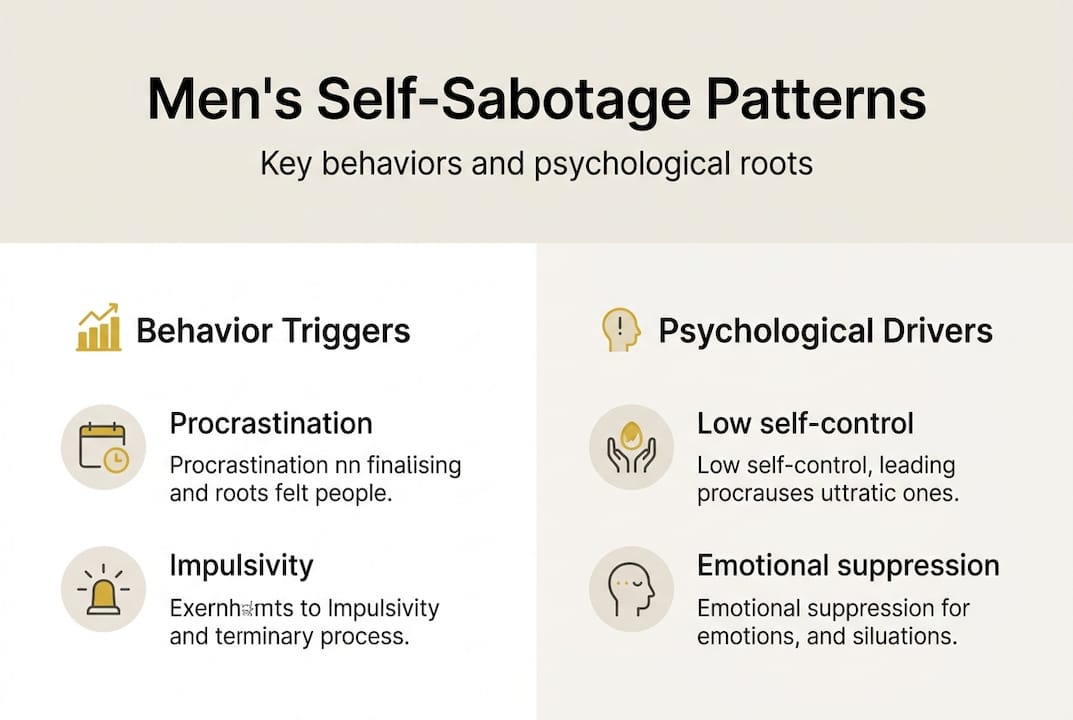
Self-sabotage isn't just procrastinating on a project or skipping the gym. It's any pattern of thought or behavior that consistently undermines your own goals and well-being. For men, it often hides behind socially acceptable masks: overworking, emotional shutdown, risk-taking, or perfectionism that never lets anything be good enough.
The science-backed steps for men to break these patterns start with honest recognition. Research on self-sabotage psychology identifies the core drivers as unresolved trauma, low self-esteem, perfectionism, fear of failure, fear of success, and a deep comfort in familiar pain. That last one is critical. Many men stay stuck not because they don't know better, but because the familiar feels safer than the unknown.
Here are the most common behavioral signs of self-sabotage in men:
- Chronic procrastination affecting roughly 20% of men on a persistent basis
- Daily negative self-talk, reported by over 70% of men
- High perfectionism that blocks action, affecting around 30% of men
- Avoidance of accountability or feedback
- Impulsive decisions that undo recent progress
- Emotional withdrawal from relationships and support systems
"Self-sabotage is not a character flaw. It's a learned survival strategy that once served a purpose and now holds you back."
Understanding this reframes the entire problem. You're not broken. You're running outdated programming.
Deep roots: The psychological drivers of self-sabotage
Once we know what self-sabotage looks like, it's crucial to examine the deep psychological causes. Most men focus on symptoms, fixing the behavior without touching the root. That's why the cycle keeps repeating.
The five most significant psychological drivers are:
- Unresolved trauma: Past experiences of failure, rejection, or abuse create subconscious rules about what you deserve or what's safe to pursue.
- Low self-esteem: When your internal narrative says you're not enough, your behavior will find ways to confirm that belief.
- Perfectionism: Setting impossible standards guarantees failure, which then justifies not trying at all.
- Fear of failure: The pain of trying and losing feels worse than never trying, so avoidance becomes the default.
- Fear of success: This one surprises most men. Success brings new expectations, new scrutiny, and a new identity. That's genuinely threatening to the subconscious.
One of the most overlooked levers for change is psychological well-being. Research shows that well-being and self-control are directly linked, with higher well-being predicting stronger self-control over time. Most men treat well-being as a reward for success, not a tool to get there. That's backwards.
"You can't out-discipline a broken internal state. Build the foundation first."
Pro Tip: Start tracking your emotional state each morning on a simple 1 to 10 scale. After two weeks, you'll see clear patterns between your mood baseline and the days you self-sabotage most. That data is more useful than any motivational quote.
Building self-improvement routines that prioritize sleep, movement, and social connection isn't soft. It's the upstream work that makes every other strategy actually stick.
The masculine factor: How gender traits and social pressures fuel sabotage
Beyond personal psychology, social and gender factors give men distinct sabotage patterns. This isn't about blaming masculinity. It's about understanding the specific pressures that make self-sabotage more likely for men and using that knowledge strategically.
Research confirms that masculine gender role traits directly account for lower self-control and higher impulsivity in men compared to women. These aren't fixed traits. They're conditioned responses to social expectations around toughness, self-reliance, and emotional suppression.

| Factor | Impact on men | Result |
|---|---|---|
| Emotional suppression | Blocks self-awareness | Sabotage goes unrecognized |
| Self-reliance pressure | Avoids help-seeking | Problems compound |
| Toughness norms | Dismisses vulnerability | Trauma stays unprocessed |
| Impulsivity | Undermines long-term plans | Short-term relief, long-term cost |
| Status competition | Triggers reactive decisions | Sabotage in relationships and work |
Key stat: Men score measurably lower on self-control and higher on impulsivity than women, and masculine gender role attitudes explain a significant portion of that gap. This isn't destiny. It's a pattern you can interrupt once you see it clearly.
For men looking to understand this more deeply, digital self-help for men offers evidence-based frameworks that account for these gender-specific dynamics rather than applying generic advice that ignores them.
Self-sabotage in competitive settings: The role of uncertainty
Impulsive sabotage reaches peak levels in competitive settings, and the data here is striking. Men don't just self-sabotage in isolation. They also sabotage others, and the trigger is often uncertainty about what the other person will do.
A study on competitive sabotage and uncertainty found that men engage in significantly more sabotage behavior when they expect their opponent might sabotage them first. When beliefs about the opponent's intentions were aligned and fair play was expected, the gender gap in sabotage nearly disappeared.
| Condition | Male sabotage rate | Female sabotage rate |
|---|---|---|
| High uncertainty about opponent | Significantly elevated | Moderate |
| Aligned beliefs, fair play expected | Near equal | Near equal |
| Competitive with clear rules | Reduced | Reduced |
This has real-world implications. Here's how this plays out in everyday life for men:
- Workplace competition: Uncertainty about a colleague's motives triggers preemptive undermining, gossip, or withdrawal.
- Romantic relationships: Fear that a partner might leave first leads to emotional distancing or picking fights.
- Personal goals: Believing others will judge or dismiss your efforts leads to quitting before you can be rejected.
- Financial decisions: Anxiety about market uncertainty drives impulsive moves that destroy long-term plans.
- Social environments: Perceived status threats trigger overcompensation or self-destructive risk-taking.
The pattern is consistent. Uncertainty plus competition equals elevated sabotage. Building lasting success for men requires learning to act from your own values rather than reacting to what you fear others might do.
From challenge to change: Lasting strategies for breaking self-sabotage cycles
Understanding the pattern is critical, but true transformation relies on specific, actionable strategies. Here's a step-by-step framework built on the psychological evidence covered in this article.
- Name the pattern: Write down the last three times you self-sabotaged. Identify the trigger, the behavior, and the short-term payoff. Patterns become visible fast.
- Build your well-being baseline: Since psychological well-being directly predicts self-control, prioritize sleep, exercise, and one genuine social connection per week before anything else.
- Interrupt the impulsive response: When you feel the urge to avoid, quit, or react, insert a 10-minute delay. Most impulsive sabotage decisions lose their power in that window.
- Rewrite the internal narrative: Identify the core belief driving the sabotage. "I don't deserve this" or "It won't work anyway." Then write a specific counter-statement grounded in past evidence.
- Use identity anchoring: Instead of setting goals, define who you are. "I'm someone who follows through" is more durable than "I want to finish the project."
- Track and review weekly: Spend 10 minutes every Sunday reviewing where you held the line and where you didn't. No judgment. Just data.
Pro Tip: Pair each high-risk sabotage moment with a pre-committed response. If you know you always quit when things get hard at week three of a new habit, plan exactly what you'll do at week three before you start. Remove the decision from the moment.
| Strategy | What it targets | Time to see results |
|---|---|---|
| Pattern naming | Awareness | 1 to 2 weeks |
| Well-being baseline | Self-control capacity | 3 to 4 weeks |
| Impulse delay | Reactive behavior | Immediate |
| Narrative rewriting | Core beliefs | 4 to 8 weeks |
| Identity anchoring | Long-term consistency | 6 to 12 weeks |
For a deeper breakdown of these methods, the guide on ending self-sabotage and the resource on build discipline routines are worth your time.
Explore professional tools and support
Knowing the psychology is a strong start. But most men hit a wall when trying to apply it alone, because the same patterns that cause self-sabotage also make it hard to stay consistent with the fix.

That's exactly what Your Last Excuse is built for. The Identity Shift System goes beyond surface-level motivation and works directly on the subconscious beliefs and identity patterns that keep men stuck in the Fluctuation Cycle. If you've tried discipline tactics before and they didn't hold, the issue isn't effort. It's the foundation. Pair that with the practical frameworks in the science-backed steps for men guide and the structured build discipline routines resource, and you have a complete system, not just another motivational push.
Frequently asked questions
What are the main psychological causes of self-sabotage in men?
The core causes include unresolved trauma, low self-esteem, perfectionism, and fear of both failure and success, as identified in self-sabotage research. These drivers operate largely below conscious awareness, which is why willpower alone rarely fixes them.
How do masculine traits affect self-sabotaging behaviors?
Masculine gender role traits lower self-control and raise impulsivity in men, creating a direct pathway to self-sabotage cycles. These are conditioned patterns, not fixed personality traits, which means they can be changed.
Why do men self-sabotage more in competitive settings?
Men increase sabotage behavior when uncertain about an opponent's intentions, but the competitive sabotage gap nearly disappears when both parties expect fair play. The trigger is perceived threat, not competition itself.
Can improving psychological well-being help stop self-sabotage?
Yes. Higher well-being predicts stronger self-control and greater resistance to sabotage behaviors over time. It's one of the highest-leverage changes a man can make.
Recommended
- How to end self-sabotage: science-backed steps for men
- Evidence-based digital self-help for discipline in men
- Self-improvement routines for men: Build discipline fast
- Self-discipline: The real key to lasting success in 2026
- Character craft, examined: denial (and how self-deception shapes behavior) | Stonington Media LLC
- How to recognize narcissistic patterns in relationships