
TL;DR:
- Men commonly make excuses due to emotional fears rather than laziness or willpower failure.
- Effective strategies include environment design, clear routines, accountability, and self-forgiveness to build discipline.
- Tracking progress and understanding emotional triggers are essential for breaking the cycle of self-sabotage.
You know the moment. The alarm goes off, the plan is set, and then some quiet voice inside you starts negotiating. "I'll start Monday." "I'm just not feeling it today." "What's the point?" If that loop sounds familiar, you're not broken and you're not lazy. You're caught in a psychological pattern that millions of men repeat without ever understanding why. This guide cuts through the noise and gives you evidence-based, practical strategies to stop making excuses, build real self-discipline, and create consistency that doesn't collapse the moment life gets hard. No motivational fluff. Just what actually works.
Table of Contents
- Understanding excuses: Why men self-sabotage
- Preparing for success: Tools and environments that beat excuses
- Execution: Step-by-step tactics to end the excuse cycle
- Verification: Tracking progress and troubleshooting common setbacks
- Our take: Why most advice fails and what actually sticks
- Ready for your last excuse?
- Frequently asked questions
Key Takeaways
| Point | Details |
|---|---|
| Excuses are emotional | Most excuses come from avoiding difficult emotions, not laziness or low willpower. |
| Preparation beats willpower | Setting up the right tools and environment prevents excuses before they start. |
| Small wins compound | Celebrating minor successes builds real discipline over time. |
| Track and adapt | Monitoring progress and adjusting tactics keeps you moving forward after setbacks. |
Understanding excuses: Why men self-sabotage
Most men assume that making excuses is a character flaw. A sign of weakness. Something to be ashamed of. That framing is not just wrong, it actively makes the problem worse. Excuses are not a failure of willpower. They are a failure of self-regulation, and that's a very different thing.
Procrastination is a self-regulatory failure that consistently undermines personal success. What this means is that when you bail on a workout or delay a hard conversation, your brain isn't being lazy. It's protecting you from something uncomfortable. Anxiety, fear of failure, perfectionism, uncertainty. These are the real drivers behind most excuses.
"Excuses are often about regulating uncomfortable emotions, not just laziness." The emotional component is what most discipline advice completely ignores.
Understanding the psychology of self-sabotage helps you stop blaming yourself and start diagnosing the actual problem. Once you know what type of excuse you're dealing with, you can pick the right tool to disrupt it.
Here's a breakdown of the three main excuse categories:
| Excuse type | Root cause | Example trigger | What it feels like |
|---|---|---|---|
| Emotional | Anxiety, shame, fear | High-stakes task | "I'm just not ready yet" |
| Cognitive | Perfectionism, overthinking | Complex project | "I need more information first" |
| Context-driven | Poor environment, ADHD, fatigue | Cluttered workspace | "I can't focus right now" |
Each type requires a different response. Emotional excuses need regulation tools. Cognitive excuses need reframing. Context-driven excuses need environmental design. Treating all three the same way is why generic discipline advice fails most men.
Research into team motivation techniques also confirms that external accountability structures reduce excuse-making significantly, because they introduce social consequences that override internal avoidance instincts. You're wired to care what others think. That's not weakness. That's leverage.
Self-forgiveness plays a critical role here too. Men who understand why they made an excuse and forgive themselves for it are far less likely to repeat the pattern than men who spiral into shame. Shame locks the cycle in place. Insight breaks it open.
Preparing for success: Tools and environments that beat excuses
Knowing why you make excuses is step one. Setting up your life so those excuses have nowhere to grow is step two. This is where most men skip ahead too fast, and it costs them.
Structured tools like time management and effort regulation directly support self-regulation and reduce avoidance behavior. That's not theory. That's a measurable outcome. The right setup makes discipline easier before you even need it.
Here's what a solid preparation framework looks like:
| Tool or tweak | What it does | How to apply it |
|---|---|---|
| Visual reminders | Keeps goals in front of you | Sticky notes, phone wallpaper, whiteboard |
| Accountability partner | Creates social consequence | Weekly check-in with a trusted person |
| Structured daily routine | Removes decision fatigue | Same wake time, blocked work sessions |
| Reduced friction | Makes starting easier | Gym bag packed the night before |
| Trigger removal | Eliminates context-driven excuses | Phone in another room during deep work |
Environment design is underrated. Your brain takes cues from its surroundings constantly. A cluttered desk signals chaos. A phone on your desk signals distraction. Small physical changes create measurable shifts in follow-through. This is not motivational talk. It's behavioral science.

Building routines to build discipline is one of the highest-leverage moves you can make. Routines reduce the number of choices you have to make, and fewer choices means fewer opportunities for excuses to creep in.
For men dealing with ADHD, coaching structures for ADHD show that external scaffolding, like coaching check-ins and structured feedback loops, dramatically improve follow-through compared to willpower-based approaches alone.
Pro Tip: Before you try to change a behavior, change the environment around it. Remove one thing that makes the excuse easier and add one thing that makes the action easier. That single swap often matters more than any amount of motivation.
Here's a quick checklist to prep your environment:
- Identify your top three excuse triggers and remove or reduce each one
- Set a non-negotiable morning anchor habit (something short and automatic)
- Choose one accountability structure and commit to it for 30 days
- Block your highest-priority task in the first two hours of your day
- Review your environment weekly and adjust based on what tripped you up
Understanding discipline identity cycles is also key here. Preparation isn't just physical. It's about building a mental identity that expects to follow through, not one that expects to fail and then scrambles to recover.
Execution: Step-by-step tactics to end the excuse cycle
Preparation sets the stage. Execution is where the real work happens. And this is where most men either break through or fall back into the same patterns.
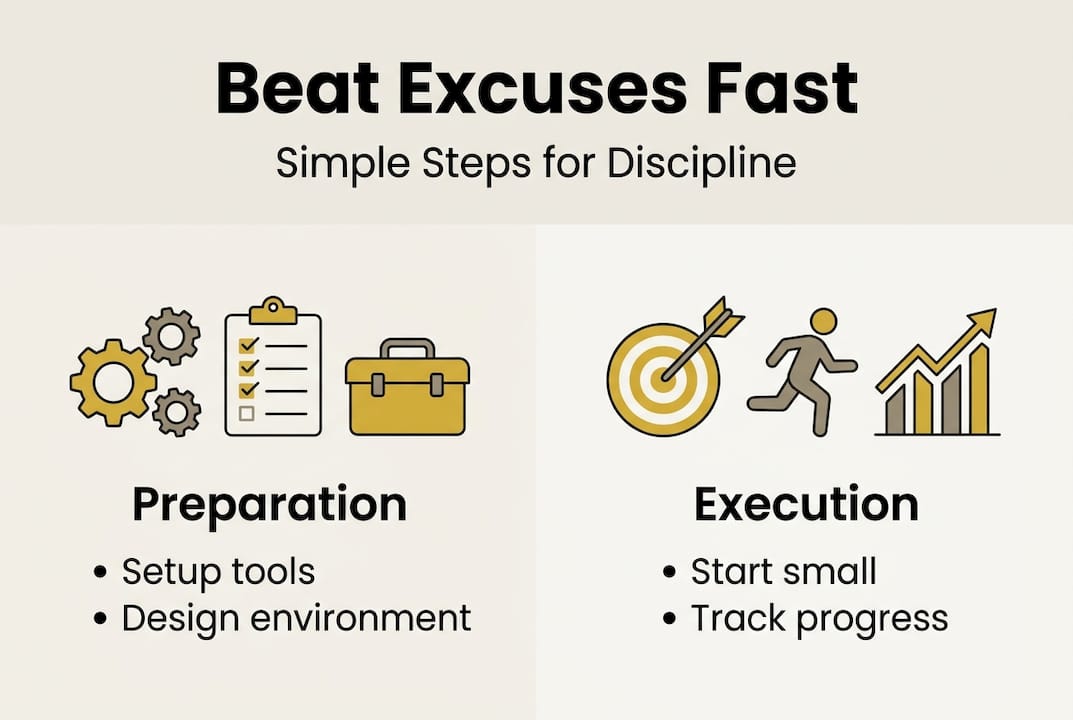
Metacognitive strategies and self-forgiveness are two of the most effective tools for reducing procrastination and building consistent discipline. Metacognition simply means thinking about your own thinking. Catching yourself mid-excuse and asking "What's actually driving this right now?"
Here's a four-step tactical process you can use in real time:
- Map your triggers. Write down the top five situations where you consistently make excuses. Time of day, task type, emotional state. Pattern recognition is your first weapon.
- Pause and reframe. When an excuse surfaces, pause for ten seconds. Name the emotion underneath it. "I'm avoiding this because I'm afraid it won't be good enough" is far more useful than "I'll do it later."
- Chunk it down. Break the task into the smallest possible action. Not "write the report" but "open the document and write one sentence." Micro-wins build momentum fast.
- Reset with self-forgiveness. When you slip, don't spiral. Acknowledge it, identify what triggered it, and recommit. Emotion regulation is core to combating excuses, not punishment or guilt.
Pro Tip: The goal of step three isn't to trick yourself into doing more. It's to break the psychological barrier of starting. Once you're in motion, the brain's natural momentum usually carries you further than the minimum.
These science-backed steps work because they address the emotional root of excuses, not just the surface behavior. You're not fighting laziness. You're rewiring a protection response.
For men going through significant life changes, the concept of personal reinvention matters here too. Your tactics need to evolve as you evolve. What worked at 25 might not work at 40. Staying rigid about your approach is itself a form of self-sabotage.
Verification: Tracking progress and troubleshooting common setbacks
Most men either track nothing or track everything obsessively for two weeks and then quit. Neither extreme works. What you need is a simple, sustainable system for monitoring what's actually happening.
Tracking wins and reviewing setbacks enables real behavioral change because it turns vague feelings into concrete data. When you can see that you followed through four out of seven days, that's information. When you notice you always skip on Thursdays, that's a pattern worth investigating.
Simple tracking methods that actually stick:
- A paper habit tracker with just three to five daily behaviors
- A weekly five-minute review: what worked, what didn't, what triggered excuses
- A voice memo to yourself at the end of the day (faster than writing, more honest)
- A shared log with an accountability partner for added social pressure
Setbacks are not failures. They are data points. The question isn't "Why did I fail again?" It's "What specific condition made it easier to quit this time?"
"The man who tracks his stumbles learns faster than the man who only counts his wins."
Here's how to troubleshoot the most common pitfalls:
- You keep skipping the same task. The task is probably too large or emotionally loaded. Break it down further or address the emotion directly.
- You do well for a week, then crash. Your system is too rigid. Build in a planned recovery day so a slip doesn't become a collapse.
- You feel motivated but still don't act. Motivation is not the problem. Friction is. Remove one more barrier from the action.
- You're consistent alone but fall apart with others around. Your environment needs social boundaries. Protect your focus time like an appointment.
Building lasting success discipline requires treating your progress like a scientist treats an experiment. Adjust variables, observe outcomes, and refine. Emotion has no place in the analysis, only in the understanding of triggers. Using evidence-based self-help frameworks keeps your adjustments grounded in what actually works rather than what feels right in the moment.
Our take: Why most advice fails and what actually sticks
Here's the uncomfortable truth most discipline guides won't tell you: the reason you keep making excuses isn't because you lack information. You know what to do. You've known for years. The real problem is that standard advice treats excuses as a knowledge gap when they're actually an emotional gap.
Shame-based motivation, the kind that says "just stop being weak," doesn't build discipline. It builds a fragile performance that collapses the moment real stress arrives. We've seen this pattern repeat endlessly, and it's not a character flaw. It's a design flaw in the advice itself.
What actually sticks is when a man starts to see himself differently. Not as someone who "should" be disciplined but as someone who is building a new identity, one action at a time. That shift, understanding cycles of real change, is what separates men who transform from men who just try harder and burn out again.
Self-compassion isn't softness. It's the foundation that makes consistency possible.
Ready for your last excuse?
You've got the framework. You understand the psychology, the preparation, the execution, and the tracking. But knowing the map isn't the same as walking the road.
If you're serious about breaking the excuse cycle for good, Your Last Excuse was built exactly for this. The Identity Shift System goes deeper than tactics. It rewires the subconscious beliefs that keep pulling you back into the same patterns. Pair that with quick-start routines designed for real men with real schedules, and you've got a system that doesn't just motivate you for a week. It changes who you are.
The next step is yours. Make it count.
Frequently asked questions
What is the most effective strategy to overcome excuses?
The most effective strategy combines self-awareness with emotion regulation and practical tools like task management and environment design. Traditional willpower-only approaches consistently fall short without addressing the emotional drivers underneath.
How can I stop self-sabotaging behaviors?
Identify your personal triggers, break tasks into small steps, and practice self-forgiveness to build momentum. Self-forgiveness and small wins measurably reduce future procrastination and increase follow-through over time.
Why do I keep making excuses even when I know what to do?
Because excuses stem from emotion regulation, not simply a lack of knowledge or willpower. Your brain is managing discomfort, not failing to understand the task.
Can psychological techniques help with excuses caused by ADHD or anxiety?
Yes. Anxiety- and ADHD-driven excuses respond well to added structure, habit loop mapping, and external accountability systems that reduce the cognitive load of self-regulation.