
Most men believe real personal change requires a rock-bottom moment, a dramatic life event, or a complete identity wipe. That belief is wrong, and it's costing you years. Personal reinvention is the intentional process of evolving your identity, skills, mindset, and behaviors, and research shows measurable shifts can happen in weeks, not years. You don't need a crisis to change. You need a system. This guide breaks down the psychology behind real transformation, the science-backed methods that actually work, and the practical frameworks men use to stop self-sabotaging and start building the discipline that lasts.
Table of Contents
- Defining personal reinvention: Beyond the buzzword
- The science of change: Iterative mindsets and measurable progress
- From sabotage to discipline: Psychological strategies for men
- Practical frameworks for lasting transformation
- The uncomfortable truth about reinvention: Small changes, big impact
- Take your transformation further
- Frequently asked questions
Key Takeaways
| Point | Details |
|---|---|
| Reinvention is iterative | Lasting transformation comes from small, ongoing changes—not dramatic overhauls. |
| Empirical change is possible | Personality traits and discipline can shift measurably within weeks to months using proven routines. |
| Men face unique barriers | Addressing emotional resistance and sabotage patterns is crucial for men’s transformation. |
| Practical frameworks matter | Stepwise methodologies and data-driven cycles produce sustainable, measurable results. |
| Mindfulness boosts success | Mindfulness and yoga reinforce psychological change and help sustain wellbeing. |
Defining personal reinvention: Beyond the buzzword
The word "reinvention" gets thrown around like it means burning everything down and starting fresh. It doesn't. Real reinvention is not about erasing who you are. It's about deliberately evolving who you're becoming.
One of the biggest misconceptions men carry is that change requires a clean slate. That you need to wait for a divorce, a job loss, or a health scare before you're allowed to rebuild. That thinking keeps you stuck. It frames transformation as something that happens to you, not something you choose.
Another myth is that reinvention is a one-time event. You decide to change, you change, done. But reinvention is iterative evolution, not a single overhaul. It uses your past experiences as raw material, not as baggage to discard. Every version of you that failed, struggled, or quit contains data. That data is useful.
Here's what reinvention actually looks like in practice:
- Identifying which beliefs are running your behavior without your conscious input
- Choosing a specific identity target, not a vague goal like "be better"
- Using reflection and adaptation to adjust your approach as you go
- Treating setbacks as feedback, not as proof you can't change
"Reinvention is not radical erasure but intentional, iterative evolution, leveraging past experiences for new identity, skillset, and behaviors."
This reframe matters because it removes the pressure of perfection. You're not trying to become a different person. You're trying to become a more deliberate version of yourself. Understanding the psychology of self-sabotage is often the first real step, because most men are fighting patterns they haven't even named yet.
The science of change: Iterative mindsets and measurable progress
Here's something most self-help content won't tell you: personality is not fixed. Traits you think are hardwired, like discipline, confidence, and emotional resilience, are actually changeable through targeted intervention.
A validated framework called the Iterative Mindset Inventory shows that habit-building combined with regular self-assessment and behavioral adjustment produces measurable gains in self-efficacy. The key word is iterative. You're not overhauling your life in one shot. You're running small cycles of action, review, and refinement.

The data on personality change is even more striking. Personality traits shift significantly after structured 15-week programs, with measurable gains in conscientiousness and extraversion. That's not motivational fluff. That's a measurable shift in who you are at a trait level.
| Approach | Timeframe | Measurable outcome |
|---|---|---|
| One-off resolution | 1-2 weeks | Minimal, fades fast |
| Iterative habit cycles | 4-12 weeks | Significant self-efficacy gains |
| Structured 15-week program | 15 weeks | Big Five trait shifts (~0.5 SD) |
Here's a simple process to apply this science right now:
- Choose one target behavior to build or eliminate this cycle
- Track it daily using a simple yes/no log
- Assess weekly by reviewing patterns and friction points
- Adjust one variable based on what the data shows
- Repeat for 8-12 weeks before evaluating results
This is how lasting discipline cycles are actually built. Not through willpower, but through structured repetition and honest assessment. And discipline's impact on success compounds over time in ways that single bursts of motivation never can. Personality change research consistently confirms that small, sustained behavioral shifts outperform dramatic pivots.
From sabotage to discipline: Psychological strategies for men
Self-sabotage isn't random. It follows patterns, and for men specifically, those patterns are often rooted in a fear of weakness or a fear of success. Both sound counterintuitive, but they're real and well-documented.
Fear of success triggers sabotage because success brings visibility, expectation, and the risk of losing the identity you've built around struggle. Therapy, CBT, and structured routines are cited as crucial tools for breaking this cycle and sustaining real change.
Here are the most effective psychological strategies for men working through this:
- Cognitive Behavioral Therapy (CBT): Identifies and rewires the thought patterns that feed self-defeating behavior
- Shadow work: Examines the parts of yourself you've suppressed or rejected, often the source of sabotage
- Mindfulness routines: Builds the gap between impulse and action, giving you room to choose differently
- Environmental design: Removes friction from good habits and adds friction to destructive ones
- Accountability structures: External check-ins that make avoidance harder than action
"Mechanisms include shifts in explicit and implicit self-concepts; benchmarks show 1-3 months for noticeable change when routines are consistent."
Pro Tip: Don't try to fix your mindset and your habits at the same time. Start with one behavior that directly contradicts your sabotage pattern. If you avoid hard conversations, have one this week. If you quit when things get uncomfortable, stay in one uncomfortable situation longer than usual. Small defiance of your old pattern is how the new identity gets traction.
If you want to go deeper on ending self-sabotage, the research is clear: the men who break the cycle aren't the ones with the most willpower. They're the ones who understand their pattern and use digital self-help for discipline to build structured support around their weak points.
Practical frameworks for lasting transformation
Knowing the theory is one thing. Applying it without falling back into old patterns is another. Here's where most men fail: they try to change everything at once, burn out in week two, and use that failure as evidence that they can't change. That's not a character flaw. That's a strategy problem.
Core methodologies for reinvention include self-awareness, goal-setting, skill-building, behavioral activation, mindfulness, accountability, and environmental upgrades. The key is sequencing them, not stacking them all at once.
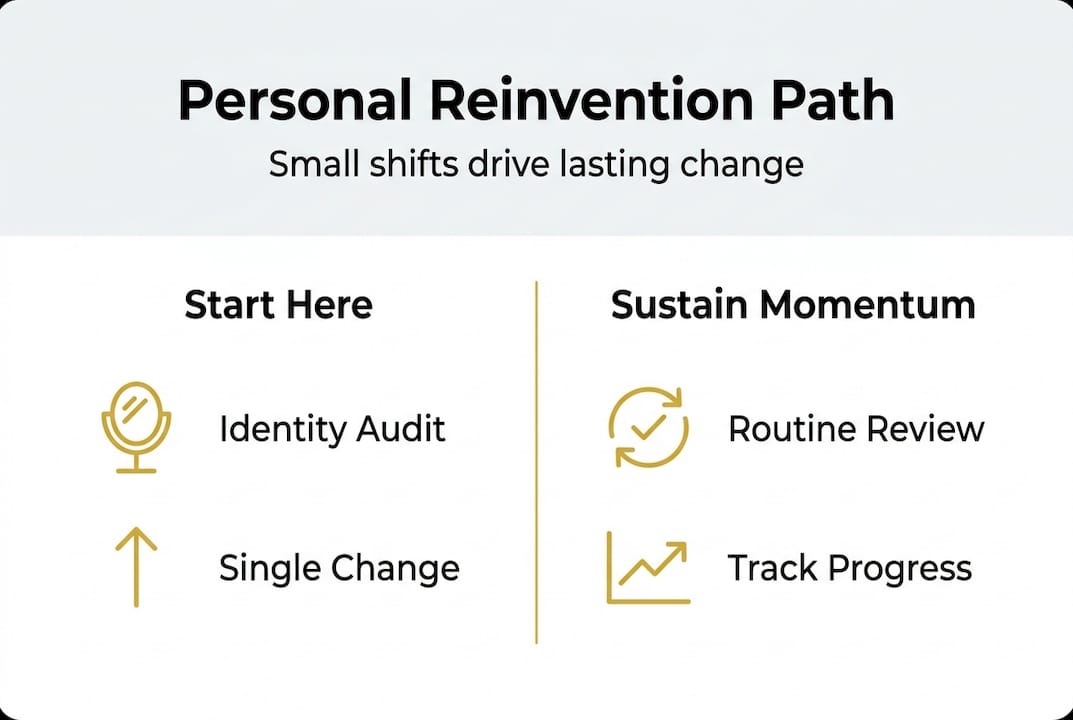
Follow this stepwise framework:
- Audit your current identity: Write down the beliefs you act on daily, not the ones you claim to hold
- Choose one target shift: Pick the single change that would have the most downstream impact
- Design your environment: Restructure your physical and digital space to support the new behavior
- Build a feedback loop: Weekly reviews, not monthly. Adjust based on real data.
- Grieve the old identity: This sounds soft, but validating resistance before acting prevents the emotional backslide that kills most attempts
| Framework element | Purpose | Timeframe |
|---|---|---|
| Identity audit | Baseline awareness | Week 1 |
| Single change focus | Prevents oscillation | Weeks 1-4 |
| Environment design | Reduces friction | Ongoing |
| Weekly feedback loop | Tracks real progress | Weekly |
| Emotional validation | Reduces resistance | As needed |
Pro Tip: The men who sustain transformation longest are the ones who build discipline routines around their identity target, not their motivation level. Motivation fluctuates. A well-designed routine runs even when you don't feel like it. Pair your new behavior with an existing anchor, something you already do every day, and the habit builds faster with less effort. Mindfulness for wellbeing is one of the most underused tools in this stack, especially for managing the emotional friction that derails progress.
The uncomfortable truth about reinvention: Small changes, big impact
Here's the contrarian take most men need to hear: the dramatic reinvention story is almost always a lie. Not intentionally, but structurally. When someone tells you they "completely transformed" in 90 days, what actually happened was a series of small, compounding decisions that, in hindsight, look like a single leap.
Radical pivots rarely last because they don't account for the emotional infrastructure required to sustain them. You can white-knuckle a new identity for a few weeks. But without addressing the subconscious patterns underneath, you'll drift back. Every time. This is what the Iterative Mindset Inventory research confirms: small, data-driven improvements compound into sustainable change. Big dramatic swings don't.
The men who actually transform are the ones who stop waiting for the perfect moment and start running small, honest cycles of change. They measure what's working. They adjust what isn't. They don't need a crisis to begin.
Most men also skip the emotional layer entirely. They focus on behavior and ignore the beliefs driving it. That's why understanding lasting discipline cycles matters so much. Real discipline isn't about grinding harder. It's about building a system that works even when your emotional state is low. That's the shift that separates men who keep growing from men who keep restarting.
Take your transformation further
If this article gave you a clearer picture of what reinvention actually requires, the next step is applying it with structure behind you. Reading about frameworks is useful. Running them with expert guidance is what produces results that stick.

At Your Last Excuse, the Identity Shift System is built around the exact principles covered here: iterative change, identity-based habit building, and psychological tools that address the root of self-sabotage, not just the surface behavior. If you're serious about breaking the cycle and building the kind of discipline that doesn't collapse under pressure, this is where that work gets done. The system is backed by a risk-free guarantee and gives you instant digital access to start today.
Frequently asked questions
Can personal reinvention really change who I am?
Personality traits shift measurably through structured interventions, with significant gains in traits like conscientiousness and extraversion visible after 15-week programs. Yes, targeted routines and mindset work can genuinely alter who you are at a trait level.
What's the most important first step for men facing self-sabotage?
Self-awareness comes first, followed by measurable goal-setting and skill-building. Identify the specific pattern you keep repeating before trying to change anything.
How long does real transformation take?
Using iterative frameworks and consistent routines, noticeable shifts appear within 1-3 months. Sustained change builds from there through continued cycles of action and review.
Does reinvention mean forgetting your past?
No. Reinvention means evolving, not erasing. Your past experiences are data points that inform the next version of you, not liabilities to discard.
Are mindfulness or yoga useful for personal reinvention?
Yes. Reduced stress after six weeks of mindfulness and yoga practice is well-documented, and both reinforce the psychological changes needed for lasting transformation.