
TL;DR:
- Unstructured self-reflection can worsen men's mental health by reinforcing shame and negativity.
- Effective self-reflection involves structured frameworks focused on specific behaviors and compassionate self-inquiry.
- Lasting change requires combining reflection with repeated actions, environmental support, and identity reinforcement.
Most men are told that self-reflection is the answer. Sit with your thoughts, journal your feelings, and clarity will follow. But that advice skips a critical warning: reflection without structure can make things worse. A meta-analysis of 39 studies involving over 12,000 participants found that self-reflection correlates more strongly with depression and anxiety than with positive outcomes. If you've ever spent an hour inside your own head and felt worse afterward, that's not weakness. That's what unstructured reflection does to men already caught in sabotage loops. This article breaks down what actually works, what backfires, and how to use self-reflection as a precision tool rather than a trap.
Table of Contents
- What self-reflection really means for men who self-sabotage
- The double-edged sword: When reflection helps and when it harms
- Making self-reflection actionable: Heuristics, frameworks, and integration
- Limits and integration: Why self-reflection isn't enough by itself
- A fresh perspective: Why most advice on self-reflection for men misses the mark
- Next steps: Practical support for your transformation
- Frequently asked questions
Key Takeaways
| Point | Details |
|---|---|
| Reflection’s double edge | Unstructured self-reflection can worsen anxiety and self-sabotage without the right approach. |
| Structure is crucial | Using practical frameworks and heuristics directs reflection toward constructive change. |
| Action beats insight | Lasting transformation relies on repeated behavioral shifts, not just reflection alone. |
| Men face unique hurdles | Masculine norms and shame cycles require trauma-aware, compassionate strategies. |
What self-reflection really means for men who self-sabotage
Self-reflection, at its core, is the practice of examining your own thoughts, motivations, and behaviors to understand why you do what you do. Sounds simple. But for men caught in self-sabotage patterns, it rarely stays simple.
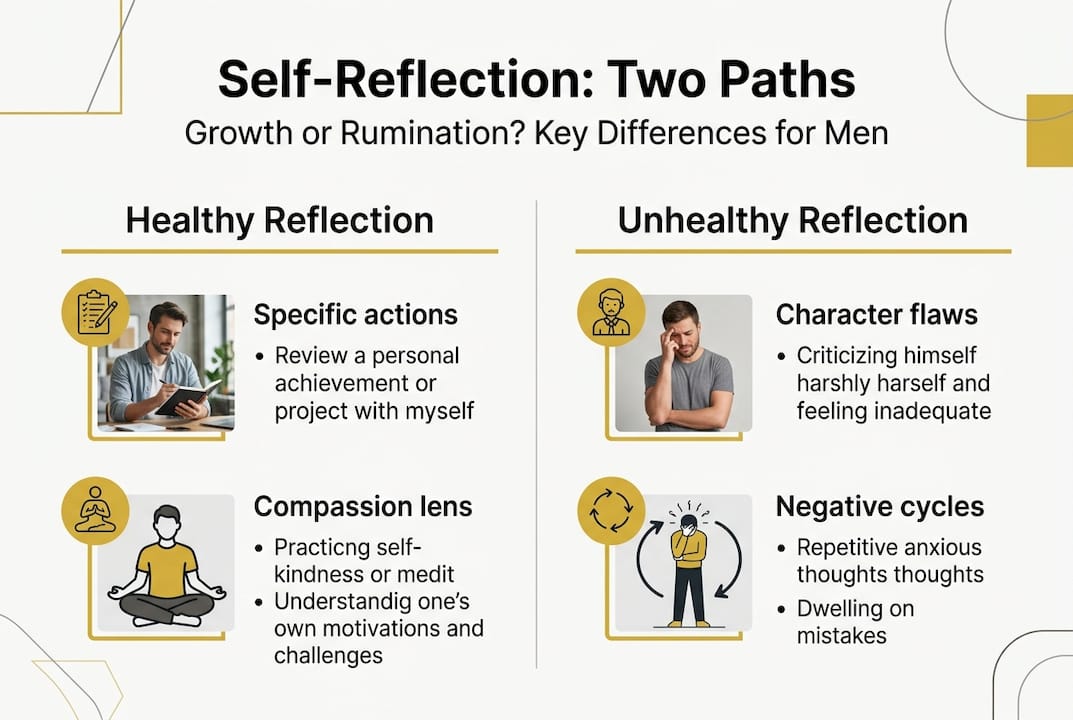
There are two very different versions of self-reflection. The first is growth-oriented reflection: you identify a behavior, trace it to a belief or trigger, and use that insight to make a specific change. The second is unstructured reflection: you replay events, criticize yourself, and spiral deeper into shame without any resolution. Most men default to the second version without realizing it.
Masculine norms make this worse. Men are often conditioned to suppress emotion, project confidence, and avoid appearing vulnerable. When reflection forces contact with feelings of failure or inadequacy, the instinct is either to shut down or to double down on self-criticism. Neither response creates change. Both reinforce the cycle.
Here are the most common thought patterns that surface during unstructured reflection for men:
- "I always do this. I'll never change."
- "Other men don't struggle like this."
- "If I were stronger, I wouldn't need to think about this."
- "I know what I should do. Why can't I just do it?"
- "Thinking about this is pointless. Nothing ever changes."
These aren't random thoughts. They're the inner critic using reflection as a weapon. And the research backs this up:
A meta-analysis of 39 studies (N=12,496) found that self-reflection correlates positively with negative mental health indicators like depression and anxiety (r=0.155), but shows no significant correlation with positive mental health outcomes.
This doesn't mean reflection is useless. It means the way you reflect determines whether it builds you up or tears you down. The goal is to shift from passive rumination to active, structured inquiry that points toward specific action.
The double-edged sword: When reflection helps and when it harms
Reflection becomes a genuine tool when it helps you spot dysfunction, trace patterns, and build a plan. It becomes a liability when it feeds shame spirals, reinforces negative identity labels, or loops without resolution. For men with perfectionist tendencies or a history of harsh self-judgment, the line between the two is razor thin.
Unstructured reflection risks reinforcing self-criticism cycles, while self-compassion responses actively break those cycles. That's not soft advice. That's the mechanism. When you reflect without compassion, you're essentially interrogating yourself without a lawyer present.
Here's a practical comparison to help you identify which mode you're in:
| Healthy reflection | Unhealthy reflection |
|---|---|
| Focuses on specific behaviors | Focuses on character flaws |
| Asks "What can I do differently?" | Asks "What's wrong with me?" |
| Leads to a concrete next step | Leads to more questions and shame |
| Time-limited and purposeful | Open-ended and draining |
| Builds self-awareness | Reinforces negative identity |
| Includes self-compassion | Driven by self-criticism |
Rumination, the repetitive replaying of negative events without resolution, is the most dangerous form of reflection for men ending sabotage cycles. It feels productive because you're thinking hard. But it produces no new information and no new behavior. It just deepens the groove of "I'm the kind of man who fails at this."
Pro Tip: When you notice you've been thinking about the same problem for more than five minutes without reaching a new insight, stop and ask one question: "What is one small thing I can do about this today?" That single redirect breaks the loop and shifts your brain from problem-dwelling to solution-seeking.
For men who carry trauma or deep shame, compassion-aware approaches aren't optional extras. They're prerequisites. You can't think your way out of a shame spiral using the same critical voice that created it.
Making self-reflection actionable: Heuristics, frameworks, and integration
If unstructured reflection is risky, the fix isn't to reflect less. It's to reflect smarter. Structure transforms reflection from a passive experience into a behavioral tool.

One of the most practical findings in recent research comes from studying how managers change ingrained habits. Self-change heuristics, simple rules like "when X happens, I do Y," are among the most effective tools for unlearning sabotage patterns and reworking identity. These aren't complex strategies. They're behavioral shortcuts that remove the need for willpower in the moment.
Here are four fundamental steps for actionable self-reflection:
- Set a focus question. Don't reflect on "everything." Pick one specific behavior or pattern. Example: "Why did I avoid the gym three times this week?"
- Apply a framework. Use a CBT thought record, an ACT defusion exercise, or a simple trigger-response-outcome map to structure your thinking.
- Track outcomes. Write down what you noticed and what you plan to test. One sentence is enough. The act of writing externalizes the thought and makes it real.
- Test and revise. Run one small behavioral experiment before your next reflection session. Did your plan work? Why or why not? Adjust and repeat.
Here's a quick reference for matching tools to targets:
| Tool | What it targets |
|---|---|
| CBT thought record | Distorted beliefs and cognitive errors |
| ACT defusion | Detachment from unhelpful mental narratives |
| If/then heuristics | Automatic responses to specific triggers |
| Trigger mapping | Identifying the root cause of sabotage behaviors |
These frameworks work because they give your mind a track to run on. Without a track, reflection wanders into rumination. With a track, it builds self-improvement routines that compound over time. For men who want evidence-based self-help, frameworks are the difference between spinning your wheels and gaining traction.
Pro Tip: Try a three-minute nightly review. Ask yourself three questions: What triggered me today? How did I respond? What would I do differently? Keep it short. The goal is pattern recognition, not therapy. Done consistently, this builds the kind of self-awareness that actually changes behavior.
Limits and integration: Why self-reflection isn't enough by itself
Here's the uncomfortable truth most self-help content won't tell you: insight alone almost never changes behavior in the long run. You can understand exactly why you self-sabotage and still do it again tomorrow. Understanding the pattern isn't the same as breaking it.
The reason comes down to neuroscience. Lasting change requires repeated action and nervous system adaptation, not just cognitive insight. Your brain doesn't rewire itself through understanding. It rewires through doing, specifically through repeated exposure to new behaviors until they become automatic.
The data reinforces this. Based on the correlation coefficient (r=0.155) from the meta-analysis cited earlier, self-reflection alone accounts for roughly 2 to 3 percent of the variance in mental health outcomes. That's not nothing, but it's far from sufficient for the kind of transformation men dealing with deep sabotage patterns actually need.
An integrated transformation cycle looks more like this:
- Structured reflection to identify the specific belief or trigger driving the behavior
- Physical or behavioral action to create new neural pathways through repetition
- Environmental design to reduce friction and make the new behavior easier to repeat
- Accountability or support to maintain momentum when motivation drops
- Regular review to track progress and adjust the approach
The men who achieve lasting success through discipline don't just think differently. They act differently, repeatedly, until the new behavior becomes their default. Reflection is the starting point, not the destination. And for men stuck in self-improvement cycles that never seem to stick, adding behavioral reinforcement to their reflection practice is usually the missing piece.
A fresh perspective: Why most advice on self-reflection for men misses the mark
Most conventional self-help advice tells men to journal daily, meditate, and "get in touch with their feelings." For some men, that works. For men with ingrained sabotage habits and a history of shame-driven self-criticism, it often makes things worse. Generic journaling without a framework is just giving the inner critic more airtime.
What the mainstream advice misses is that men don't just need better insight. They need a method that respects how shame actually operates in the male nervous system. Shame doesn't respond to more thinking. It responds to small, repeated experiences of doing something differently and surviving it.
The real work is in matching insight with behavioral experiments. Not big promises or dramatic overhauls. Small tests. "I'll do this one thing differently today and see what happens." That's how identity shifts. Not through a single breakthrough moment, but through accumulated evidence that you are capable of acting differently.
As we see consistently when working through the psychology of male sabotage:
"Lasting change doesn't come from better insight, but from acting differently, even before you fully believe you can."
That's the real leverage point. Reflection sets the direction. Action builds the identity.
Next steps: Practical support for your transformation
Understanding the science of self-reflection is a strong start. But bridging the gap between insight and real behavioral change is where most men get stuck. Reading about frameworks is not the same as having a structured system that walks you through applying them to your specific patterns.
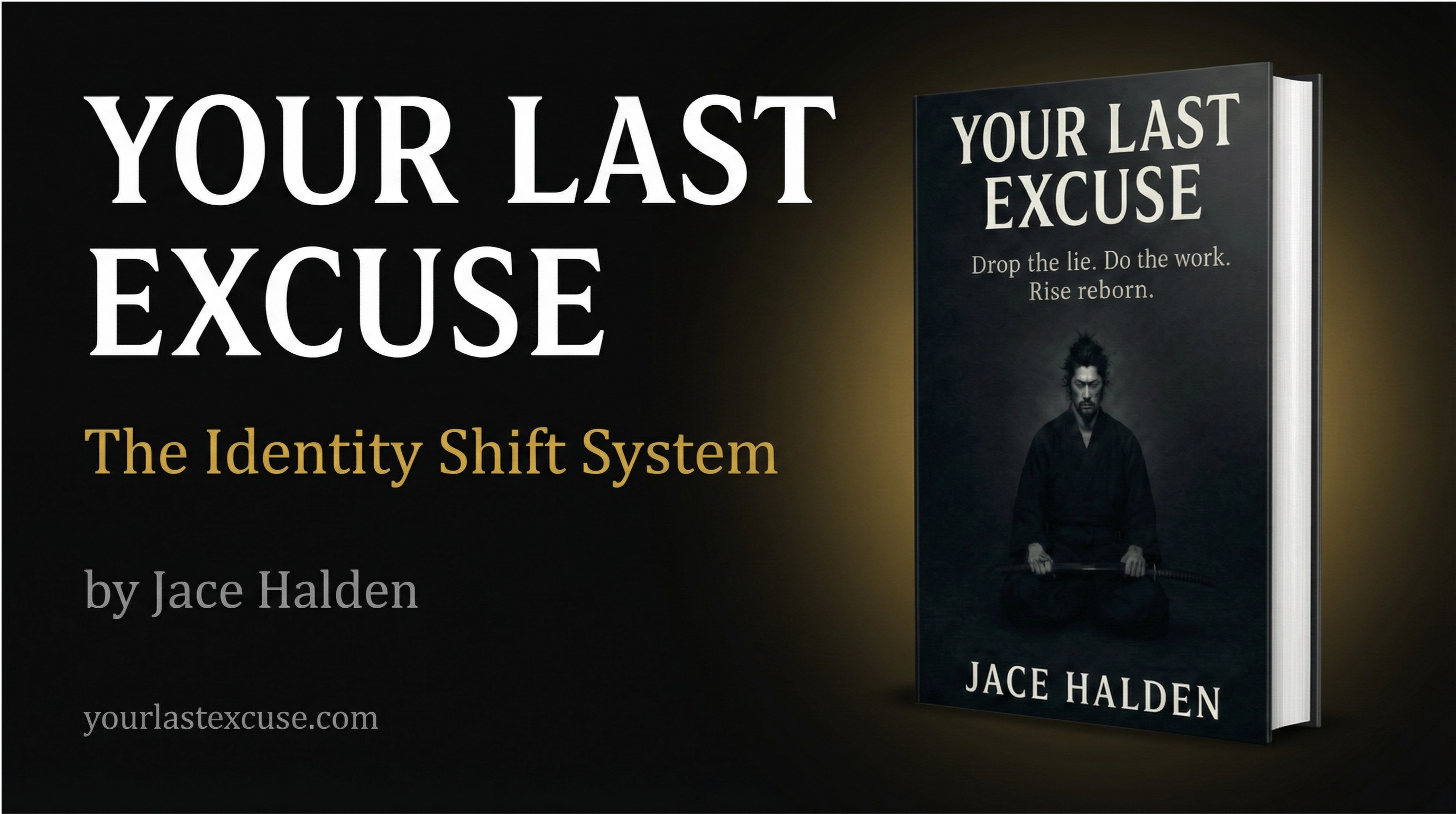
Your Last Excuse was built specifically for men who are done cycling through motivation and collapse. The Identity Shift System gives you a step-by-step protocol that combines structured reflection, behavioral experiments, and identity-level rewiring into one integrated process. No vague journaling prompts. No motivational fluff. Just a proven system designed to move you from self-awareness to sustained discipline. If you're ready to stop analyzing and start changing, this is the next step.
Frequently asked questions
Can self-reflection make anxiety or self-sabotage worse?
Yes. Without structure or compassion, reflection can intensify anxiety and reinforce negative beliefs. A meta-analysis of 39 studies found self-reflection correlates positively with depression and anxiety indicators, not positive mental health outcomes.
What's the difference between healthy self-reflection and rumination?
Healthy self-reflection is solution-focused and time-limited, while rumination replays negative thoughts without resolution. Self-compassion responses actively break criticism cycles that unstructured reflection tends to reinforce.
How can men structure self-reflection to actually change habits?
Use specific frameworks like if/then heuristics or CBT thought records rather than open-ended journaling. Self-change heuristics such as "when X happens, I do Y" are among the most effective tools for unlearning sabotage habits.
Is self-reflection alone enough for psychological transformation?
No. Reflection identifies the problem, but lasting transformation requires repeated behavioral action and nervous system adaptation. Insight without consistent action rarely produces durable change.