
TL;DR:
- Building automatic habits is more effective than relying on willpower for long-term change.
- Positive habits rewire the brain's automatic systems, reducing self-sabotage and increasing resilience.
- Small, consistent steps and supportive frameworks help men break cycles of self-sabotage and achieve lasting success.
You've tried willpower. You've tried motivation. You've set goals, made promises, and still ended up back at square one. That's not weakness. That's the Fluctuation Cycle doing exactly what it's designed to do: pull you back. The uncomfortable truth is that self-sabotage psychology isn't about laziness or lack of desire. It's a deeply wired pattern of automatic behavior. The real solution isn't trying harder. It's building positive habits so solid they run on autopilot, even when your motivation hits zero. This guide breaks down the science, the frameworks, and the exact steps to make that shift permanent.
Table of Contents
- The science behind positive habits and self-sabotage
- Evidence: Why positive habits drive health, happiness, and success
- Frameworks for building habits that break self-sabotage
- Overcoming hidden barriers: Shame, fear, and relapse
- A new perspective on positive habits for men
- Step into lasting change
- Frequently asked questions
Key Takeaways
| Point | Details |
|---|---|
| Habits beat willpower | Automatic routines are more reliable than relying on constant motivation or discipline alone. |
| Small wins compound | Building tiny, easy habits daily leads to exponential growth and lasting change over time. |
| Identity shapes action | Positive habits matter most when anchored to the person you want to become, not just goals. |
| Address deeper barriers | Overcoming shame and fear often requires support, therapy, and self-compassion along with habit change. |
The science behind positive habits and self-sabotage
Your brain runs two operating systems. The conscious mind handles deliberate decisions, like choosing a salad over fries. The automatic mind handles everything else, including the habits that either lift you up or drag you down. Most of your daily behavior runs on autopilot, which is exactly why willpower fails. You can't consciously override a system that operates below conscious awareness.
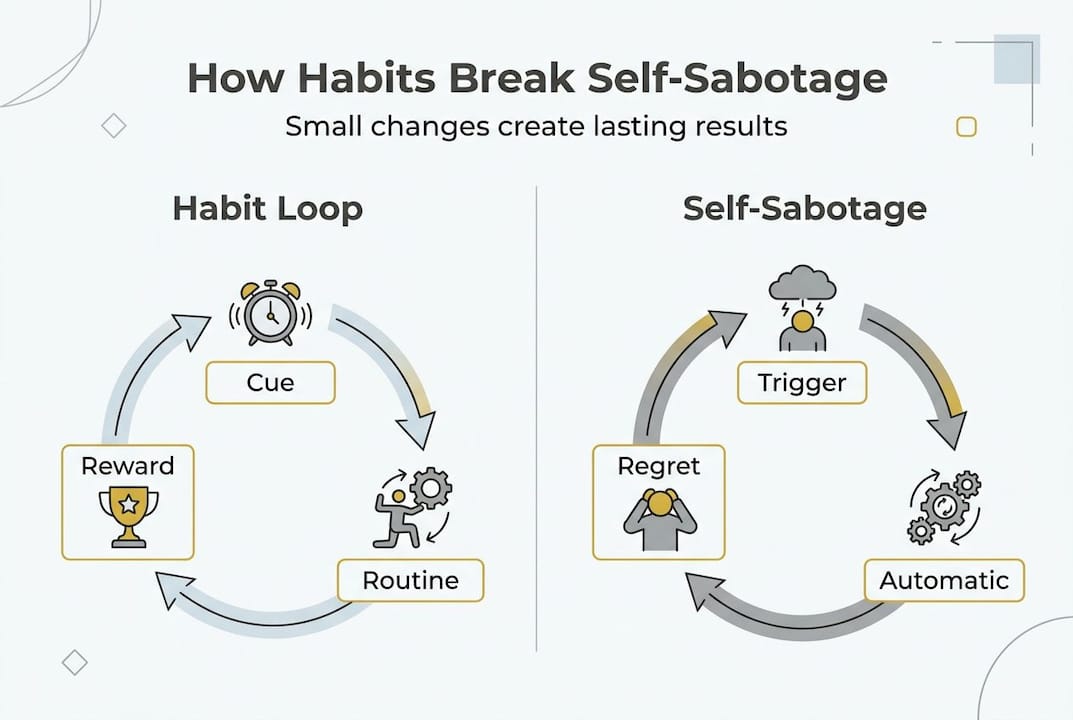
Habits are built on a three-part loop: cue, routine, reward. A cue triggers the behavior, the routine is the action itself, and the reward reinforces it. Positive habits counteract self-sabotage by replacing unconscious negative patterns with automatic positive behaviors rooted in this exact loop. That's Charles Duhigg's core insight from The Power of Habit, and it's backed by decades of behavioral research.
Here's what makes self-sabotage so stubborn: it's not just a bad decision. It's a protective loop your brain developed to manage discomfort, uncertainty, or fear. Skipping the gym after a hard day isn't laziness. It's your brain running a familiar routine that once provided relief. The reward is real, even if the behavior is destructive.
The good news is neuroplasticity. Your brain physically rewires itself through repeated behavior. Habits form via repetition in stable contexts, taking a median of 59 to 66 days to reach automaticity. That's the window where a new behavior stops feeling like effort and starts feeling like just what you do.
| Factor | Willpower-based approach | Habit-based approach |
|---|---|---|
| Relies on | Motivation and energy | Automatic triggers |
| Durability | Fades under stress | Strengthens over time |
| Failure mode | Collapse after one bad day | Misses one day, resumes next |
| Brain system | Prefrontal cortex | Basal ganglia |
| Long-term success | Low | High |
"You do not rise to the level of your goals. You fall to the level of your systems." — James Clear
This is why men stuck in self-sabotage cycles keep failing despite genuine effort. They're fighting the wrong battle. Trying harder with willpower is like trying to outswim a current. Building habits is like learning to use the current itself.
Evidence: Why positive habits drive health, happiness, and success
Understanding the science, we see habit change isn't just theory. It delivers tangible results. Here's how data supports positive habits for men's well-being.
Research consistently shows that positive habits link to better health, with effect sizes ranging from β=0.22 to 0.46. Starting vigorous physical activity raises optimism scores by 0.06 to 0.10 points on validated scales. That might sound small, but compounded over months, it shifts your entire baseline. Men who build consistent routines report higher life satisfaction, stronger resilience, and fewer depressive episodes.
A systematic review covering 74 studies and 10,000 participants confirmed that positive psychology interventions improve both physical and mental health outcomes. These aren't soft findings. They're replicated across cultures, age groups, and starting conditions.
Here's a direct comparison of approaches:
| Approach | Short-term effect | Long-term outcome |
|---|---|---|
| Punishment/restriction | High motivation spike | Relapse and shame |
| Avoidance strategies | Temporary relief | Reinforced fear |
| Positive habit building | Slow start | Compounding resilience |
| Identity-based habits | Moderate start | Sustained transformation |
Key outcomes men report after building consistent positive habits:
- Reduced anxiety and emotional reactivity
- Stronger sense of self-worth and agency
- Better sleep, energy, and physical performance
- Fewer shame spirals after setbacks
- Greater ability to maintain lasting discipline cycles
The data point that matters most: Men who approach self-discipline for success through identity-based habit systems, rather than sheer force, show dramatically lower relapse rates. Punishment-based approaches create shame. Shame fuels more self-sabotage. Positive habits interrupt that loop at the source.
Statistic: Men with consistent daily habits report up to 46% better health outcomes compared to those relying on motivation-based behavior change.
Frameworks for building habits that break self-sabotage
With the importance and benefits clear, let's explore exactly how you can put positive habit frameworks into action to disrupt old cycles.
There are five proven methodologies for men breaking self-sabotage through habit building: habit stacking, implementation intentions, environment design, identity shifting, and small starts. Each one targets a different failure point in the cycle.
Five-step framework to build habits that stick:
- Habit stacking: Attach a new habit to an existing one. "After I pour my morning coffee, I will write three priorities for the day." This uses your existing routines as anchors, cutting friction dramatically.
- Environment design: Make good behaviors easier and bad ones harder. Put your gym shoes by the door. Delete apps that trigger scrolling. Your environment shapes your behavior more than your intentions do.
- Identity shift: Stop saying "I'm trying to work out." Start saying "I'm someone who trains." This reframe changes what decisions feel natural. Follow science-backed steps to make this shift real, not just rhetorical.
- Track and reward: Use a simple habit tracker. Check off the box. The visual streak creates its own motivation. Pair completion with a small reward to reinforce the loop.
- Small starts: Begin with habits so small they feel almost embarrassing. Two pushups. One page. Five minutes. Build discipline routines from the ground up, not from where you wish you were.
Pro Tip: Use self-reflection structure at the end of each week. Ask yourself: what triggered my best behaviors this week, and what triggered the worst? Patterns become visible fast when you look for them.
The math behind small wins is real. A 1% daily improvement compounds to roughly 37 times better performance over a full year. That's not motivational fluff. That's exponential growth applied to human behavior. The men who understand this stop chasing dramatic transformations and start building systems.
- Keep new habits under two minutes to start
- Pair habits with consistent time and location cues
- Track streaks visually to build momentum
- Celebrate small completions, not just big milestones
Overcoming hidden barriers: Shame, fear, and relapse
Even with strong frameworks, hidden barriers can sabotage your best intentions. Here's how to overcome the most common blocks for men.
Most self-improvement content treats self-sabotage like a discipline problem. It's not. For many men, it's a trauma response. Fear of success, fear of losing control, chronic low self-worth, and unprocessed shame all trigger behavioral self-handicapping, a pattern where men unconsciously create obstacles to protect themselves from the pain of trying and failing. Research shows men exhibit this pattern at higher rates than women.
Here's what that looks like in practice:
- Procrastinating on goals that actually matter to you
- Sabotaging relationships or opportunities right before a breakthrough
- Numbing with alcohol, screens, or food when discomfort rises
- Dismissing your own progress to avoid the vulnerability of hope
Going it alone rarely works when shame is in the picture. Shame thrives in isolation. It tells you that you're the only one who can't get it together, and that belief keeps you stuck. Therapy, peer accountability, and structured programs all reduce shame's grip by breaking the silence around it.
Somatic techniques, like breathwork, cold exposure, and body-based awareness practices, help regulate the nervous system so you can tolerate discomfort without fleeing into old patterns. Paired with positive habit building, they address both the surface behavior and the emotional root driving it.

Pro Tip: When you relapse, don't analyze it in the moment. Give it 24 hours, then review what the cue was, what emotion preceded it, and what need it was trying to meet. That's data, not failure.
Digital self-help tools built specifically for men can bridge the gap between knowing what to do and actually doing it when your nervous system is in fight-or-flight mode. The right structure matters as much as the right information.
Relapse is part of the process. Not an exception to it. Every man who has built lasting change has a story of falling apart and rebuilding. The difference between those who make it and those who don't isn't talent. It's whether they treat relapse as data or as proof they're broken.
A new perspective on positive habits for men
Here's what most advice on positive habits for men gets wrong: it treats habits like a productivity hack. Show up, check the box, optimize your morning routine. That framing misses the deeper truth entirely.
Habits aren't about grinding harder. They're about making self-care automatic when motivation disappears, which it always does. The goal isn't discipline through force. It's discipline through design.
Self-trust doesn't come from perfect streaks. It comes from showing up consistently, even imperfectly. Every time you follow through on a small commitment, you send a signal to your nervous system: I do what I say I'll do. That signal compounds. That's personal reinvention at the identity level, not the behavior level.
Cultural myths about toughness tell men to push through, suppress emotion, and never ask for help. Those myths don't build resilience. They build shame, and shame is the fuel of every self-sabotage cycle. Real transformation requires dismantling that story, not performing through it. You don't rise to your goals. You fall to your systems. Build better systems.
Step into lasting change
If this guide showed you anything, it's that the problem was never your effort. It was the system, or the lack of one. Positive habits work when they're built on identity, supported by structure, and protected from shame.
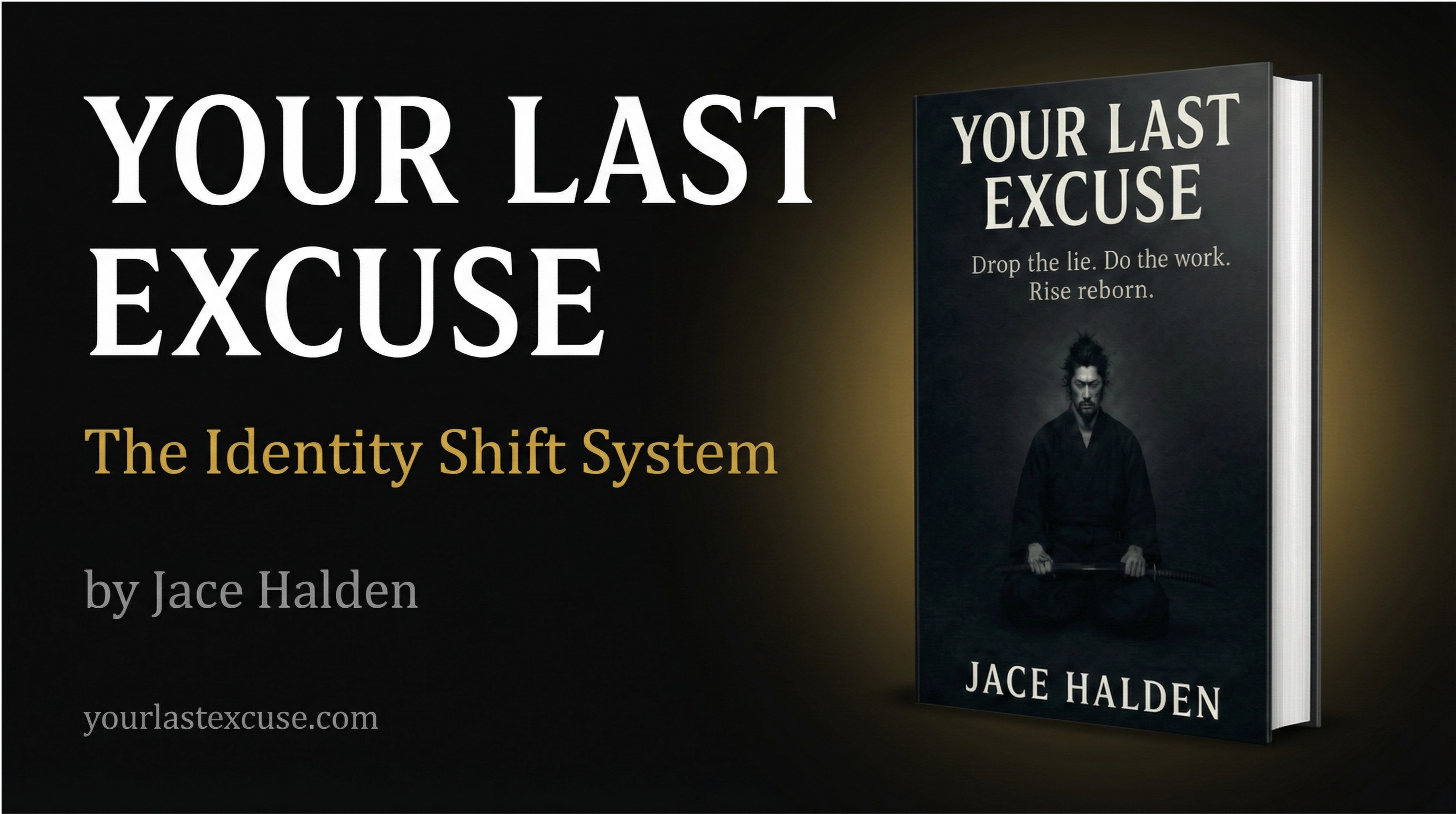
Your Last Excuse exists specifically for men ready to stop cycling through motivation and collapse. The Identity Shift System gives you the psychological framework, the daily protocols, and the community to build habits that don't break under pressure. No fluff, no generic advice. Just a proven system built for men who are done making excuses. If you're serious about lasting change, this is the next step.
Frequently asked questions
How long does it take to build a positive habit?
Research shows habits reach automaticity at a median of 59 to 66 days, though the range spans from 18 to 335 days depending on the complexity of the behavior and consistency of practice.
Can positive habits really override negative self-sabotage patterns?
Yes. Positive habits replace unconscious patterns by rewiring automatic responses through repetition and reward, gradually making the new behavior the path of least resistance.
Why is starting small important when building new habits?
Simple, low-friction habits succeed at 80 to 87% rates because they remove the activation energy barrier that causes most men to quit before the behavior becomes automatic.
What should I do if I relapse and fall back into old habits?
Treat relapse as data, not failure. Relapse is part of the process for most men; review your triggers, recommit to small wins, and return to your system without shame spiraling.
Do I need therapy as well as building habits to beat self-sabotage?
For men dealing with deep shame, trauma, or chronic self-handicapping, therapy combined with habits addresses both the emotional root and the behavioral structure needed for lasting change.