
TL;DR:
- Habits operate below conscious effort and are more resilient than willpower.
- Building small, automatic habits protects against self-sabotage and burnout.
- Regularly review and adjust habits to maintain flexibility and long-term effectiveness.
Most men trying to change their lives aren't failing because they don't care enough. They're failing because they're using the wrong tool. Willpower feels like the answer, but 88% of resolutions fail precisely because willpower runs out. It's finite, fragile, and collapses under stress. Habits, on the other hand, operate below the level of conscious effort. They're automatic, repeatable, and resilient. If you're stuck in a loop of starting strong and burning out fast, this guide will show you exactly how habits interrupt self-sabotage and build the kind of consistency that actually lasts.
Table of Contents
- Why willpower fails and habits win
- How self-sabotage works and how habits interrupt it
- Building better habits: Strategies that actually work
- Key nuances: Habit decay, flexibility, and personalized change
- Our perspective: Why true transformation isn't about more effort
- Transform your habits with expert coaching
- Frequently asked questions
Key Takeaways
| Point | Details |
|---|---|
| Willpower isn’t enough | Habits outperform sheer grit by automating actions you need for long-term success. |
| Habits interrupt self-sabotage | Replacing old patterns with intentional habits prevents procrastination and consistency pitfalls. |
| Personalize your approach | Tailor habits to your unique triggers and focus on progress, not perfection. |
| Start small for lasting change | Micro-habits anchored in identity lead to stronger, more resilient routines. |
Why willpower fails and habits win
Here's the brutal truth: the "just try harder" approach is a trap. Willpower is a resource, and like any resource, it depletes. The more decisions you make, the more stress you absorb, and the more temptation you resist, the less of it you have left. By evening, most men are running on empty, and that's exactly when old patterns creep back in.
The science backs this up. 88% of New Year's goals collapse without a system supporting them. Meanwhile, research on habit formation shows that habits automate roughly 43% of your daily actions. That means nearly half of what you do every day isn't a conscious choice. It's a pattern running on autopilot.
"High self-control individuals aren't fighting impulses. They've automated the right choices."
This reframes everything. The men who seem to have iron discipline aren't grinding harder than you. They've built systems that make the right behavior the default. That's not a personality trait. It's a design decision. And it's one you can make too.
Here's a direct comparison of both approaches:
| Factor | Willpower approach | Habit approach |
|---|---|---|
| Mental energy required | High | Low after formation |
| Performance under stress | Degrades fast | Remains stable |
| Long-term sustainability | Poor | Strong |
| Dependence on motivation | Yes | No |
| Risk of burnout | High | Low |
The habit approach wins because it removes the need for constant decision-making. Once a behavior is automatic, self-identity drives lasting change far more effectively than motivation ever could. Key advantages of habit-based systems include:
- Lower mental fatigue since decisions become automatic over time
- High repeatability regardless of mood or motivation levels
- Stress resilience because the behavior fires even under pressure
- Compounding returns as habits stack and reinforce each other
If you're serious about transformation, identity-based strategies for men are where the real leverage lives. Not in pushing harder, but in building smarter.
How self-sabotage works and how habits interrupt it
Self-sabotage isn't random. It's a predictable loop. Most men who struggle with consistency aren't lazy. They're caught in automatic thought patterns rooted in low self-worth, perfectionism, avoidance, or the pull toward short-term comfort. These patterns fire before conscious thought even kicks in.

Self-sabotage in men most often shows up as procrastination, inconsistency, and perfectionism, all of which trace back to fear of failure or a deep belief that you're not capable. The behavior protects the ego. But it also keeps you stuck.
Here's how common sabotage patterns break down:
| Sabotage pattern | Psychological trigger | Habit interruption |
|---|---|---|
| Procrastination | Fear of failure or judgment | Two-minute start rule |
| Perfectionism | Low self-worth, all-or-nothing thinking | Progress tracking with grace |
| Avoidance | Anxiety, overwhelm | Scheduled exposure habits |
| Comfort seeking | Emotional regulation deficit | Replacement reward habits |
The good news is that habits work at the same automatic level as self-sabotage. You can't always think your way out of a pattern, but you can install a competing one. When the trigger fires, a pre-loaded habit response can redirect the behavior before the old loop completes.
Here's how to spot and interrupt sabotage triggers:
- Identify your top trigger. What situation, emotion, or time of day most often leads to the behavior you want to stop?
- Map the loop. What's the cue, what's the behavior, and what reward does it give you?
- Design a competing response. Choose a habit that gives a similar reward but moves you forward instead of backward.
- Pre-commit with environment design. Remove friction from the new habit and add friction to the old one.
- Track the interruptions. Every time the new habit fires instead of the old one, that's a win worth noting.
To break self-sabotage cycles, the environment has to do most of the heavy lifting. Willpower can't compete with a well-designed trigger. If you want to go deeper on the patterns driving your specific blocks, the psychology of men's self-sabotage is worth understanding before you try to fix anything.
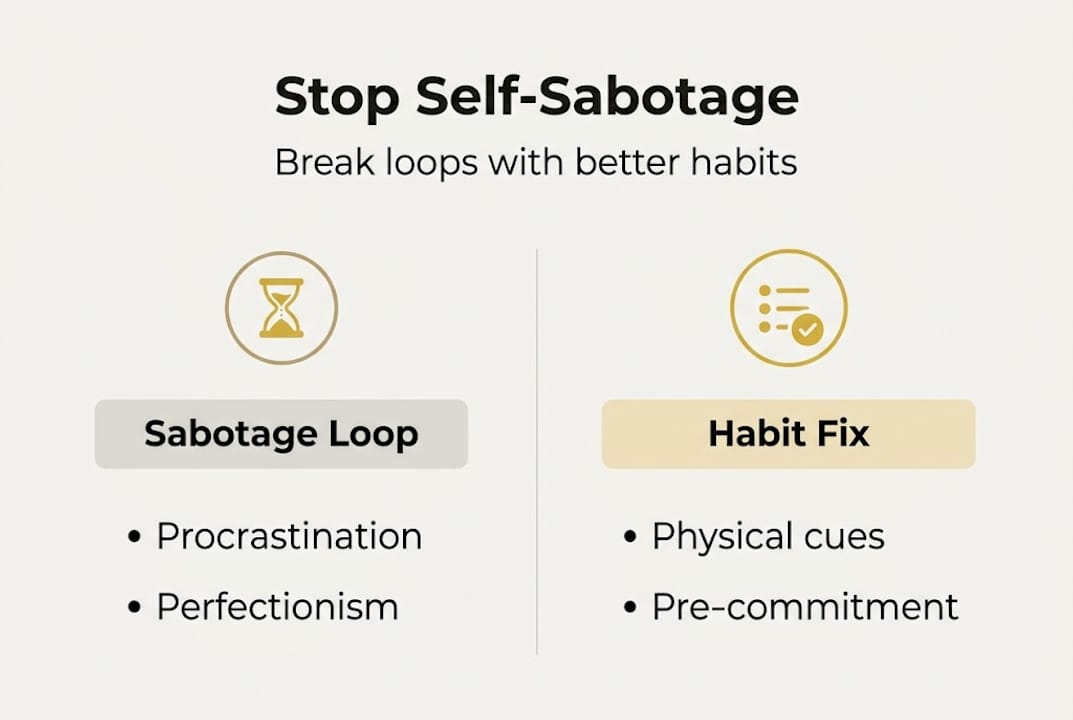
Pro Tip: Use physical cues to pre-commit. Put your gym bag by the door the night before. Set a phone reminder labeled with your "why." These small environmental triggers make the right behavior the path of least resistance before your brain even wakes up.
Building better habits: Strategies that actually work
Knowing why habits matter is one thing. Installing them is another. Most men overcomplicate this step. They try to overhaul everything at once, aim for perfection from day one, and then crash when life gets in the way. The research points in a different direction.
The most effective approach starts small. Micro-habits, behaviors so easy they feel almost embarrassing, build the neural pathways that make bigger behaviors possible later. Each small win acts as an identity vote. You're not just doing a thing. You're becoming the kind of person who does that thing. That's how cycles of lasting discipline actually get built.
Here's a five-step template for installing a new habit:
- Choose one behavior. Pick something specific, small, and tied to a clear outcome.
- Anchor it to an existing cue. After I pour my morning coffee, I will do five minutes of journaling.
- Make it almost too easy. The goal is to start, not to perform perfectly.
- Reward the action immediately. Even a mental acknowledgment counts. "I did it" is a reward.
- Track it for 30 days. Consistency data is motivating. Missing once is fine. Missing twice starts a new pattern.
When it comes to breaking old habits, multi-strategy approaches work best. The three most effective methods are substitution (replacing the behavior with something healthier), inhibition (creating friction that slows the old response), and reward updating (changing what you associate as the payoff). Using all three together accelerates change faster than any single method.
Here are the most common habit-weakening strategies to apply:
- Substitution: Replace the old behavior with a new one that meets the same need
- Inhibition: Add friction, distance, or delay to the old habit trigger
- Reward shift: Consciously connect the new behavior to a satisfying outcome
For a practical framework on building discipline fast, aim for 80% adherence rather than perfection. That means if you miss one day in five, you're still winning. This mindset prevents the all-or-nothing collapse that kills most habit attempts. Check out this practical behavioral change guide for a deeper breakdown of how to structure your approach.
Pro Tip: Don't chase perfect streaks. Chase consistent patterns. A habit done imperfectly for six months beats a perfect habit abandoned after three weeks every single time.
Key nuances: Habit decay, flexibility, and personalized change
Here's what most habit guides won't tell you: habits can decay. They can also become rigid, compulsive, or misaligned with where your life is heading. Treating habits like a set-it-and-forget-it system is where a lot of men eventually hit a wall.
The popular claim that habits form in 21 days is a myth. Research shows habit stabilization takes anywhere from 1 to 65 days depending on the person, the behavior, and the context. Some habits lock in fast. Others take months of repetition before they feel automatic. Expecting a fixed timeline sets you up for unnecessary frustration.
Stat to know: Habit formation timelines range from 1 to 65 days. The 21-day rule has no scientific basis.
There's also the risk of over-automation. Habits that become too rigid can reduce your ability to adapt when circumstances change. A man who can only exercise at 6 a.m. in a specific gym is one schedule disruption away from falling off completely. Flexibility isn't weakness. It's what keeps the system alive when life gets unpredictable.
Here's how to audit and protect your habit system:
- Review your habits monthly. Ask whether each one still serves your current goals and life situation.
- Reframe failure with self-compassion. Missing a day isn't a character flaw. It's data. What triggered the miss?
- Avoid all-or-nothing thinking. One bad week doesn't erase months of progress. Get back on the next available day.
- Stay metacognitive. That means staying aware of your own patterns, noticing when a habit is helping versus when it's become automatic without purpose.
For science-backed steps for men looking to build systems that actually hold up over time, the key is treating your habit stack as a living document, not a finished product. Adjust it. Prune it. Add to it as your identity evolves.
Our perspective: Why true transformation isn't about more effort
Most men come to us exhausted. They've tried the early mornings, the cold showers, the motivational content. They've pushed harder and still ended up back where they started. Here's the uncomfortable truth we've seen play out repeatedly: effort without the right architecture just accelerates burnout.
What actually changes a man isn't repeated force. It's repeated evidence. Every small habit completed adds a data point to a new self-image. Over time, those data points become a story. That story becomes an identity. And identity is what sustains behavior when motivation is gone.
The men who transform don't grind more. They build discipline with routines that make the right choice automatic. They stop relying on feeling ready and start relying on systems that work whether they feel ready or not.
"What works is not force but friction. Remove as much of it as possible in your daily actions."
Pro Tip: When you miss a day, skip the self-criticism. Ask one question instead: "What made this hard?" Then fix that one thing. Self-compassion isn't softness. It's the fastest path back to consistency.
Transform your habits with expert coaching
If this article shifted something for you, that's a start. But reading about habits and actually rewiring the patterns driving your self-sabotage are two very different things. The real work happens when you have a system built around your specific triggers, your identity, and your goals.
At Your Last Excuse, Jace Halden works directly with men who are done cycling through the same patterns. The Identity Shift System isn't about motivation. It's about building the psychological infrastructure that makes discipline automatic. If you're ready to stop relying on willpower and start building something that actually holds, this is where that work begins.
Frequently asked questions
How long does it really take to form or break a habit?
Habits stabilize in 1 to 65 days, not the commonly cited 21 days. The timeline depends on the person, the behavior, and the consistency of repetition.
Why does willpower alone fail to create success?
Willpower is a finite resource that depletes under stress. Lasting success comes from automating the right behaviors through habits, not from relying on motivation to show up every day.
What's the fastest way to stop self-sabotaging behaviors?
Identify your core trigger, then use substitution and reward updating to install a competing response before the old loop completes.
Should I try to change all my habits at once?
No. Start with one micro-habit at 80% adherence to build momentum without overwhelming your system. Adding more comes naturally once the first behavior stabilizes.
Are habits always good or can they backfire?
Habits can become compulsive or rigid if left unchecked. Balancing routine with flexibility and staying aware of whether a habit still serves your goals keeps the system sustainable long-term.