
TL;DR:
- Self-identity influences habits, resilience, and the success of lasting change.
- Shifting internal beliefs about who you are improves motivation and behavior adoption.
- Combining internal identity work with external support enhances the likelihood of sustained change.
Most men who struggle with self-sabotage aren't lazy, weak, or broken. They're operating from the wrong identity. Every time you set a goal and quit, every time motivation spikes and then collapses, the common thread isn't a lack of willpower. It's a mismatch between who you're trying to become and who you currently believe you are. Research confirms this isn't motivational fluff. Your self-identity is the engine behind your habits, your resilience, and your ability to follow through when life gets hard. This guide breaks down what self-identity actually is, how it drives or destroys lasting change, and what you can do right now to start reshaping it.
Table of Contents
- What is self-identity and why does it matter?
- How self-identity shapes behavior and lasting change
- The self-sabotage trap: Patterns and identity solutions for men
- Building a resilient self-identity: Practical steps that work
- An honest take: What most guides won't tell you about self-identity and change
- Next step: Build your identity for real change
- Frequently asked questions
Key Takeaways
| Point | Details |
|---|---|
| Identity fuels results | Shaping your self-identity is the foundation for real, lasting behavior change. |
| Self-sabotage is identity-driven | Patterns of procrastination and avoidance often reflect deeper, hidden identity scripts. |
| Use practical steps | Building a resilient self-identity requires daily actions, support, and reframing setbacks. |
| Context matters too | Relational and environmental factors influence how well identity changes stick. |
What is self-identity and why does it matter?
Self-identity is the internal picture you carry of who you are. It's not your resume or your reputation. It's the running narrative in your head that answers the question: What kind of person am I? That narrative shapes every decision you make, often before you're even conscious of it.
When you think of yourself as "someone who always quits," you'll find reasons to quit. When you see yourself as "a disciplined man who handles hard things," you'll find ways to push through. This isn't positive thinking. It's how the brain filters reality and selects behavior. Your identity acts as a lens, and everything you experience gets sorted through it.
The connection between self-identity and mental resilience is well documented. Self-identity predicts psychological resilience and mediates how well men adjust to adversity, with a correlation of r=0.657 (p<0.01). That's a strong relationship. It means the clearer and more stable your sense of self, the better you handle stress, setbacks, and pressure without falling apart.
Compare two men facing the same setback at work. One sees himself as a victim of circumstance. The other sees himself as someone who figures things out. Same situation, completely different responses. The difference isn't intelligence or luck. It's identity.
You can explore identity-based strategies for men that go deeper into how this plays out in real life. But first, here are the warning signs that your identity is working against you:
- Chronic procrastination on things that matter to you
- Avoidance of challenges where failure feels personal
- Recurring failures in the same areas despite repeated attempts
- Victim mindset, where external forces always get the blame
- Inconsistency between your stated values and your actual choices
"Identity is not just who you are — it's the filter through which you decide what's possible for you."
| Identity signal | What it looks like | What it means |
|---|---|---|
| Strong self-identity | Consistent action under pressure | High resilience baseline |
| Weak self-identity | Behavior collapses when stressed | Low resilience, high self-sabotage risk |
| Conflicted self-identity | Starts strong, then quits | Internal identity mismatch |
If you recognize yourself in that table, you're not stuck. You're just starting from an honest place.
How self-identity shapes behavior and lasting change
Once you know what self-identity is, the next step is understanding how it actually influences your daily behaviors and your ability to change.
Identity determines what you prioritize, especially under stress. When pressure hits, willpower-based systems collapse because willpower is a finite resource. Identity doesn't run out. If you genuinely see yourself as a disciplined man, skipping your workout or bailing on a commitment creates identity dissonance, an uncomfortable gap between who you are and what you just did. That discomfort becomes a built-in correction mechanism.
Identity-based motivation improves outcomes like GPA and homework completion in students, outperforming traditional goal-setting approaches. The same principle applies to adult men working on fitness, career, or relationships. When the goal is tied to identity, follow-through improves.
Here's how the shift actually happens in practice:
- Awareness: Recognize the current identity label you're operating from ("I'm someone who can't stay consistent").
- Alignment: Define the identity you want to inhabit ("I'm becoming a man who keeps his word to himself").
- Action: Take small, identity-confirming actions daily that provide evidence for the new self-image.
- Reinforcement: Review those actions and let them compound into a stronger identity over time.
This process is what separates men who build cycles for lasting discipline from men who stay stuck in the Fluctuation Cycle of motivation and collapse.
Pro Tip: Don't just set goals. Set identity cues. Instead of saying "I will work out more," say "I am becoming a man who trains consistently." The first is a task. The second is a declaration of who you are.
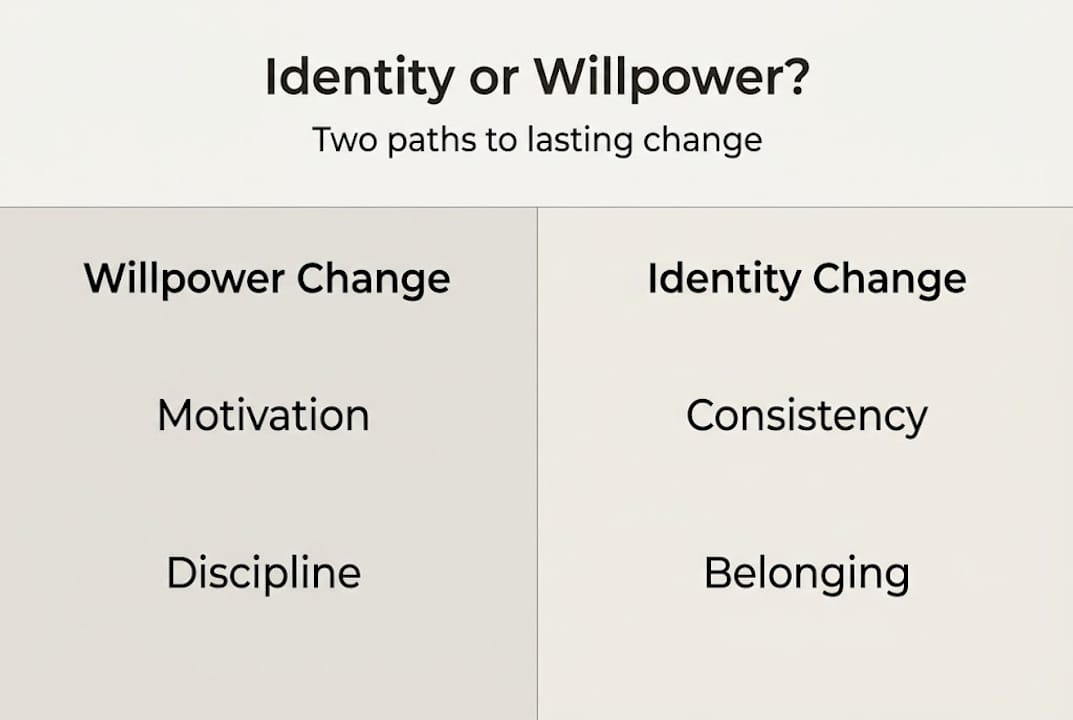
| Factor | Willpower-based change | Identity-based change |
|---|---|---|
| Fuel source | Motivation and discipline | Self-concept and meaning |
| Durability under stress | Low | High |
| Recovery after setback | Slow, shame-driven | Faster, self-correcting |
| Long-term success rate | Inconsistent | Significantly stronger |
If you've tried to end self-sabotage through sheer force of will and kept failing, this table explains why.
The self-sabotage trap: Patterns and identity solutions for men
Now that we've examined the mechanics of identity change, let's zero in on the real adversary: self-sabotage, and why it traps so many men.

Self-sabotage isn't random. It follows patterns, and those patterns are rooted in identity. The psychology of self-sabotage in men aged 25 to 45 shows recurring themes: procrastination, emotional avoidance, and victim identity are the most common traps, and all three are identity-driven.
Here are the most common forms:
- Procrastination: Delaying action to avoid the risk of confirming a fear ("If I try and fail, it proves I'm not capable")
- Emotional avoidance: Numbing discomfort through distraction, substances, or overwork instead of facing it
- Victim identity: Framing every setback as something done to you, which removes your agency
- Perfectionism: Using impossible standards as an excuse to never start
- Self-handicapping: Sabotaging your own effort so you have an excuse ready if you fail
Every one of these patterns reinforces a negative identity role. The procrastinator keeps proving he can't follow through. The victim keeps collecting evidence that the world is against him. The loop feeds itself.
Breaking it requires three moves. First, pattern recognition: you have to catch yourself in the loop before it completes. Second, shifting to an internal locus of control (the belief that your actions determine your outcomes). Third, using accountability partners who reflect your desired identity back to you, not your old one.
Pro Tip: When you catch yourself procrastinating, stop and ask: "What identity am I reinforcing right now?" That single question creates a gap between the impulse and the action. That gap is where change lives.
You can also use positive habits to break self-sabotage cycles and build self-reflection practices that create structure instead of chaos.
Building a resilient self-identity: Practical steps that work
You've now seen the traps of self-sabotage, so how do you actually build a mind that resists backsliding?
Here are the core steps:
- Daily identity statements: Write or say out loud who you are becoming. Not who you wish you were. Who you are in the process of becoming. This keeps the identity active in your brain.
- Micro-commitments: Make small promises to yourself and keep them. Every kept promise is evidence that you're the kind of man who follows through.
- Reframe setbacks as data: A missed day isn't proof you're a failure. It's information about what needs adjusting. Resilient identity treats failure as feedback.
- Take ownership: Even when external factors contributed to a setback, ask what you could have done differently. Ownership builds agency.
- Build social proof: Surround yourself with men who embody the identity you're building. Their behavior normalizes yours.
Stronger recovery identity associates with higher daily meaning and successful change maintenance. In other words, men who see themselves as changed aren't just happier. They actually maintain their new behaviors longer.
"The man who knows who he is doesn't need perfect conditions to act. He acts because that's what he does."
That said, identity work has real limitations under stress. Relational and contextual barriers, like a toxic environment or unsupportive relationships, can undermine even the strongest internal identity. This is why personal reinvention sometimes requires external changes alongside internal ones. And when the internal resistance feels overwhelming, overcoming excuses requires more than mindset shifts alone.
An honest take: What most guides won't tell you about self-identity and change
Here's the part most self-improvement content skips. Identity work is genuinely hard, especially when you're under real stress. Research confirms that identity shifts are harder under stress but buffer better than goal-focused strategies when they do hold. That's important nuance. It means identity is your best long-term tool, but it's not immune to pressure.
Most mainstream content tells men to "just be more disciplined" as if discipline exists in a vacuum. It doesn't. Your environment, your relationships, and the social context you operate in all shape how easy or hard identity work becomes. A man trying to build a new identity while surrounded by people who reinforce his old one is fighting two battles at once.
The honest truth is that solo willpower and solo identity work both have ceilings. The men who make the deepest changes combine internal identity work with evidence-based digital self-help for men, environmental design, and real accountability. Identity is the foundation. But foundations need walls and a roof.
Next step: Build your identity for real change
You now understand why identity, not motivation, is the real driver of lasting change. That insight alone puts you ahead of most men still grinding through willpower-based approaches that keep failing them.
If you're ready to move from understanding to action, Your Last Excuse offers structured, psychology-backed tools built specifically for men who are serious about breaking self-sabotage for good. The Identity Shift System walks you through the exact process of rewiring your self-concept, step by step, with no fluff. You can also start with the science-backed steps to end self-sabotage and build from there. Real change starts with the right framework.
Frequently asked questions
What is the difference between self-identity and self-esteem?
Self-identity shapes your sense of who you are and directs your behaviors, while self-esteem is how much you value yourself. You can have high self-esteem and still carry a limiting identity.
How does self-identity reduce self-sabotage?
By shifting your identity from "procrastinator" or "victim" to "disciplined" or "accountable," you reinforce behaviors that align with your goals. Men self-sabotage via victim identity and procrastination, and identity shifts directly interrupt those patterns.
Does identity work better than setting goals alone?
Identity-based motivation improves outcomes like GPA and homework completion more reliably than goal-setting alone, particularly when stress is high and willpower runs thin.
Can self-identity be changed quickly?
Identity shifts happen through consistent action, daily statements, and support over time. Stronger recovery identity links to higher meaningfulness, but some situations require patience and outside help before change takes hold.
Are there limits to identity-based change?
Yes. Relational resilience research highlights limits of focusing only on individual identity, especially when environmental or relational factors actively work against the change you're trying to make.