
TL;DR:
- Self-sabotage patterns like procrastination and perfectionism are coping mechanisms, not character flaws.
- Building habits involves understanding triggers, starting micro, and designing an environment for success.
- Lasting discipline relies on identity shifts, process strategies, and self-compassion rather than sheer willpower.
You already know what you should be doing. That's the brutal part. You've read the books, watched the videos, made the plans, and still find yourself back at square one. Self-discipline built through habits outlasts any willpower sprint, yet most men keep betting on motivation to save them. It never does. This guide cuts through the noise and gives you a science-backed, step-by-step system to identify your self-sabotage triggers, build unshakeable routines, and stop the cycle for good. No fluff. No empty pep talks. Just a proven structure you can start using today.
Table of Contents
- Why self-sabotage happens and how to spot it
- Essential preparation: Foundations and mindset shift
- The step-by-step self-discipline habit system
- Troubleshooting: Overcoming setbacks and common pitfalls
- The real reason most self-discipline advice fails men
- Ready for change? Make your transformation last
- Frequently asked questions
Key Takeaways
| Point | Details |
|---|---|
| Audit self-sabotage patterns | Identifying triggers is the first step to breaking old cycles. |
| Build on habits, not willpower | Small, consistent routines make discipline sustainable and automatic. |
| Prepare your foundation | Prioritize sleep, nutrition, and movement to increase self-control capacity. |
| Troubleshoot setbacks quickly | Using the 'never miss twice' rule keeps you on track after slip-ups. |
| Focus on progress, not perfection | Achieving 80% consistency beats aiming for flawlessness and quitting. |
Why self-sabotage happens and how to spot it
Self-sabotage isn't a character flaw. It's a pattern, and patterns can be broken once you see them clearly. The self-sabotage science shows that the most common forms are procrastination, perfectionism, and self-handicapping. These behaviors aren't laziness. They're coping mechanisms your brain developed to protect you from failure, judgment, or discomfort. Understanding the self-sabotage psychology behind these patterns is the first real step toward dismantling them.
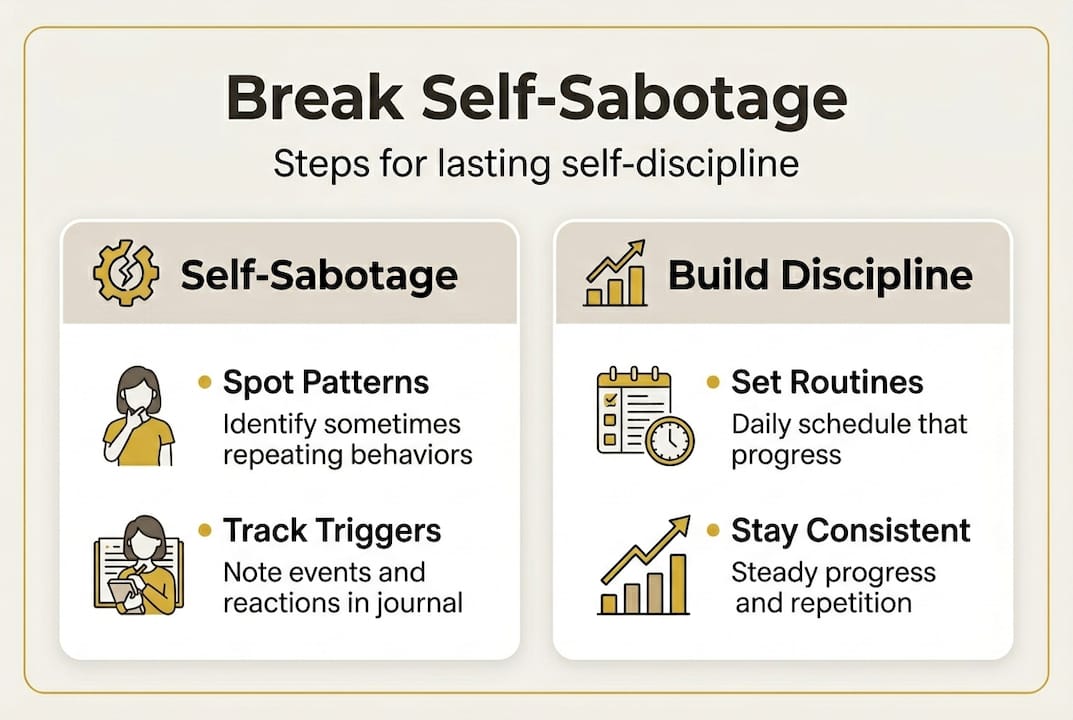
The problem is that most men try to muscle through these patterns without ever auditing them. You can't fix what you can't see. To break self-sabotage cycles, you need to identify the specific triggers that send you off track. Is it stress at work? A bad night of sleep? A social situation that drains you? These are the entry points where the cycle starts.
Here's a comparison of common self-sabotage patterns versus healthy responses:
| Self-sabotage pattern | Healthy response |
|---|---|
| Procrastinating until conditions are perfect | Starting with a 2-minute version of the task |
| Quitting after one missed day | Applying the "never miss twice" rule |
| Blaming external factors | Auditing your environment and triggers |
| Overcommitting and burning out | Setting minimum viable daily actions |
| Shame spiraling after a setback | Responding with curiosity instead of criticism |
Common signs you're in a self-sabotage loop:
- You feel motivated on Sunday night but stall by Tuesday
- You set ambitious goals and abandon them when friction hits
- You avoid starting because the conditions aren't "right"
- You punish yourself mentally after slipping, then give up entirely
Pro Tip: Start a daily log. Each time you break one of your own rules, write down what triggered it, what you felt, and what you did instead. After one week, patterns become obvious. That awareness alone changes behavior.
Essential preparation: Foundations and mindset shift
Recognizing your patterns is step one, but you can't build new routines on a shaky foundation. Before you try to stack ambitious habits, you need to get the basics right. Your prefrontal cortex, the part of your brain responsible for decision-making and impulse control, runs on sleep, real food, and movement. The science of willpower confirms that when these basics are neglected, your capacity for self-regulation tanks fast.
The self-improvement routines for men that actually stick prioritize foundations before anything advanced. Self-compassion also plays a bigger role than most men expect. Research consistently shows that treating yourself with understanding after a slip produces better long-term outcomes than self-criticism. Shame shuts down learning. Curiosity opens it up.
Minimum daily foundations you need before adding anything else:
- Sleep: 7 to 9 hours. Non-negotiable for cognitive function and emotional regulation.
- Nutrition: Eat real food most of the time. You don't need perfection, just consistency.
- Movement: 10 minutes minimum. A walk counts. The goal is to keep the chain unbroken.
Here's how "all-in" compares to a minimum viable approach:
| Habit | All-in version | Minimum viable version |
|---|---|---|
| Exercise | 60-minute gym session | 10-minute walk |
| Nutrition | Strict meal prep | One whole food meal per day |
| Sleep | Full wind-down routine | Lights out by a set time |
| Mindset work | 30-minute journaling | One sentence reflection |
Using identity-based strategies shifts the frame from "I'm trying to do this" to "this is who I am." That shift is what drives lasting behavioral change rather than another short burst of effort.
Pro Tip: Set your baseline habit to something you can do on your absolute worst day. If you can do it sick, stressed, and exhausted, it will never fully break.
The step-by-step self-discipline habit system
With your foundation in place, here's the real-world, research-driven system to lock in discipline for life. This isn't theory. These are the exact steps that routine-building for discipline research supports.
- Audit your self-sabotage. Use your daily log to find your top three triggers. Name them specifically.
- Set identity-based goals. Instead of "I want to exercise more," say "I am someone who moves every day." Identity drives action.
- Start with micro-habits. Make the habit so small it feels almost embarrassing. Tiny actions build neural pathways.
- Apply the 2-minute rule. If a habit takes less than two minutes to start, you have no excuse to skip it. Read one page. Do one pushup. Begin.
- Reduce friction through environment design. Put your gym shoes by the door. Delete apps that trigger distraction. Make the good choice the easy choice.
- Track daily with a 24-hour reset. Each day is a fresh start. Self-improvement cycles that stick use daily tracking, not weekly reviews.
- Build keystone habits. Habit automation research shows that behaviors like exercise and sleep planning trigger positive ripple effects across your whole day.
One critical stat: habits take an average of 66 days to become automatic, with a range of 18 to 254 days depending on complexity. The 21-day myth is just that. Plan for the long game.
For evidence-based self-help for discipline, implementation intentions are one of the most powerful tools available. These are "if-then" plans that remove the decision in the moment.
Pro Tip: Write your if-then plan tonight. "If it's 7am and I haven't moved yet, then I will do 10 pushups before coffee." Automate the decision before the moment arrives.
Troubleshooting: Overcoming setbacks and common pitfalls
No one is perfect. Here's what to do when discipline slips, motivation drops, or life throws you off track.

The biggest trap is all-or-nothing thinking. Perfectionism leads to quitting faster than almost anything else. One missed workout becomes "I've ruined everything" becomes two weeks off the rails. The antidote is simple: never miss twice. One miss is an accident. Two misses is the start of a new habit you don't want.
When motivation is low, don't try to feel motivated first. Act first. Motivation follows action, not the other way around.
Minimum viable actions for motivation slumps:
- Do one rep, one sentence, one minute of the habit
- Text an accountability partner instead of posting on social media
- Review your "why" list, the real reasons you started
- Change your environment, go outside, move to a different room
- Use the end self-sabotage framework to audit what's actually depleting you
"Missing a day doesn't kill your streak. Quitting does."
Track adherence honestly. Hitting 80% of your habits consistently over months is a massive win. Chronic stress and sleep deprivation genuinely deplete your capacity for self-control, so when you're running on empty, scale back rather than push harder. Overcoming excuses isn't about ignoring reality. It's about having a pre-built response ready when reality gets hard.
Respond to failure with curiosity. Ask "what happened?" not "what's wrong with me?" That question leads to data. Data leads to lasting success with discipline. Shame leads nowhere useful. Self-control research consistently supports process-based recovery over emotional punishment.
The real reason most self-discipline advice fails men
Here's our honest take: most advice for men is built on a broken model. It assumes willpower is a fixed resource you either have or don't. The classic "ego depletion" theory, the idea that self-control runs out like a battery, largely failed replication. Modern research points to motivation shifts, process strategies, and habit automation as the real drivers of consistent behavior.
Yet most guides still tell you to "try harder." That's not a strategy. That's a guilt trip dressed up as advice.
What actually works is designing your environment so the right choice is the path of least resistance, and forgiving yourself fast when you slip. We've seen men transform their consistency not by grinding harder but by removing two friction points from their morning routine and stopping the shame spiral after a bad day. Small environmental tweaks beat white-knuckling every single time.
The lasting habit cycles that stick are built on identity, systems, and self-compassion, not punishment. Experiment with what works for you. Keep what sticks. Ditch what doesn't. The man who adapts wins.
Ready for change? Make your transformation last
You now have the framework. You know how to spot self-sabotage, build your foundation, execute the system, and recover from setbacks without quitting. The next step is putting it into a structure that holds you accountable when motivation fades.

The Your Last Excuse program is built specifically for men who are done cycling through the same patterns. It combines identity-based psychology, the Forge Protocol, and practical habit systems into one focused transformation program. If you want to build discipline fast with a proven structure behind you, this is where to start. Anyone can break the old cycle. The difference is having the right system and the right support to make it stick.
Frequently asked questions
How long does it really take to build self-discipline?
On average, habits become automatic in 66 days, but the actual range is 18 to 254 days depending on the complexity of the habit and how consistently you practice it.
What should I do if I keep slipping back into bad habits?
Audit your triggers, apply the never miss twice rule, and return immediately to your minimum viable habit. Progress isn't lost unless you quit entirely.
Is willpower the key to self-discipline?
No. Modern self-control research shows that habit automation, environment design, and process strategies consistently outperform brute-force willpower.
What is a keystone habit?
A keystone habit is a small behavior, like daily exercise or sleep planning, that triggers positive improvements across multiple other areas of your life automatically.
How do I stay motivated when life gets busy or stressful?
Focus on your bare minimum daily habit, practice self-compassion, and remember that 80% adherence over months beats occasional perfection every time.