
TL;DR:
- Self-sabotage is a learned pattern that protects against failure but creates a cycle of setbacks.
- Building a personalized system and mindset shifts are essential for lasting behavior change in men.
- Effective change involves focusing on identity, environment design, and structured recovery, not just willpower.
You've tried the 5 AM routines. You've downloaded the habit tracker apps. You've made the promises on Sunday night only to break them by Wednesday. The problem isn't your effort. It's that willpower alone can't override the psychological patterns of self-sabotage that run underneath your conscious decisions. Research confirms that new behaviors take 66 days to stick, not the 21 days you've heard everywhere. This guide cuts through the noise and gives you a psychology-backed, step-by-step framework to break the cycle for good.
Table of Contents
- Understanding the roots of self-sabotage
- Laying the groundwork: Preparation and mindset shift
- Step-by-step process for lasting behavioral change
- Overcoming setbacks and solidifying your progress
- Why most guides get behavioral change wrong for men
- Ready to build your discipline? Start here
- Frequently asked questions
Key Takeaways
| Point | Details |
|---|---|
| Change takes time | Forming lasting habits averages 66 days, not the popular 21. |
| Multiple strategies win | Combining reminders, environment changes, and accountability is more effective than relying on willpower alone. |
| Setbacks are normal | Losing momentum happens—rebuild patiently and use structure to stay on track. |
| Identity shift matters | Long-term change requires deeper shifts in mindset, not just routines. |
Understanding the roots of self-sabotage
Self-sabotage is not weakness. It's a pattern. More specifically, it's a set of learned behaviors your brain uses to protect you from failure, judgment, or discomfort. The problem is that the protection mechanism becomes the cage.
For men, this pattern shows up in two particularly damaging forms. The first is self-handicapping, where you create obstacles before you even start. You stay up late the night before a big project, skip the gym before a weigh-in, or procrastinate until the deadline makes failure feel inevitable. Now you have a built-in excuse. The second is learned helplessness, where repeated setbacks convince you that effort doesn't matter. You stop trying not because you're lazy, but because your brain has concluded that trying is pointless.
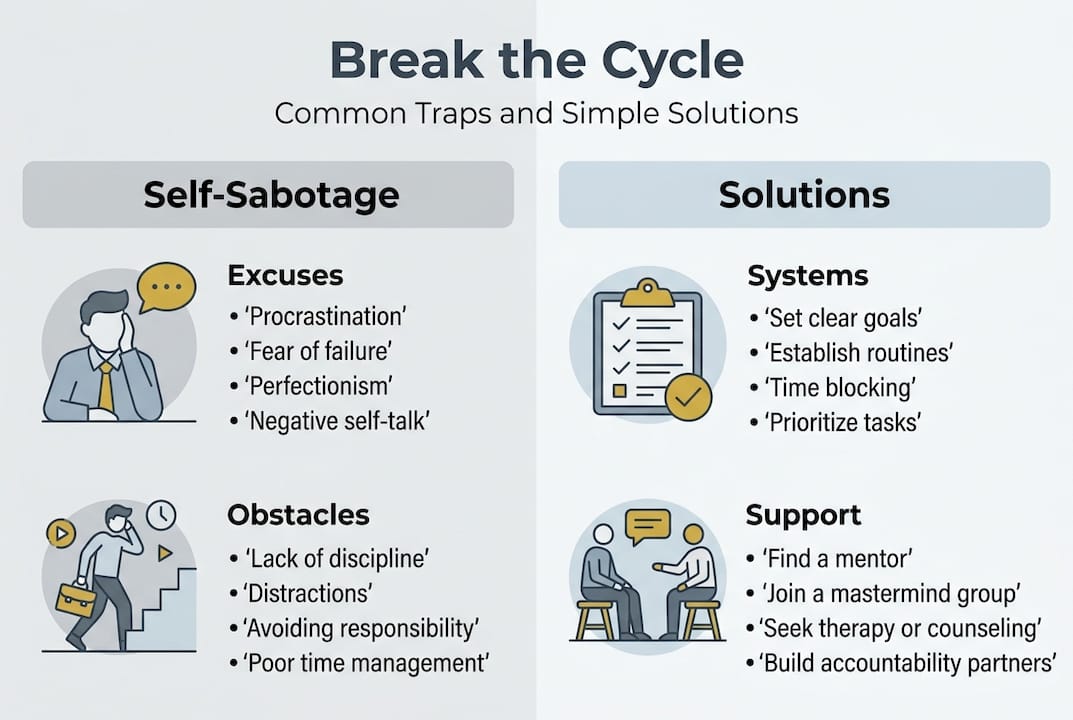
Here's what makes this dangerous for men specifically: most men are conditioned to solve problems through force and willpower. When the psychological root isn't addressed, brute-forcing change just reinforces the cycle. You push hard, collapse, feel shame, and repeat. This is what the Fluctuation Cycle looks like in practice.
Common signs you're caught in self-sabotage:
- Consistently starting strong and fading by week two
- Avoiding situations where you might be evaluated or judged
- Telling yourself you'll start "when things calm down"
- Feeling relief when a commitment falls through
- Blaming external circumstances for internal decisions
"The man who keeps failing at the same thing isn't undisciplined. He's operating from an unexamined script."
Addressing the root cause matters more than adding another strategy on top of a broken foundation. Self-improvement routines only work when the psychological soil is prepared first. Without that, you're planting seeds in concrete. The research on habit formation consistently shows that men who understand their triggers before attempting change have dramatically better outcomes than those who rely on motivation alone.
Laying the groundwork: Preparation and mindset shift
With the roots of self-sabotage in mind, it's time to lay a solid foundation before jumping into action. Most men skip this phase entirely. That's why most men fail.
The first step is an honest audit. Look at the last three times you tried to change a behavior and failed. What happened right before you quit? What was the story you told yourself? This isn't about self-criticism. It's about pattern recognition. Negative self-talk, for example, often sounds like logic. "I'm just not a morning person" or "I've always been this way" are beliefs dressed up as facts.
Setting realistic expectations is equally critical. Effective behavioral change requires using several strategies in tandem rather than relying on a single approach. The 66-day average for habit formation means you need a system that can survive bad weeks, travel, stress, and life interruptions.
Mindset shifts that actually support lasting change:
- Replace "I need to be motivated" with "I need a system"
- Replace "I failed again" with "I found another variable to adjust"
- Replace "I'll start Monday" with "I'll start with one rep right now"
- Replace "I'm not disciplined" with "I haven't built the right structure yet"
| Mindset trap | Reframe |
|---|---|
| Motivation-dependent | System-dependent |
| All-or-nothing thinking | Progress-based thinking |
| Identity fixed | Identity in progress |
| Failure = evidence I can't | Failure = data to adjust |
Environment design matters more than most men realize. Remove friction from good behaviors and add friction to bad ones. Put your workout clothes out the night before. Delete the apps that pull you into distraction. Tell one person what you're working on. These aren't tricks. They're structural changes that reduce the cognitive load required to make good decisions.

Explore identity-based strategies to understand how shifting your self-concept accelerates this process. You can also use self-reflection practices to build a clearer picture of your specific trigger patterns before you start.
Pro Tip: Focus on changing one behavior at a time. Once that behavior is stable, layer in the next. Stacking too many changes at once is one of the most reliable ways to guarantee collapse.
Step-by-step process for lasting behavioral change
With preparation set, let's break down the actual process into concrete steps that fit your psychology and lifestyle.
- Choose one target behavior. Be specific. "Get healthier" is not a behavior. "Do 20 pushups before my morning shower" is.
- Identify your triggers. What time of day, emotional state, or situation precedes the behavior you want to change? Write it down.
- Set implementation intentions. Decide in advance: "When X happens, I will do Y." This removes the need for in-the-moment willpower.
- Use environmental reminders. Place visual cues in your space. A sticky note, a set alarm, or a specific object can serve as a prompt.
- Enlist one accountability partner. Not a cheerleader. Someone who will ask you directly whether you did the thing.
- Track your streak, not your perfection. Use a simple calendar or app. The goal is to miss as rarely as possible, not to be flawless.
- Plan your recovery in advance. Decide now what you'll do when you slip. "If I miss a day, I will do a shortened version the next morning" beats improvising in a shame spiral.
Multi-strategy approaches combining goal reminders, distraction techniques, and social accountability consistently outperform single-method attempts. This is not optional. It's how behavior change actually works.
| Approach | Pros | Cons |
|---|---|---|
| Cold turkey | Fast start, clear commitment | High failure rate, no recovery plan |
| Incremental mastery | Sustainable, adapts to life | Slower visible results, requires patience |
Most men default to cold turkey because it feels decisive. Incremental mastery wins long-term. Use the science-backed steps for men to customize this process to your specific situation. Understanding lasting discipline cycles will also help you anticipate the natural dips that come around weeks three and five.
Pro Tip: Use both internal cues like your emotional state and external cues like your environment together. One without the other leaves gaps that self-sabotage will fill.
Overcoming setbacks and solidifying your progress
Even with the best plan, setbacks happen. Here's how to stay on track when life interrupts your momentum.
The biggest mistake men make after a slip is treating it as proof that they've failed. A missed day is not a broken habit. It's an interruption. The research is clear: rebuilding momentum after disruption is a normal part of the process, not an exception to it.
For men who are neurodivergent or who experience what we'd call "edge case" patterns, highly structured routines are especially important. When your brain is prone to trigger stacking, where one stressor leads to another and another until the whole system collapses, identity-based strategies and rigid environmental design become your primary defense.
Recovery strategies that actually work:
- Do a shortened version of the habit instead of skipping entirely
- Identify what caused the slip without attaching shame to it
- Return to the behavior the same day if possible, or the next morning at the latest
- Review your implementation intention and update it if needed
- Talk to your accountability partner about what happened
"Patience during interruptions is the discipline most men neglect."
The men who break self-sabotage cycles for good are not the ones who never slip. They're the ones who have a system for getting back up that doesn't require motivation to activate. Building that recovery system in advance is what separates lasting change from another failed attempt.
If you find yourself cycling through the same excuses, the problem isn't your willpower. It's your framework. Overcoming excuses requires recognizing them as symptoms of a deeper pattern, not character flaws. Self-improvement routines that account for setbacks from the start are the ones that survive contact with real life.
Why most guides get behavioral change wrong for men
Having explored strategies for recovery and momentum, let's challenge some common myths in this space.
Most behavioral change guides are written for a general audience and assume that motivation is the missing ingredient. Add a morning routine, journal more, think positive. This advice isn't wrong. It's just incomplete in a way that specifically fails men.
What's missing is identity. You don't just need better habits. You need to become the kind of man for whom those habits are natural. That's a different project entirely. It requires confronting the story you've been telling yourself about who you are and whether you're capable of change.
The second thing most guides miss is psychological safety. Men are less likely to ask for help, less likely to admit a plan isn't working, and more likely to white-knuckle through failure until they burn out. A good system builds in self-forgiveness structurally, not as a motivational afterthought.
The real insight is this: it's not willpower, it's system power. Willpower is a depleting resource. Systems run on structure. Exploring personal reinvention strategies will show you how to build the kind of flexible, adaptive system that holds up when life gets hard, which it always does.
Ready to build your discipline? Start here
Putting all this into action can be easier with expert support.

If you've read this far, you already know that information alone isn't the problem. You need a structured system built around your psychology, not generic advice recycled from productivity blogs. Jace Halden's discipline guide at YourLastExcuse.com gives you exactly that. The Identity Shift System is designed specifically for men who are done cycling through failed attempts and ready to build something that actually holds. Tools, frameworks, and a clear protocol are waiting for you. The next step is yours to take.
Frequently asked questions
How long does it really take to form a lasting new habit?
Research shows it takes an average of 66 days for a new behavior to become automatic, not the 21 days most people have heard. The timeline varies by person and behavior complexity.
What are the most effective strategies to stop self-sabotage?
Combining multiple strategies like environmental design, goal reminders, and social accountability is far more effective than relying on a single method or willpower alone.
What should I do if I lose momentum or slip up?
Restart as quickly as possible, ideally the same day, and use a pre-planned recovery protocol. Rebuilding after setbacks is a normal part of the process, not a sign of failure.
How do I know if my approach is working for me?
Track how often setbacks occur over time. If slips are becoming less frequent and recovery is getting faster, your system is working even when it doesn't feel like it.