
TL;DR:
- Willpower is unreliable because it draws from a depletable resource, affected by stress and fatigue.
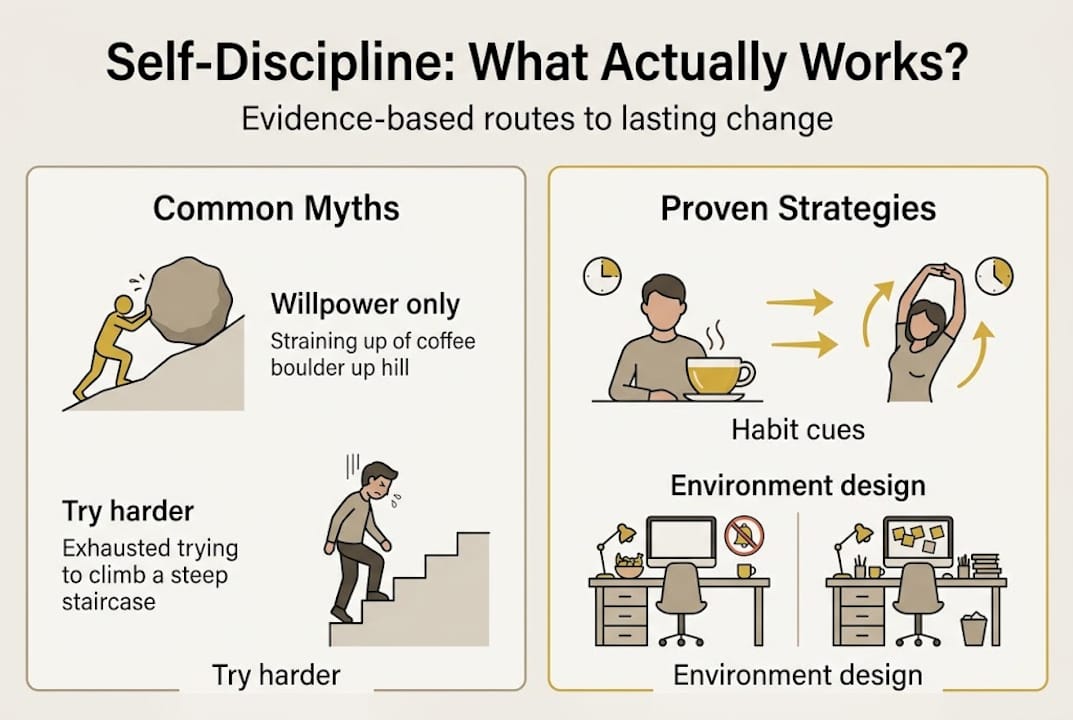
- Successful men focus on habits, environment design, and identity shifts rather than sheer willpower.
- Building systems and modifying environments are more effective for lasting discipline than relying on motivation alone.
Most men believe self-discipline is a character trait you either have or don't. They grind harder, chase motivation, and white-knuckle their way through bad habits, only to collapse weeks later wondering what's wrong with them. Nothing is wrong with you. The problem is the strategy. Willpower is unreliable because it draws from a depletable resource, not a fixed strength. This article breaks down exactly why conventional discipline advice backfires, what the latest science actually says, and the practical frameworks that produce real, lasting change for men who are done repeating the same cycles.
Table of Contents
- Why willpower and motivation always break down
- The myth and controversy of ego depletion
- What people with real self-discipline do differently
- Practical strategies to override self-sabotage
- The uncomfortable truth about lasting discipline
- Take the next step to sustainable self-discipline
- Frequently asked questions
Key Takeaways
| Point | Details |
|---|---|
| Willpower is unreliable | Science shows relying on motivation and grit alone usually fails when building discipline. |
| Habits and systems win | Men who sustain self-discipline use environment design and routines—not constant effort. |
| Ego depletion debate | Recent research says ego depletion may be less important than mindset and process models. |
| Multiple strategies work | Combining techniques like habit-building and situation modification best resists temptation. |
| Identity and self-care matter | Lasting discipline requires reframing self-control as growth, not punishment. |
Why willpower and motivation always break down
Here's something nobody tells you when you're pumped up on a Sunday night ready to change your life: that energy has an expiration date. Motivation is an emotional state, not a personality trait. It rises and falls based on sleep, stress, mood, and a dozen other variables you can't control. Building your discipline on motivation is like building a house on sand.
Willpower operates the same way. Think of it like a phone battery. Every decision you make, every temptation you resist, every stressful meeting you sit through drains it. By 7 PM, you're running on 12%, and that's exactly when the old habits kick back in. This is why self-discipline fails under stress, poor sleep, emotional load, and decision fatigue. It's not weakness. It's biology.
"Relying on willpower to sustain behavior change is like relying on holding your breath to survive. You can do it for a while, but eventually, you have to breathe."
The research backs this up hard. Motivation fluctuates in ways that make it fundamentally unreliable for building lasting habits. Men who understand this stop blaming themselves for "lacking discipline" and start building smarter systems instead. That shift alone is the beginning of breaking self-sabotage for good.
Here's what drains willpower fastest:
- Decision fatigue: Every choice you make, big or small, costs mental energy
- Poor sleep: Even one bad night cuts self-control significantly
- Chronic stress: Cortisol actively undermines the brain's ability to regulate impulses
- Emotional exhaustion: Suppressing feelings takes the same mental fuel as resisting temptation
- Low blood glucose: Physical energy and mental self-control are directly linked
The path to lasting self-discipline success doesn't run through more grit. It runs through understanding why your current approach keeps failing, and replacing it with something that actually works with your brain instead of against it.
The myth and controversy of ego depletion
For decades, the dominant theory in psychology was called ego depletion. The idea was simple: self-control draws from a limited mental resource, like glucose in the brain, and once it's used up, your ability to resist temptation collapses. Roy Baumeister's original 1998 studies became some of the most cited in all of psychology. Every productivity book, every discipline coach, every self-help program built on this foundation.
Then the cracks appeared.
Large-scale replication studies began failing. Researchers found ego depletion effects near zero when they ran the same experiments more carefully, with bigger samples and better controls. The explanation shifted: what looks like resource depletion might actually be motivation shifts or general fatigue, not a finite mental fuel running dry.
| View | Core claim | Current status |
|---|---|---|
| Original ego depletion | Willpower is a finite resource | Heavily disputed |
| Replication critics | Effect is near zero or motivation-based | Growing support |
| Baumeister's defense | Replicable with proper methods | Ongoing debate |
| Process models | Mindset and motivation drive outcomes | Gaining traction |
Baumeister himself pushed back hard, arguing the theory remains replicable when studies are designed correctly. Critics say the original findings were fragile and that mindset beliefs, not a depleting resource, explain the results. If you believe willpower is limited, it behaves as if it's limited. That's a fundamentally different problem.
What does this mean for you practically? The psychology of self-sabotage is more complex than a gas tank running empty. Your beliefs about your own capacity matter enormously. Men who think "I'm just not a disciplined person" create a self-fulfilling prophecy. Men who focus on process over grit tend to outlast everyone else.
The science-backed steps that emerge from this debate point clearly toward one thing: stop trying to manage your willpower like a resource and start designing systems that require less willpower in the first place.
"The most disciplined people aren't fighting their impulses harder. They're engineering their lives so the fight happens less often."
What people with real self-discipline do differently
Here's the counterintuitive truth: men with high trait self-control don't actually feel like they're exerting more effort. Studies show that high self-control individuals succeed through habits, environment design, and intrinsic motivation, not through grinding harder or resisting more temptations. They experience fewer internal conflicts because their lives are structured to minimize them.

That's the real secret. They're not stronger. They're smarter about setup.
Habits are essentially automatic self-control. When a behavior becomes habitual, it no longer requires conscious decision-making or willpower. It just happens. Habits take an average of 66 days to form, and routines consistently outperform raw willpower for sustaining behavior over time. The first two months are the investment. After that, the system runs itself.
| Strategy | Willpower required | Long-term effectiveness |
|---|---|---|
| Pure motivation | Very high | Low |
| Environment design | Low | High |
| Habit stacking | Low after formation | Very high |
| Identity shift | Medium upfront | Very high |
Here's what disciplined men actually do:
- Remove friction: They make the good choice the easy choice by physically restructuring their environment
- Stack habits: They attach new behaviors to existing ones so routines build automatically
- Protect energy: Sleep, food, and stress management are non-negotiable because they know performance depends on it
- Build identity: They think of themselves as the type of person who does X, not someone trying to do X
- Use discipline routines for men: Consistent structure reduces the number of decisions they face daily
Pro Tip: Audit your environment before you audit your motivation. Move the junk food out of sight. Put your gym bag by the door. Set your phone to charge in another room. Small structural changes reduce the number of times you need willpower at all, and that's where lasting discipline cycles actually begin.
Practical strategies to override self-sabotage
Knowing why discipline fails is useful. Having a system to replace it is what actually changes your life. Here are the strategies that research consistently supports.
- Situation modification: Change your environment before temptation appears. Research on resisting desires shows that situation modification is the most effective strategy for edge cases where habits haven't formed yet. Don't trust yourself in the moment. Change the situation before the moment arrives.
- Goal reminders: Write your goals where you'll see them. Visual cues activate goal-relevant behavior automatically, without conscious effort.
- Strategic distraction: When a craving or urge hits, redirect attention to something absorbing. The urge passes faster than most men expect, usually within 10 to 20 minutes.
- Habit stacking: Attach a new behavior to an existing one. "After I pour my morning coffee, I will open my journal." The existing habit becomes the trigger.
- Energy management: Practical discipline strategies consistently point to sleep and stress reduction as foundational. No system works well on an exhausted brain.
- CBT and DBT frameworks: For men dealing with deep self-sabotage patterns, cognitive behavioral therapy and dialectical behavior therapy address the root fears and beliefs driving the behavior, not just the surface symptoms.
Pro Tip: Don't pick one strategy and hope it holds. The multi-strategy approach consistently outperforms single tactics. Stack situation modification with habit building and energy management together, and you create a system that covers your weak points.
Here's what to focus on when building your system:
- Reframe discipline as self-care, not punishment. Men who see discipline as something they do for themselves sustain it longer.
- Address the root fear, not just the symptom. If you keep sabotaging your diet, ask what emotional need the food is meeting.
- Use habits that drive success as your foundation, then layer in motivation when it shows up as a bonus.
- Build positive habit strategies around your natural energy peaks, not against them.
The uncomfortable truth about lasting discipline
Most discipline advice is built on a broken model. It tells you to want it more, push harder, and find your "why." That works for about two weeks. Then life happens, motivation drops, and you're back at square one wondering why you can't just stick to anything.
Here's what we've seen work, not in theory but in practice: men who succeed long-term stop chasing motivation and start engineering their environment and identity. They stop asking "how do I get more willpower?" and start asking "how do I need less of it?"
The ego depletion debate matters here. Whether Baumeister's model is right or wrong, the practical takeaway is the same. Stop treating willpower as your primary tool. Build systems. Redesign your environment. Shift your identity. The men who crack this aren't the ones with the most grit. They're the ones who stopped relying on grit and built a life where grit is rarely needed. That's what developing self-discipline skills actually looks like when it's done right.
Take the next step to sustainable self-discipline
You now have a clearer picture of why discipline breaks down and what actually builds it. The next step is applying these principles in a structured way, with a system designed specifically for men who are tired of cycling through the same patterns.

The Your Last Excuse program is built around the exact psychology covered in this article: identity-based change, environment design, and root-cause transformation. If you're ready to stop relying on motivation and start building something that holds, explore the identity-based strategies that have helped men break their self-sabotage cycles for good. This isn't motivational content. It's a system built to work when motivation doesn't show up.
Frequently asked questions
Why does my willpower seem strong some days but vanish the next?
Willpower draws from a depletable resource that fails under stress, poor sleep, and decision fatigue, making it naturally inconsistent from day to day. Building systems and habits reduces how much you rely on it.
How can I build self-discipline that lasts longer than a few weeks?
Shift your focus from motivation to habit formation. Habits form in about 66 days on average and sustain behavior far more reliably than motivation or willpower alone.
Is ego depletion still a valid explanation for failing discipline?
It's heavily contested. Large replications found near-zero effects, with researchers now pointing to motivation shifts and mindset beliefs as bigger drivers than a finite mental resource.
What strategies do successful men use to resist temptation?
They combine situation modification, goal reminders, distraction, and habit-building rather than relying on any single tactic. The multi-strategy approach consistently outperforms willpower alone.
How can I stop sabotaging myself when trying to change?
Address the root cause, not just the behavior. Reframing discipline as self-care and using CBT or DBT frameworks to tackle underlying fears produces more lasting results than pushing harder through motivation.