
TL;DR:
- Willpower is ineffective; lasting change depends on environment, identity, and habit design.
- Habit formation takes longer than 21 days, typically around 66 days, requiring patience.
- Behavior change is easier when habits align with your identity and are supported by positive emotions.
Most men have tried to change. They've set goals, built routines, pushed hard for weeks, and then watched it all fall apart. 80% of resolutions are abandoned by February, and the frustrating part is that failure rarely comes from laziness or lack of desire. The real problem runs deeper, sitting in your brain's wiring, your environment, and your sense of identity. This guide breaks down the science of why change rarely sticks, what self-sabotage actually looks like at a neurological level, and what you can do differently starting now.
Table of Contents
- Why willpower fails: The science behind self-sabotage
- The real mechanism: How habits form and break
- Misunderstood timelines: How long does change really take?
- Psychological barriers: Why we resist lasting change
- What most men miss about lasting transformation
- Next steps: Start your journey with science-backed guidance
- Frequently asked questions
Key Takeaways
| Point | Details |
|---|---|
| Willpower isn’t enough | True change relies on systems, not raw self-control. |
| Habits drive behavior | Nearly half of daily actions are habits triggered by cues and rewards. |
| Change takes time | Building new habits can range from 18 to 254 days, so patience is essential. |
| Self-acceptance matters | Belief change only sticks when backed by psychological safety and self-acceptance. |
| Relapse is normal | Falling off track isn’t failure; it’s part of establishing lasting change. |
Why willpower fails: The science behind self-sabotage
Here's the thing most guys get wrong: they treat willpower like a muscle you build by forcing yourself through pain. Push harder, resist longer, white-knuckle it until the new behavior becomes automatic. But that model is broken, and the science is clear about it.
The old idea of "ego depletion," the theory that willpower runs out like battery life, has been largely discredited. Large-scale studies found negligible evidence that willpower is a depletable resource in the way we assumed. And yet, why motivation fails men isn't because they're weak. It's because they're relying on the wrong tool entirely.
Self-sabotage isn't a character flaw. It's your brain defaulting to familiar reward patterns, especially under stress. When your environment doesn't change and your identity stays the same, your brain drags you back to old behavior. That's not weakness. That's neuroscience.
"Willpower isn't the issue. The real barrier is that most men are trying to override deeply wired reward systems with sheer force, and the brain always wins that fight."
Here are the most common self-discipline pitfalls men fall into:
- Relying on motivation instead of systems
- Expecting linear progress when change is naturally non-linear
- Treating a single slip as proof of failure
- Setting goals without redesigning the environment
- Skipping the identity work that makes new behavior feel natural
The most damaging myth? That slipping once means you've failed. Behavioral research is consistent: resolutions fail at an 80% rate not because men lack drive, but because the approach itself is flawed. One bad day doesn't erase your progress. It's a data point, not a verdict.
The real lever for change isn't force. It's design. And that starts with understanding how habits actually work.
The real mechanism: How habits form and break
Your brain runs on efficiency. It doesn't want to consciously evaluate every decision, so it creates shortcuts. These shortcuts are habits, and they follow a predictable loop: cue, routine, reward. A trigger fires, you run a behavior automatically, and your brain receives a chemical signal that it did the right thing.

This loop is why habits drive roughly 40 to 43% of your daily behaviors without conscious thought. You're not deciding most of what you do. You're executing patterns.
The cue-routine-reward system is also why most change attempts collapse. Men try to add new behaviors without redesigning the cues or creating real rewards. No cue, no trigger. No reward, no reinforcement. The brain files the new behavior as optional and eventually drops it.
Here's a quick look at what separates habits that stick from ones that fall apart:
| Element | Successful habits | Failed habits |
|---|---|---|
| Cue | Clear, consistent trigger | Vague or inconsistent |
| Routine | Specific and simple | Too complex or undefined |
| Reward | Immediate and meaningful | Delayed or absent |
| Environment | Designed to support | Default or distracting |
| Identity fit | Aligned with self-image | Feels foreign or forced |
Typical triggers men face include end-of-work stress that drives them to unwind with junk food, social pressure to drink or disengage, and home environments loaded with distractions. These aren't personal failures. They're environmental forces that need to be restructured, not resisted.
According to habit formation research, the key steps to break bad cycles are:
- Identify the specific cue that fires the old behavior
- Replace the routine while keeping the same cue
- Build in an immediate reward that your brain actually wants
- Modify your environment to reduce friction for the new habit
- Repeat consistently until the loop becomes automatic
Pro Tip: Stack new habits onto existing cues. If you already make coffee every morning, attach a five-minute journaling or planning session directly after. Your brain links them together faster than you'd expect.
Misunderstood timelines: How long does change really take?
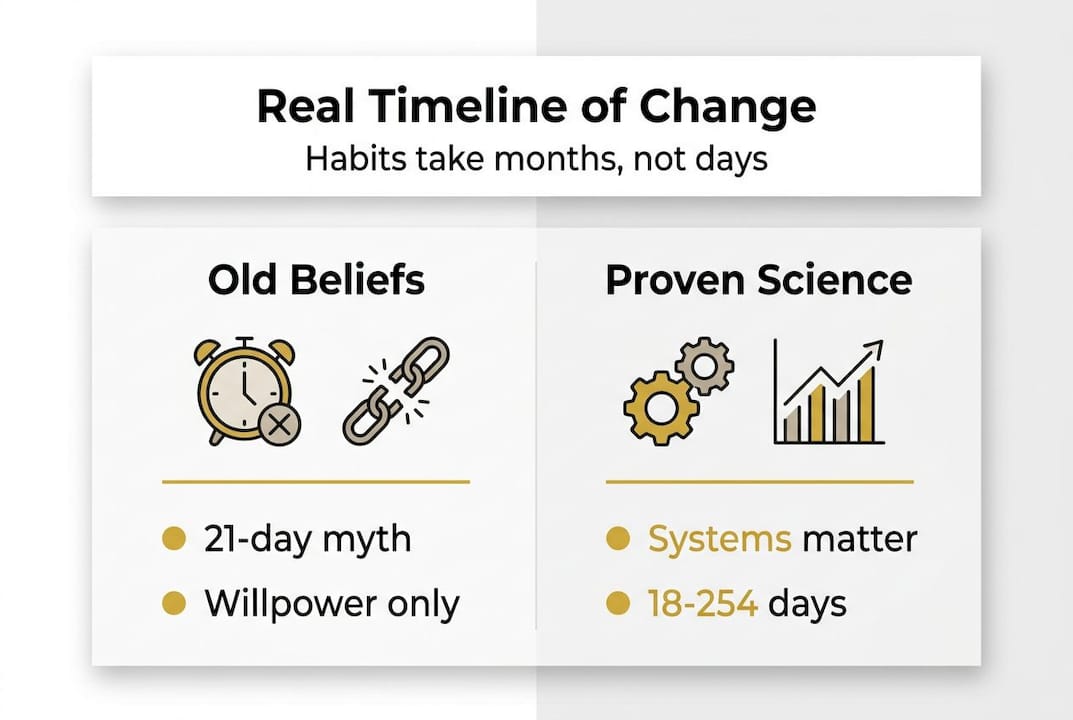
You've heard it before. "It takes 21 days to build a habit." That number is everywhere, and it's completely made up. Or rather, it's a misquote from a 1960s plastic surgeon who noticed patients took about three weeks to adjust to seeing their new face in the mirror. It was never about behavioral change.
Real data tells a different story. Habit formation actually takes anywhere from 18 to 254 days depending on the person and the complexity of the behavior. The average lands around 66 days, more than three times what most programs promise.
| Habit type | 21-day myth | Real research range |
|---|---|---|
| Simple (e.g., drinking water) | Done by day 21 | 18 to 40 days |
| Moderate (e.g., daily exercise) | Done by day 21 | 50 to 90 days |
| Complex (e.g., diet overhaul) | Done by day 21 | 100 to 254 days |
This matters because most men quit before the habit has actually formed. They hit day 30, feel like it should be automatic by now, notice it still feels hard, and conclude they're broken. They're not. They're just ahead of a process that takes longer than anyone told them.
Research on behavior change also shows that stage-based and non-stage-based interventions produce similar success rates, which means the specific program matters less than your ability to stay consistent through the discomfort phase.
Here's how to build real staying power:
- Track consistency, not perfection. Use a simple calendar and mark each day you execute.
- Expect the behavior to feel difficult for weeks longer than you planned.
- Define what "good enough" looks like for days when you're depleted.
- Review your lasting change strategies weekly and adjust the cue or reward if momentum stalls.
- Use personalized habit tracking methods that match your specific behavioral complexity.
Missing a day doesn't reset the clock. Research consistently shows that a single missed day has minimal impact on long-term habit formation. What breaks habits isn't one bad day. It's the story you tell yourself about that day.
Psychological barriers: Why we resist lasting change
Here's where most programs stop short. They give you the mechanics and ignore the inner game. But behavioral science is direct: lack of self-acceptance and psychological safety are major blockers to lasting change. When you're fighting your own beliefs about who you are, the brain treats change as a threat.
Your beliefs didn't form randomly. They were shaped by experience and reinforced over years. Fighting them directly creates resistance. The smarter move is building psychological safety around the new behavior, making it feel less like a threat and more like an experiment.
Signs you're fighting old beliefs instead of creating space for new ones:
- You set aggressive goals but feel paralyzed before starting
- You succeed for a few weeks, then unconsciously sabotage progress
- New habits feel fake or unsustainable, like you're performing a role
- You return to old behavior after stress without understanding why
- Setbacks feel like they confirm something negative about who you are
This is where identity-based approaches become critical. When a new habit aligns with who you believe you are, it stops feeling like effort and starts feeling natural. A man who believes he's "someone who trains" doesn't negotiate with himself about going to the gym. It's just what he does.
Psychological safety in the context of behavior change means your brain isn't treating the new behavior as dangerous or unfamiliar. This is also tied to hyperbolic discounting, where the brain overvalues immediate comfort over future reward. Building small, immediate wins into your habits counteracts this pull.
"The men who change are not the ones who push hardest. They're the ones who make the new identity feel safe enough to live in."
Pro Tip: Frame every new habit as an experiment, not a test of your character. "I'm testing whether daily walks reduce my stress" removes the self-judgment that kills momentum. You're not proving you're good enough. You're gathering data.
What most men miss about lasting transformation
Conventional self-improvement culture tells men to grind harder, wake up earlier, and discipline their way through discomfort. There's value in that. But here's the part nobody says out loud: relentless force burns out the very energy system you need to sustain change.
The men who actually transform aren't the ones who white-knuckle every craving. They're the ones who design a life where the new behavior becomes easier than the old one. They make it enjoyable, manageable, and connected to something they actually value.
Building enjoyment into a new routine isn't weakness. It's strategy. Your brain consolidates behaviors faster when they carry positive emotion. Micro-habits, tiny versions of the behavior you want, prime the neural pathway without triggering resistance.
Slipping isn't failure. It's information. The question isn't "why did I fall off?" but "what does this tell me about my cues, rewards, or environment?"
Lasting transformation is less about force and more about identity, design, and making peace with being imperfect along the way. Practical self-discipline skills aren't about becoming a machine. They're about becoming someone who no longer needs to fight himself.
Next steps: Start your journey with science-backed guidance
If you've been running the same cycle of motivation, collapse, and shame, the issue isn't your effort. It's the system you're using. Real change takes the right framework, not more willpower.
Your Last Excuse is built specifically for men who are done with half-measures. The Identity Shift System combines behavioral psychology and cognitive restructuring to help you rewire the patterns driving your self-sabotage at the root. If you want to stop negotiating with yourself every morning and start building routines that actually hold, explore the tools designed for exactly that. You can also start with practical guidance on how to build discipline fast and build real momentum from day one.
Frequently asked questions
Why do I always fall back into old habits even after making progress?
Falling back happens because lasting change requires rewiring the full cue-routine-reward loop, not just boosting motivation. When key elements are missing from your habit design, relapse is almost inevitable.
Is it true that it takes 21 days to change a behavior?
No. Research shows habit formation ranges from 18 to 254 days depending on complexity, with the average sitting around 66 days, more than triple the popular myth.
Does having more willpower guarantee lasting change?
No. Studies show willpower is not depleting in the way we thought. Lasting change depends on systems, environment design, and identity alignment, not raw force of will.
How can I make sure I'm not sabotaging my own efforts?
Design habits with a clear cue, an immediate reward, and a link to your core identity. Identity-aligned habits feel natural rather than forced, which dramatically reduces self-sabotage.
Is relapse a sign I can't change?
Absolutely not. Relapse is part of the behavior change process for most people. Consistency over time matters far more than a perfect streak.