
TL;DR:
- Lasting change occurs when behaviors become natural parts of your self-identity.
- Relapse is normal; focus on reinforcing identity and recovering quickly.
- Practical steps include starting small, tracking progress, and building habits onto routines.
Most men trying to change their lives are solving the wrong problem. They adjust their diet, join a gym, or white-knuckle through a productivity challenge—then wonder why it falls apart by week three. The real issue isn't effort or strategy. It's identity. Identity-based habits create lasting results because your actions start to match who you believe you are, not what you're forcing yourself to do. This article breaks down exactly why identity-driven change works, how psychology backs it up, and what practical steps you can take to make the shift permanent.
Table of Contents
- Defining permanent lifestyle change
- The science behind lasting change: Transtheoretical Model and identity
- Building permanent change: Practical steps that work
- Overcoming setbacks: Relapse, support, and sustaining identity
- Why most men underestimate true lifestyle change
- Take the next step in your transformation
- Frequently asked questions
Key Takeaways
| Point | Details |
|---|---|
| Identity over willpower | Permanent change sticks when new habits reflect your core self-view, not just goals or discipline. |
| Relapse is normal | Expect setbacks but treat them as learning experiences, not failures. |
| Small steps matter | Start with tiny, manageable changes, then grow your wins for long-term success. |
| Support accelerates results | Accountability partners or mentors make transformation more resilient and lasting. |
Defining permanent lifestyle change
Permanent lifestyle change is not about hitting a goal and maintaining it through grind. It's about reaching a point where the new behavior feels natural, like breathing. You don't have to talk yourself into the gym when going to the gym is simply what you do. That's the core shift.
The difference between temporary and permanent change comes down to your self-concept. When you see yourself as "a disciplined person," you make decisions that match that image, especially under stress, when old patterns want to resurface. Outcome goals (lose 20 pounds, save $500) create temporary pressure. Identity goals (I am someone who treats my body well) create a new internal standard.
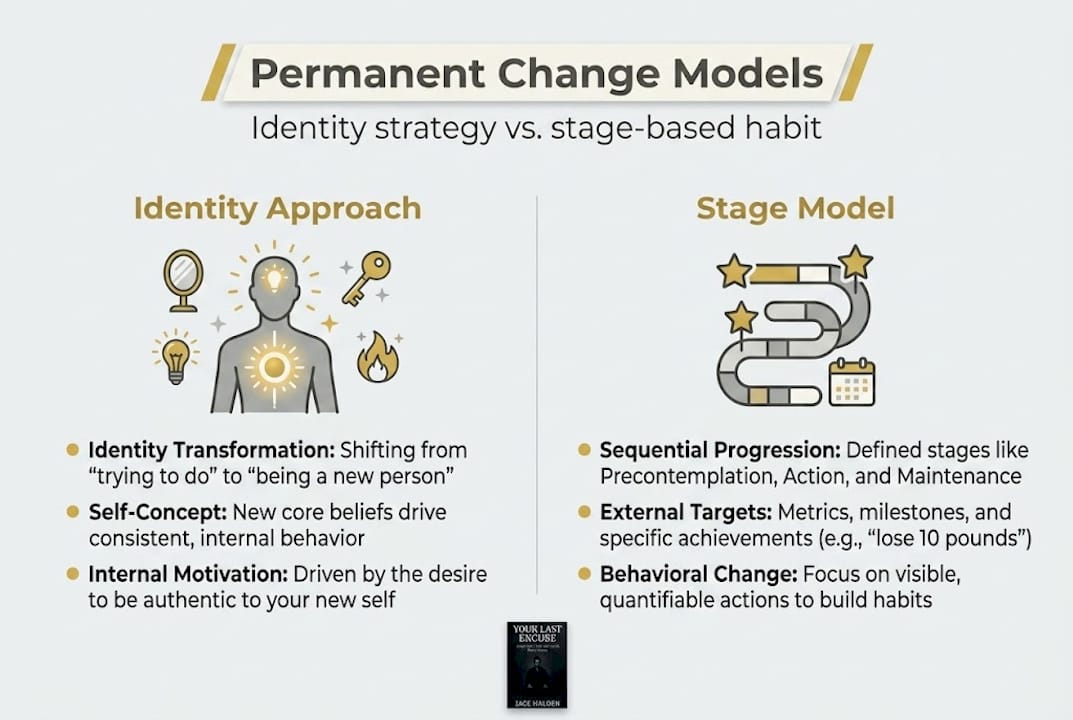
Permanent change involves shifting from behavior modifications you force yourself through to habits that align with a new self-concept. That's a fundamentally different mechanism than willpower.
Here's what identity-based change actually looks like in practice:
- You stop negotiating with yourself about whether to follow through
- Healthy behaviors become defaults, not decisions requiring effort
- Setbacks feel like exceptions, not confirmations of who you really are
- Your environment and choices start to reflect the person you're becoming
"The goal is not to read a book, the goal is to become a reader. Not to run a marathon, but to become a runner." Identity IS the strategy.
Using identity-based strategies consistently creates the internal pressure that external goals never can. And if you've been trapped in lasting discipline cycles that loop back to collapse, this is the layer you've been missing.
The science behind lasting change: Transtheoretical Model and identity
Psychology has studied behavior change for decades, and one model has held up better than most: the Transtheoretical Model, or TTM. It maps the stages people move through when changing a behavior.
The TTM outlines six stages: Precontemplation (not aware of a problem), Contemplation (aware but not acting), Preparation (getting ready), Action (actively changing), Maintenance (sustaining change past six months), and Termination (no risk of relapse). Most men start at Action without preparing the identity foundation. That's why they stall.
Here's how the two dominant frameworks compare:
| Feature | TTM (Staged Model) | Identity-Based Model |
|---|---|---|
| Core mechanism | Stage-by-stage progression | Self-concept alignment |
| Strength | Tracks where you are in the process | Builds intrinsic motivation |
| Weakness | Can miss the "why" behind relapse | Requires inner belief shift |
| Best use case | Mapping your progress clearly | Creating long-term resilience |
| Handles relapse | Expects and accounts for it | Reframes relapse as identity inconsistency |
Here's something most people don't know: relapse during maintenance is expected, not a sign that you've failed. The TTM treats it as a normal part of the cycle, not the end of the road.
To stack both frameworks, work through these stages with identity in mind:
- Identify which TTM stage you're in right now, honestly
- Name the identity you need to build to reach Termination
- Use the Action stage to collect evidence that the new identity is real
- In Maintenance, reinforce identity daily, not just behavior
A behavioral change guide can help you work through these stages systematically. And if you want the broader picture, start with a solid personal reinvention guide before diving into tactics.
Building permanent change: Practical steps that work
Frameworks are only useful when you can actually apply them. Here's a step-by-step approach rooted in what research and real-world results show actually moves the needle.
Practical methodologies for lasting change include starting small, mapping out concrete steps, tracking behavior, and treating every slip as useful information rather than moral failure. That's not just motivational talk. It's the method.
- Pick one behavior to anchor your identity to. Don't overhaul everything. Choose the single behavior that most represents the person you want to become.
- Break it into the smallest measurable action. If you want to become someone who trains consistently, start with ten minutes, not an hour-long program.
- Stack it onto an existing routine. After your morning coffee, you train. After work, you review your goals. Use habit change strategies to build these chains intentionally.
- Track it visibly. A simple checklist or app keeps you honest and shows you evidence that the identity is forming.
- Get accountability. A training partner, mentor, or group creates social stakes that make showing up easier.
- When you slip, review, don't punish. Ask: what triggered the relapse? Adjust the environment, not your self-worth.
Understanding how habits and self-sabotage interact is key here. Most slips aren't random. They're triggered. And when you build discipline routines around identity rather than willpower, the routines protect you when motivation disappears.

Pro Tip: Stack a new habit onto something you already do automatically, like brushing your teeth or making coffee. This removes the friction of starting from zero and helps the new behavior feel less foreign faster.
It also helps to break self-sabotage habits at the environmental level. If your environment keeps pulling you back to old patterns, the best mindset work in the world won't hold.
Overcoming setbacks: Relapse, support, and sustaining identity
Even men who build solid foundations hit walls. That's not a flaw in the method. It's part of the process.
Relapse is a normal part of the cyclical nature of lasting change, not a verdict on your character. The men who make it aren't the ones who never slip. They're the ones who know how to recover fast.
Here's what common setbacks look like, and how to respond:
| Setback | Effective response | Emotional pattern |
|---|---|---|
| Missed workouts for a week | Review triggers, restart with one session | Frustration, then relief |
| Returned to old diet | Identify emotional trigger, plan meals ahead | Shame, then resolve |
| Skipped accountability check-ins | Reconnect with partner, lower the threshold | Avoidance, then re-engagement |
| Negative self-talk spiral | Identity journaling, talk to a mentor | Anxiety, then clarity |
Support accelerates recovery. When you're accountable to someone who understands your goals, slipping silently becomes harder. And evidence-based digital self-help resources can fill the gap when in-person coaching isn't available.
It's also worth knowing that clusters of healthy behaviors, like diet, exercise, and sleep combined, measurably reduce depression and anxiety symptoms. When one area slips, it pulls the others. When one area holds, it stabilizes the rest.
Mental shifts to keep your identity intact after a slip:
- "I had a bad day, not a bad identity"
- "This is data, not a verdict"
- "Every person I admire has been exactly here"
- "The response matters more than the slip"
Pro Tip: Redesign your environment to make your old triggers harder to access. If you drink too much when you keep alcohol in the house, don't keep alcohol in the house. Simple friction is more powerful than most mental strategies.
Why most men underestimate true lifestyle change
Here's the hard truth: most men approach permanent change the same way they approach a sprint. They go hard for two weeks, hit a wall, collapse, and interpret that collapse as evidence they're not built for this. That's not a discipline problem. That's a misunderstanding of what the process actually requires.
Real change is uncomfortable at first because it feels inauthentic. You're acting like a person you haven't fully become yet. That gap is supposed to feel weird. Most men mistake that discomfort for a signal to quit when it's actually a signal that the identity is being built.
The other trap is the relapse spiral. You slip, you punish yourself, that punishment tanks your self-image, and a damaged self-image produces more self-sabotaging behavior. Round and round it goes. A self-discipline guide can help you see the pattern clearly, but recognizing it isn't enough. You have to replace it with identity-level accountability.
"Change is not an act, it's a shift in being."
The men who actually make it don't find a magic hack. They get tired of their excuses before they get tired of the work. That's the real turning point.
Take the next step in your transformation
You now understand why identity is the engine of lasting change, and why willpower-only approaches keep men stuck in the same loop. But knowing this is only half the equation.
The Jace Halden program at Your Last Excuse is built specifically for men who are done with short cycles and want the psychological infrastructure for permanent change. The Identity Shift System and The Forge Protocol walk you through the exact identity-level rewiring that turns discipline from a struggle into a default. If you're ready to stop cycling through motivation and collapse, the tools and community waiting for you there will meet you where you are.
Frequently asked questions
How long does it take to achieve permanent lifestyle change?
Research shows the Maintenance stage begins after six months of consistent action, but true Termination, where relapse is no longer a real risk, takes longer and varies by person.
What if I relapse while trying to change?
Relapse is an expected part of the change cycle. Relapse is not failure according to the TTM framework—it's a signal to analyze triggers and re-engage with your identity.
Can identity-based change help with self-sabotage?
Yes. When identity aligns with habits, positive behaviors feel natural rather than forced, which is what breaks the self-sabotage loop at its root.
How do I stay consistent after initial motivation fades?
Support and identity anchoring are the two most effective tools once early motivation drops. Track your behavior, stay accountable, and keep reinforcing who you're becoming, not just what you're doing.