
TL;DR:
- Self-sabotage in men stems from neurobiological patterns like avoidant attachment and habenula activation.
- Building habits with 80% adherence and shifting self-identity creates lasting change.
- Addressing underlying psychological roots and using structured routines outperform willpower-based methods.
You've set the goal, felt the fire, and then watched yourself quietly undo every bit of progress you made. Not once. Repeatedly. Most men assume this is a willpower problem, but the science says otherwise. Self-sabotage is a deeply wired psychological and neurobiological pattern, not a character flaw. This guide breaks down the real roots of self-destructive behavior in men aged 25 to 45, then walks you through a step-by-step system for auditing your patterns, building bulletproof routines, and shifting your identity at the level where permanent change actually happens.
Table of Contents
- Understand the roots of self-sabotage in men
- Audit your patterns and reframe automatic negative thoughts
- Build discipline with 80% adherence routines
- Shift your identity: Small winning promises
- What most guides get wrong about transformation
- Next steps: Get expert support for lasting change
- Frequently asked questions
Key Takeaways
| Point | Details |
|---|---|
| Root causes matter | Lasting change starts with understanding why you self-sabotage, not just fixing behaviors. |
| 80% beats perfection | Focusing on consistent routines outperforms all-or-nothing thinking for discipline. |
| Small wins shift identity | Setting and keeping tiny promises rewires your story faster than brute willpower. |
| Mindset trumps grit | Iterative, compassionate self-correction creates real momentum and resilience. |
| Support accelerates growth | Science-backed coaching and community often make the difference for long-term results. |
Understand the roots of self-sabotage in men
Before mapping actionable steps, ground your understanding in why change attempts typically break down. Most self-help advice skips this entirely, jumping straight to morning routines and cold showers. That's why it fails.
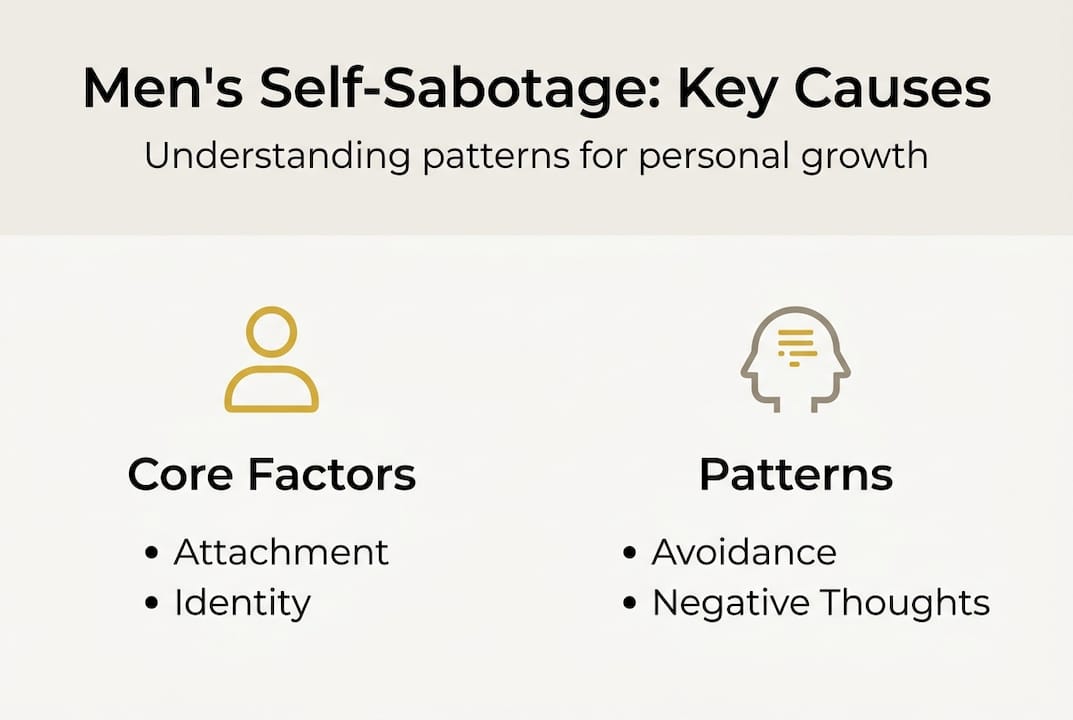
The uncomfortable truth is that self-sabotage in men often stems from avoidant attachment, low self-efficacy, habenula activation, and thought suppression driven by traditional masculinity ideology. These aren't abstract concepts. They are the actual mechanisms running in the background every time you blow up a good streak.
The habenula is a small but powerful brain region that activates after perceived failure, flooding the brain with signals that suppress motivation and reward-seeking. Think of it as your brain's internal punishment system. Once it fires repeatedly, your nervous system starts treating effort itself as a threat. That's not weakness. That's biology.
Here's what makes this worse for men specifically: thought suppression mediates traditional masculinity ideology, leading directly to externalizing symptoms like irritability, aggression, and substance use. Men are conditioned to push down discomfort, and that suppression doesn't neutralize the problem. It amplifies it.
Common signs you're caught in a self-sabotage loop:
- Procrastinating on goals you genuinely care about
- Picking fights or isolating when things start going well
- Perfectionism that keeps you from starting
- Blaming external circumstances for internal patterns
- Numbing with food, screens, or alcohol after setbacks
| Root cause | Behavioral signal | What it looks like |
|---|---|---|
| Avoidant attachment | Emotional withdrawal | Pulling back when relationships or goals get serious |
| Low self-efficacy | Giving up quickly | Quitting after one bad day |
| Habenula activation | Demotivation after failure | Can't get back on track after a slip |
| Thought suppression | Irritability, externalizing | Anger, substance use, blame-shifting |
"The nervous system doesn't distinguish between a physical threat and a perceived failure. Both trigger protection mode. Change requires making growth feel safe, not just desirable."
Understanding these roots doesn't excuse the behavior. It gives you an accurate map so you can stop fighting the wrong enemy.
Audit your patterns and reframe automatic negative thoughts
Now that you understand the underlying patterns, it's time to get hands-on with your own habits and thoughts. Awareness without action is just rumination. You need a structured process.
This is where most men skip ahead and pay for it later. They try to build new habits without ever identifying what's pulling them back. A regular self-audit fixes that. Pair it with structured self-reflection and you're working with a system, not just willpower.
Auditing self-sabotage patterns and reframing automatic negative thoughts (ANTs) is a core strategy for men's transformation. Here's a simple four-step process you can run weekly:
- Identify the trigger. What situation, emotion, or event precedes the self-sabotaging behavior? Common ones include stress, comparison, boredom, and perceived failure.
- Name the automatic thought. Write down the exact thought that fired. "I always ruin things." "I'm not built for this." "What's the point?"
- Challenge the story. Ask: Is this thought a fact or an interpretation? What evidence actually supports or contradicts it?
- Replace with an empowering frame. Not toxic positivity. A realistic, forward-facing alternative: "I slipped, and I know what to adjust next time."
For example, a man who misses a workout might automatically think, "I have no discipline." That thought then justifies skipping the next session, and the next. The behavior isn't the problem. The story attached to the behavior is. Catching that story early is how you interrupt the science-backed self-sabotage cycle before it gains momentum.
Pro Tip: Don't aim for 100% clean thinking. The goal is to catch the ANT before it drives a decision. Even a 30-second pause between trigger and reaction changes the outcome over time.
This process consistently outperforms brute-force willpower because it targets the thought layer, not just the behavior layer. Willpower is a finite resource. Reframed beliefs run on autopilot.
Build discipline with 80% adherence routines
With your self-defeating patterns mapped, it's time to build the routines that form your new self. And here's the first thing to throw out: the idea that you need to be perfect.

80% adherence yields more sustainable results than aiming for 100%. When you build routines around consistency rather than perfection, you stop treating a missed day as a reason to quit. That shift alone changes everything.
Mastery experience is the most powerful source of self-efficacy for lasting change. In plain terms: every time you follow through, even imperfectly, your brain updates its belief about who you are. That's the mechanism. Stack enough small wins and the identity starts to shift.
Here's a comparison of core habit categories by difficulty and effectiveness:
| Habit | Difficulty | Effectiveness | Starting benchmark |
|---|---|---|---|
| Daily mindfulness | Low to medium | Very high | 17 minutes per day |
| Movement or exercise | Medium | Very high | 3 to 4 sessions per week |
| Sleep optimization | Medium | High | 7 to 8 hours consistently |
| Nutrition structure | Medium to high | High | 3 whole-food meals daily |
Research shows that 17 minutes of daily mindfulness practiced consistently over 6 weeks can cut perceived stress nearly in half, dropping PSS scores from around 13 to 7. That's not a minor tweak. That's a measurable neurological shift.
Simple habits to start with right now:
- Walk for 20 minutes after waking up
- Eat a protein-rich breakfast before checking your phone
- Set a consistent sleep and wake time, even on weekends
- Do five minutes of breathwork before any high-stress task
For a deeper breakdown of building systems that stick, the self-discipline guide at Your Last Excuse covers the full architecture. You can also explore evidence-based digital self-help tools that support habit formation without requiring a therapist.
Pro Tip: Make the habit so small you literally cannot fail. "I will do one push-up" sounds ridiculous until you realize it builds the identity of someone who shows up. That identity compounds.
Shift your identity: Small winning promises
Routines work best when paired with a shift in how you see yourself. Here's how to catalyze that shift.
Behavior-only change is fragile. You can white-knuckle a new habit for weeks and still revert the moment life gets hard. Identity-level change outpaces behavior-only approaches for lasting transformation because it rewires the why behind the action, not just the action itself.
30-day small habit challenges rewire identity through basal ganglia automation. The basal ganglia is the brain's habit center. When you repeat a behavior consistently for 30 days, it starts to encode as part of your default self, not a conscious effort.
Here's how to run the process:
- Start tiny. Pick one promise so small it feels almost embarrassing. "I will drink one glass of water before coffee every morning."
- Track it daily. Use a simple check-box system. Visual streaks create psychological momentum.
- Review weekly. Ask: Did I keep this promise? What got in the way? What needs to adjust?
- Repeat and layer. After 30 days, add one more promise. Don't stack five habits at once.
"Change happens when your actions prove your story to yourself, over and over."
The most common pitfalls men hit in this phase are going too big too soon, expecting fast results, and falling into all-or-nothing thinking. Missing one day doesn't break the chain. Deciding the chain is broken does.
For a full breakdown of how self-identity drives lasting change, the research is clear: men who anchor habits to identity statements, "I am someone who moves every day," maintain them significantly longer than men who rely on motivation or external accountability alone.
What most guides get wrong about transformation
Having mapped the exact steps and routines, it's critical to see why you may have been set up to fail by common advice, and what actually works better.
Here's the hard truth: most transformation content for men is built on shame and grit. "Man up. Work harder. Stop making excuses." That framing might generate clicks, but it ignores the neuroscience entirely. Integrating neuroscience and psychology including habenula function, nervous system regulation, attachment patterns, and belief systems yields far better results than willpower-based approaches alone.
Self-sabotage in men is often a protection response, not self-destruction. The nervous system learned somewhere along the way that success, visibility, or growth was dangerous. Punishing yourself for that response doesn't rewire it. Safety, repetition, and small wins do.
Grit is overrated. Identity is underused. Men who build a lasting behavioral change practice that blends nervous system work, mindfulness, structured routines, and identity-level commitments consistently outperform men who just try harder.
Reframe every setback as data. Not a verdict on your character. Data for your next adjustment.
Next steps: Get expert support for lasting change
Ready to accelerate your progress and break cycles for good? Here's what to do next.
This guide gives you the framework, but frameworks work faster with the right structure behind them. Science-backed accountability, personalized coaching, and identity-focused programs compress the timeline dramatically. You don't have to figure this out alone or start from scratch every time motivation dips.

The Your Last Excuse transformation programs are built specifically for men who are done cycling through motivation and collapse. The Identity Shift System addresses the exact psychological and neurobiological patterns covered in this guide, with a step-by-step protocol, risk-free access, and tools designed to make the identity shift permanent. If you're serious about change, this is where structured support meets real science.
Frequently asked questions
What is the biggest reason men sabotage their own transformation?
Root causes in men often include avoidant attachment, low self-efficacy, and subconscious identity traps, not just weak willpower. Addressing these underlying drivers is what separates temporary motivation from lasting change.
How long does it take to see results with these strategies?
Evidence shows stress reduction and habit shifts can begin in as little as 6 weeks, with identity-level changes solidifying around the 30-day mark of consistent practice.
Is therapy or counseling required for self-sabotage?
Therapy can help address attachment and trauma, but identity-focused self-help strategies combined with structured routines produce real results for many men without clinical intervention.
What is an iterative mindset in this process?
An iterative mindset means treating setbacks as data for tweaking habits rather than failures, which research shows supports long-term habit persistence far better than relying on grit or resilience alone.
What if I relapse into old self-sabotage patterns?
Relapses are normal and expected. Reframing setbacks as data rather than evidence of failure is one of the most effective long-term strategies for sustained behavioral change.