
TL;DR:
- Male personal growth requires intentionality, emotional intelligence, discipline, and authentic masculinity.
- Building sustainable change involves structured systems, community support, and quick recovery from setbacks.
- Effective transformation depends on environment design, trigger awareness, and identity-centered strategies rather than willpower alone.
Most men don't fail because they lack talent or ambition. They fail because they keep getting in their own way. Rigid masculine norms correlate closely with higher rates of depression, self-sabotage, and chronic unhappiness. That's not a character flaw. It's a pattern, and patterns can be broken. Male personal growth isn't about reading motivational quotes or white-knuckling your way through another Monday. It's a targeted, evidence-based process for building the kind of discipline and self-awareness that makes lasting change feel inevitable rather than exhausting. This guide walks you through exactly what that looks like in practice.
Table of Contents
- Defining male personal growth: What it really means
- Why self-sabotage traps men: The hidden psychology
- Key strategies for breaking self-sabotage and building discipline
- Building a sustainable personal growth framework
- What most guides miss about lasting male transformation
- Ready for your next step in personal growth?
- Frequently asked questions
Key Takeaways
| Point | Details |
|---|---|
| Tailored growth matters | Men’s personal growth means addressing unique social and psychological patterns, not just following generic advice. |
| Break patterns with structure | Consistent discipline and frameworks curb self-sabotage far more effectively than willpower alone. |
| Therapy and habits work | Evidence-backed therapies and daily habits help men create lasting change. |
| Support accelerates success | Brotherhood and accountability groups make sticking to growth much more likely. |
Defining male personal growth: What it really means
To understand how to grow, you first need to know what male personal growth actually involves. It's not the same as generic self-improvement, which often treats every person identically and ignores the specific psychological pressures men face daily.
Male personal growth is intentional, holistic transformation shaped by the realities of modern manhood. According to research on healthy masculinity guidelines, it addresses emotional intelligence, discipline, self-awareness, and a redefined sense of strength that's grounded in authenticity rather than dominance. As one APA-backed framework puts it, male personal growth redefines masculinity, emphasizing emotional intelligence, discipline, self-awareness, and authentic strength.
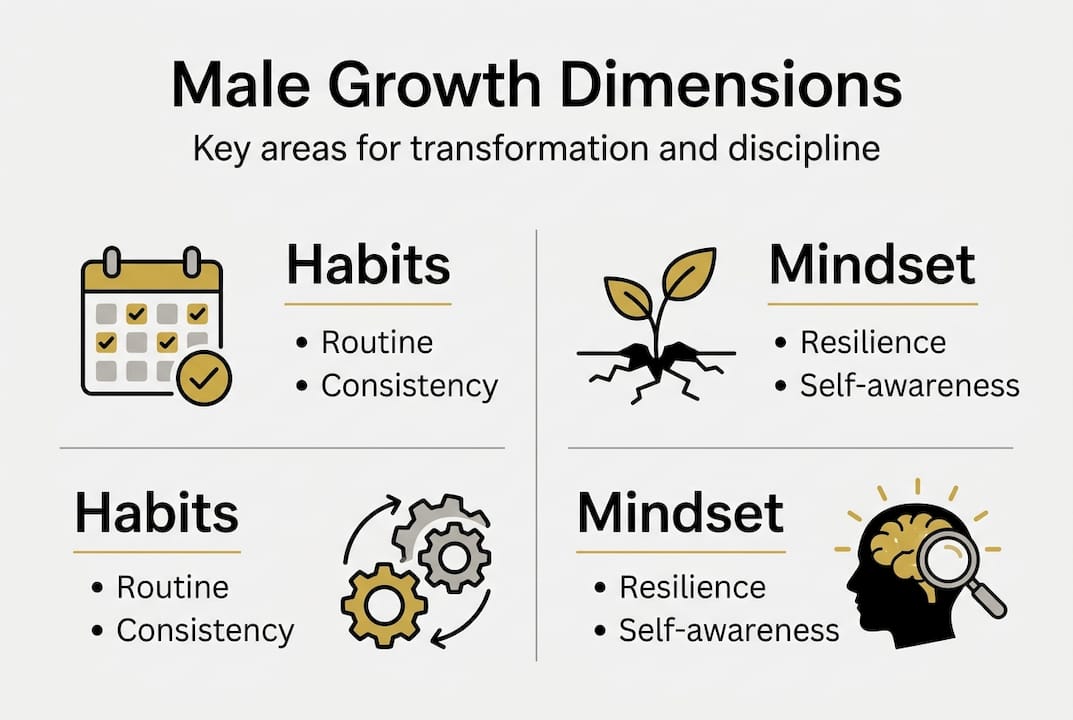
Here's a quick breakdown of how traditional masculinity stacks up against what researchers now call mature masculinity:
| Dimension | Traditional masculinity | Mature masculinity |
|---|---|---|
| Emotional expression | Suppressed, seen as weakness | Acknowledged, used strategically |
| Strength definition | Physical dominance | Resilience and self-regulation |
| Conflict response | Aggression or avoidance | Direct communication |
| Help-seeking | Rare, stigmatized | Normal, respected |
| Identity source | External status | Internal values |
This shift matters because identity and lasting change are inseparable. When you're operating from an identity rooted in outdated norms, every attempt to build new habits is fighting against your core self-concept.
The core components of genuine male personal growth include:
- Emotional intelligence: Recognizing and regulating your internal states without numbing them
- Structured discipline: Building systems that don't rely on motivation
- Self-awareness: Identifying your triggers, patterns, and default behaviors
- Authentic masculinity: Replacing performative toughness with real inner strength
- Accountability: Accepting responsibility for outcomes without shame spirals
"The goal isn't to become a softer man. It's to become a more complete one, someone whose strength comes from clarity rather than fear."
This is what separates men who make real progress from those stuck cycling through the same frustrating patterns every six months.
Why self-sabotage traps men: The hidden psychology
Once you know what male personal growth is, it's crucial to recognize the most common obstacle: self-sabotage. It's not laziness. It's not weakness. It's a deeply ingrained psychological defense mechanism.
Self-sabotage in men is often unconscious and stems from low self-worth or unresolved trauma. It shows up in subtle ways: procrastinating on a goal the moment it gets real, creating relationship conflict when things go well, or numbing out with alcohol or screens when stress builds. These aren't random. They're predictable patterns tied to specific triggers.
Here's a snapshot of how common these behaviors actually are:
| Self-sabotage behavior | Prevalence among men | Primary root cause |
|---|---|---|
| Chronic procrastination | ~20% of adults | Fear of failure or success |
| Substance use as coping | 1 in 5 men | Stress dysregulation |
| Relationship self-destruction | Very common in 25-45 range | Attachment and worth issues |
| Abandoning fitness goals | Over 80% by February | Motivation-based systems |
The causes run deeper than most men realize. Childhood conditioning, unprocessed trauma, rigid social norms around vulnerability, and lack of meaningful daily structure all create the perfect storm. Research on social support confirms that isolation amplifies these patterns, while connection buffers against relapse.
Understanding the psychology of male self-sabotage starts with identifying your recurring triggers. Here's a simple four-step process:
- Notice the pattern: What behavior keeps repeating in your life, even when you don't want it to?
- Trace it backward: What feeling or situation tends to precede it?
- Name the belief underneath: What does this behavior protect you from feeling or facing?
- Map the cost: What has this pattern cost you in relationships, career, or health?
Using self-reflection for growth as a regular practice turns this from a one-time exercise into an ongoing feedback loop.
Pro Tip: Don't try to defeat self-sabotage with willpower. Build structure instead. Willpower is a finite resource. A well-designed environment removes the need for it.
Key strategies for breaking self-sabotage and building discipline
Now that you understand the origins of self-sabotage, it's time to apply strategies proven to work. The science-backed steps aren't complicated, but they require consistency over intensity.
The foundational practices that research consistently backs include:
- Daily structure: A fixed morning routine anchors your identity before the day can hijack it
- Habit stacking: Attach new behaviors to existing ones to reduce friction
- Small wins: Early momentum builds the confidence needed for harder challenges
- The 80% rule: Daily structure, 80% adherence, mindfulness, and therapy are essential tools for sustained discipline, not perfectionism
- Trigger tracking: Log when and where you derail to find patterns, not just symptoms
On the therapeutic side, CBT for men's habits is one of the most well-researched interventions available. It teaches you to catch distorted thinking before it drives destructive behavior. Somatic therapy, CBT, nervous system regulation, and trigger tracking are all empirically supported for lasting male transformation.
Here's a sample daily routine designed specifically for men aged 25 to 45:
- 6:00 AM: Wake, hydrate, five minutes of breathing or stillness (no phone)
- 6:15 AM: Movement, 20 to 45 minutes (weights, run, or walk)
- 7:00 AM: Review daily priorities, written not mental
- 7:30 AM: Deep work block, highest-leverage task first
- 12:00 PM: Midday reset, brief walk or five-minute breathing exercise
- Evening: Review the day, note one win and one trigger to watch tomorrow
Building positive habits for change requires a complete self-discipline guide approach that blends structure, mindset, and physiological awareness.

Pro Tip: After a setback, your next move determines everything. Don't start over Monday. Get back on track at the very next available moment. That single habit separates men who change from men who keep trying.
Building a sustainable personal growth framework
With core strategies in place, creating a framework for sustainability is key to true transformation. Systems outlast motivation every time.
Start by auditing three areas: your environment, your triggers, and your support network. These three things determine about 80% of your behavioral outcomes, far more than intention or discipline alone. A framework including brotherhood, accountability, environment design, and identity work dramatically boosts adherence for men over the long run.
The 9 pillars of mature masculinity offer a flexible but powerful structure to build around. Applied practically, your framework should cover:
- Environment design: Remove friction from good habits and add friction to bad ones
- Trigger mapping: Know your high-risk moments before they happen
- Brotherhood and accountability: One committed peer or group changes everything
- Identity anchoring: Define the man you're becoming before you start building habits
- Recovery protocols: Plan your response to failure in advance, not after the fact
- Progress tracking: Measure behavior, not just outcomes
Participating in men's groups or retreats is one of the most underused tools in personal development. Most men try to grind through transformation alone. That's not strength. It's isolation wearing a costume.
The approaches covered in lasting behavioral change and identity-based strategies both confirm the same thing: sustainable change requires a system, not just effort.
Pro Tip: Stop measuring your growth by perfect days. Measure it by how fast you recover after a bad one. Progress is not a straight line. Recovery speed is the actual metric.
What most guides miss about lasting male transformation
Most personal development content tells you to want it badly enough. Grind harder. Wake up earlier. Just decide to change. That advice isn't just useless. It actively sets men up to fail.
Here's what veteran practitioners actually observe: growth is sustained by structure, not raw willpower. Most relapses happen after motivation wanes, not at the start when energy is high. The men who build durable change aren't more disciplined by nature. They've built better containers for their behavior.
The second piece most guides ignore is connection. Setbacks almost always happen in isolation. A man quietly skips the gym, quietly starts drinking again, quietly retreats. A support system or accountability structure changes that dynamic completely. The deep dive on men's development from APA confirms that community and relational accountability are central to male psychological health, not optional add-ons.
Choosing maturation over bravado is the defining move of real transformation. The strongest thing you can do is build a system that doesn't depend on you feeling strong. That's what digital self-help for discipline done right looks like. Structure first, identity second, motivation last.
Ready for your next step in personal growth?
If you've read this far, you already know what most men never figure out: the problem isn't effort, it's the system behind the effort. Breaking self-sabotage and building real discipline requires structure, identity work, and the right support.

At Your Last Excuse, we've built a structured program specifically for men who are done cycling through the same frustrating patterns. The Identity Shift System combines behavioral psychology, cognitive restructuring, and proven daily protocols to help you build discipline fast and make it last. If you're serious about permanent change, the next step is a structured one.
Frequently asked questions
What's the difference between male personal growth and traditional self-improvement?
Male personal growth is tailored to men's contexts, addressing societal expectations, emotional skills, and identity in ways that generic self-improvement frameworks rarely do. Traditional self-improvement tends to ignore the unique psychological pressures men carry.
What are the first steps to breaking self-sabotage for men?
Structure and trigger awareness are empirically shown to reduce sabotage in men more reliably than motivation alone. Start by tracking when you derail, then build a system that reduces the need for willpower in those moments.
How important is social support in male personal growth?
Social support and brotherhood support longevity of change in men by reducing isolation and increasing accountability. Even one strong peer relationship significantly improves follow-through on personal goals.
Does therapy really help men change self-defeating behavior?
CBT and somatic therapy show measurable improvements in men's self-control and behavior change by targeting the underlying beliefs and nervous system patterns that drive self-sabotage. For most men, structured therapeutic support accelerates results significantly.