TL;DR:
- Men often use self-handicapping behaviors to protect their self-esteem from failure.
- Breaking the cycle requires identity-based habits rather than relying solely on willpower.
- Recognizing and addressing underlying fears and beliefs is key to overcoming excuses.
Making excuses isn't a character flaw. It's a survival strategy. Your brain uses self-handicapping to protect your self-esteem from the threat of failure, creating psychological cover before you even try. The problem? That cover becomes a cage. For men especially, this pattern runs deep, wired into how masculinity, identity, and stress interact. This article breaks down the real psychology behind excuse-making, shows you exactly how the cycle traps you, and gives you a concrete plan to escape it. No motivational fluff. Just evidence, new perspectives, and steps you can act on today.
Table of Contents
- What is self-handicapping and why do men do it?
- The vicious cycle: How excuses protect and sabotage you
- Breaking the pattern: Why identity—not willpower—wins
- Action plan: Steps to dismantle your own excuses
- The uncomfortable truth: Excuses serve you—until they don't
- Next steps: Start your transformation journey
- Frequently asked questions
Key Takeaways
| Point | Details |
|---|---|
| Excuses protect, but limit | Making excuses shields self-esteem in the short term but sabotages long-term success. |
| Men's unique challenges | Men are especially prone to self-handicapping, often resulting in increased anxiety and lower achievement. |
| Identity— not willpower | Building a new self-image and identity-based habits is the proven way to break excuse cycles. |
| Action beats analysis | Practical steps and daily wins are more effective than motivation or overthinking. |
| Self-acceptance enables growth | True transformation requires acknowledging your excuses without shame and building new patterns from there. |
What is self-handicapping and why do men do it?
Self-handicapping is when you create obstacles for yourself before a challenge, so that if you fail, you have a built-in excuse. Didn't sleep well before the big presentation. Skipped the gym because work was crazy. Started the project late on purpose. These aren't random bad habits. They're your mind running a protection program.
The core logic goes like this: if you never fully try, you never fully fail. Your ego stays intact. But the cost is enormous, because you also never fully succeed.
Research shows that men self-handicap more than women, and the consequences are serious. Higher rates of anxiety, depression, and worse psychosocial outcomes follow men who rely on this pattern. It's not a minor quirk. It's a psychological trap with real-world damage.
Why are men especially vulnerable? Masculinity creates a specific kind of pressure. Men are socialized to appear competent, strong, and in control. Admitting fear of failure feels threatening to that image. So instead of confronting the fear directly, the mind builds a detour. You procrastinate. You over-prepare but never launch. You tell yourself conditions aren't right yet. Understanding the male psychology of self-sabotage reveals just how deeply this pattern is wired.
Common self-handicapping behaviors include:
- Procrastination: Delaying action so failure can be blamed on timing
- Perfectionism: Setting impossible standards so quitting feels justified
- Substance use: Creating a ready-made excuse for underperformance
- Over-commitment: Spreading yourself thin so nothing gets your best effort
- Downplaying effort: Saying you didn't really try, so the result doesn't count
| Behavior | What it protects | What it costs |
|---|---|---|
| Procrastination | Fear of judgment | Lost time and momentum |
| Perfectionism | Fear of inadequacy | Paralysis and missed starts |
| Under-preparation | Fear of real failure | Actual underperformance |
| Self-deprecation | Fear of high expectations | Credibility and confidence |
If you recognize yourself in this list, you're not broken. You're running a very human, very costly defense system. The science-backed steps for men to dismantle this start with understanding what the pattern actually does to you over time.
The vicious cycle: How excuses protect and sabotage you
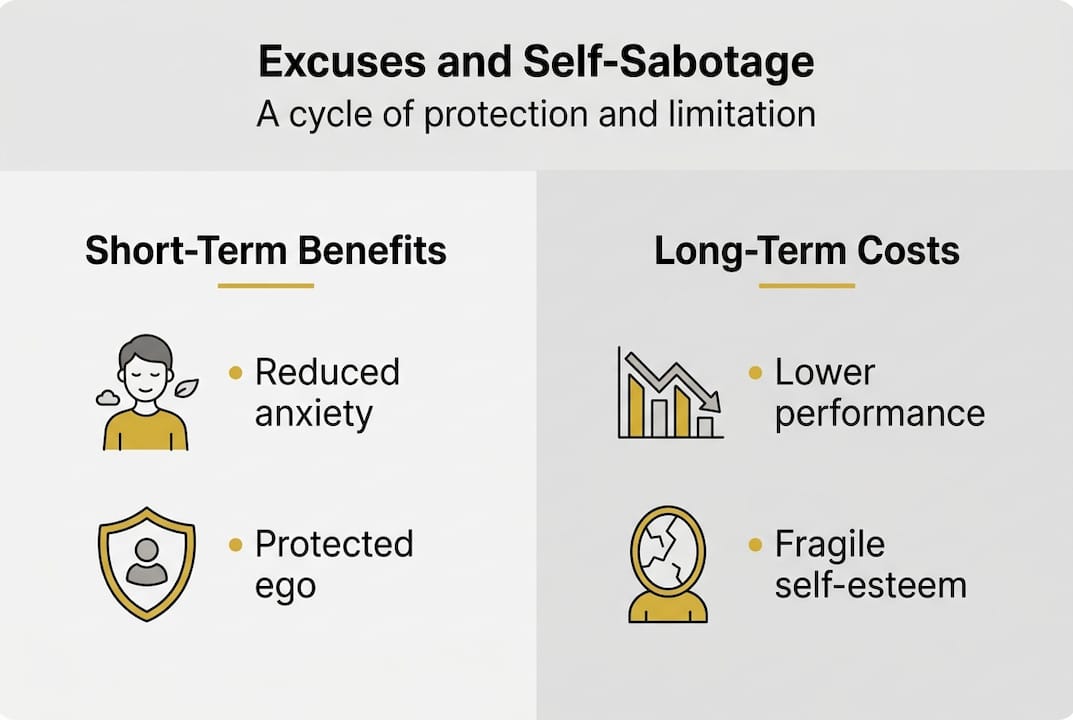
Here's where it gets counterintuitive. Excuses work in the short term. They genuinely reduce anxiety in the moment. You feel relief when you decide not to try something scary. That relief is real, and your brain remembers it.

But excuses lower actual performance over time, while only protecting a fragile version of your self-esteem. You're trading real growth for temporary comfort, and the trade gets worse with every cycle.
| Short-term comfort | Long-term consequence |
|---|---|
| Avoiding judgment | Shrinking confidence |
| Reduced anxiety | Increased self-doubt |
| Ego protection | Identity built on avoidance |
| Feeling in control | Loss of actual capability |
Here's how the cycle traps you, step by step:
- Threat appears: A goal, opportunity, or challenge shows up
- Fear activates: Your brain flags possible failure as a threat to your identity
- Excuse forms: You create a reason not to fully engage
- Short-term relief: Anxiety drops. The excuse feels like a solution
- Performance suffers: You underperform or don't start at all
- Self-esteem erodes: Deep down, you know what happened
- Next threat feels bigger: The cycle repeats with more fear and less confidence
Low self-esteem doesn't just follow this cycle. It feeds it. Low self-esteem correlates strongly with procrastination and mediates self-sabotage, meaning it's both a cause and a result. The longer you run this pattern, the harder it becomes to break without deliberate intervention.
Understanding the science behind excuse-making makes it clear: this isn't about laziness. It's a feedback loop with psychological momentum. And the way to break self-sabotage is to interrupt the loop at the identity level, not just the behavior level.
Pro Tip: Start noticing the moment relief hits when you decide to avoid something. That feeling of "phew" is your signal that self-handicapping just fired. Catching it in real time is the first step to changing it.
Breaking the pattern: Why identity—not willpower—wins
Willpower is a finite resource. You've probably noticed this. You start strong on Monday, white-knuckling your way through good decisions, and by Thursday you're back to the old patterns. That's not weakness. That's biology.
Identity, on the other hand, is self-sustaining. When you genuinely see yourself as a certain kind of man, your behavior aligns with that image automatically. You don't need to force yourself to do things that feel consistent with who you are.
Identity-based habits help men transform by building small daily wins that shift self-perception over time. Each small action becomes a vote for a new identity. Miss a workout but still do ten pushups? That's a vote. Write one paragraph instead of the whole chapter? Vote. These micro-wins compound.
For men specifically, masculine disinvestment under stress worsens self-sabotage, but identity-based change reverses this by replacing defensive avoidance with proactive self-definition.
Here's how to start shifting your identity through action:
- Replace "I need to work out" with "I'm the kind of man who moves every day"
- Replace "I should stop procrastinating" with "I'm someone who starts before he's ready"
- Complete one small, relevant task daily that reflects the identity you're building
- Speak about your goals as current facts, not future hopes
- Track your daily votes in a simple journal, no elaborate system needed
Explore identity-based self-improvement to go deeper on how this shift works at the belief level. And if you want to see how habits break sabotage in practice, the research is clear: behavior follows belief, not the other way around.
Pro Tip: At the end of each day, write down three actions you took that reflect your target identity. Not goals. Actions. This trains your brain to see yourself differently, faster than motivation ever could.
Action plan: Steps to dismantle your own excuses
Knowing the psychology is powerful. But it doesn't change anything until you act. Here's a concrete, research-grounded plan you can start today.
- Build awareness: For one week, write down every excuse you make. No judgment. Just data. You can't interrupt a pattern you haven't mapped.
- Identify the trigger: What threat is the excuse protecting you from? Fear of judgment? Fear of failure? Fear of success? Name it specifically.
- Interrupt the pattern: When you notice the excuse forming, pause for ten seconds. Ask: "What would the man I want to be do right now?"
- Make a micro-commitment: Don't aim for perfect. Aim for one small action that aligns with your target identity. Start the email. Open the document. Lace up the shoes.
- Stack the habit: Attach your new behavior to something you already do. After coffee, write for ten minutes. After brushing your teeth, do five minutes of reflection.
Self-handicapping can be overcome with intentional self-reflection and deliberate habit construction. The key word is intentional. Passive awareness doesn't cut it.
Common pitfalls to avoid:
- Going too big too fast: Massive goals trigger massive fear, which triggers massive excuses
- Skipping the reflection step: Action without awareness just builds new excuses
- Waiting for motivation: Motivation follows action, not the other way around
- Measuring by outcome: Measure by identity-consistent actions, not results
For deeper support, explore how to overcome excuses with proven strategies, use structure for self-reflection to process your triggers, build self-discipline skills for men that hold under pressure, and understand how habits drive success when they're tied to identity.
Pro Tip: Use this self-reflection prompt when an excuse surfaces: "What am I afraid will happen if I actually try?" Write the answer down. That fear is the real target, not the excuse.
The uncomfortable truth: Excuses serve you—until they don't
Here's what most personal development content gets wrong. It treats excuses as the enemy. It tells you to "stop making excuses" as if you're simply choosing to be lazy. That framing misses the entire point.
Excuses exist because something in you is worth protecting. Your sense of competence. Your self-image. Your hope that you might actually be capable of something great. The excuse is a shield, and shields exist because something real is under attack.
Even high self-esteem men self-handicap to maintain a self-image, which means discipline alone isn't the answer. Self-acceptance is part of the equation too. You have to acknowledge what you're protecting before you can stop protecting it defensively.
Real transformation isn't about crushing your fear responses. It's about building an identity so solid that you don't need the shield anymore. That's the work. And it requires honesty, not just hustle. Explore self-discipline for lasting change through this lens and you'll find the approach that actually sticks.
Next steps: Start your transformation journey
You now understand the psychology behind your excuses, the cycle that keeps you stuck, and the identity shift that breaks it. That's more clarity than most men ever get.
But clarity without support fades fast. At Your Last Excuse, you'll find the Identity Shift System, a structured protocol built specifically for men who are done cycling through motivation and collapse. It's not a motivational course. It's a psychological framework that rewires how you see yourself, so your behavior changes from the inside out. If you're ready to stop defending a fragile identity and start building an unshakeable one, this is your next move.
Frequently asked questions
Why do I keep making excuses even when I want to change?
Excuses protect your self-esteem from possible failure, creating a psychological safety net that makes genuine change feel threatening even when you consciously want it.
How does low self-esteem drive excuse-making?
Low self-esteem correlates strongly with procrastination and self-sabotage, meaning the less you believe in yourself, the more excuses your mind generates to avoid exposing that belief to a real test.
Are men more likely to self-sabotage with excuses?
Yes. Men show higher rates of self-handicapping than women, and the pattern is linked to increased anxiety, depression, and lower overall performance over time.
What's the most effective strategy to stop making excuses?
Identity-based habits consistently outperform willpower-based approaches because they change how you see yourself, making excuse-making feel inconsistent with who you are rather than just something you're trying to avoid.