
TL;DR:
- Excuses are psychological defenses protecting self-esteem from perceived failure and shame.
- Understanding triggers and patterns helps dismantle excuses and build lasting discipline.
- Viewing excuses as growth signals shifts focus from shame to opportunities for self-improvement.
Most men assume excuses are a character flaw, a sign they're lazy or undisciplined. But the science tells a completely different story. Excuse-making is a sophisticated psychological defense system your brain built to protect you, and it works so well that you often don't even see it happening. Understanding why excuses exist, what they're actually shielding you from, and how to dismantle them without white-knuckling your way through every day is the real path to lasting change. This guide breaks down the psychology, the research, and the practical steps to get you there.
Table of Contents
- What are excuses really protecting?
- The science behind excuses: Demystifying procrastination
- Excuse-making and emotion: The role of short-term mood repair
- From awareness to action: Practical steps to eliminate excuses
- A new perspective: Why making excuses signals an opportunity for growth
- Take the next step—end excuses for good
- Frequently asked questions
Key Takeaways
| Point | Details |
|---|---|
| Excuses protect self-esteem | Men often make excuses to shield their self-image from failure or judgment rather than out of laziness. |
| Motivation theory explains procrastination | Low confidence, delayed rewards, and impulsivity drive excuses through predictable mental patterns. |
| Emotion regulation is key | Excuses are often a tool to escape discomfort, providing short-term relief but long-term problems. |
| Actionable routines work best | Tracking triggers, focusing on 80% adherence, and auditing self-sabotage help break the excuse cycle. |
| Growth comes from resistance | Recognizing and reflecting on your excuses can reveal where real psychological transformation is possible. |
What are excuses really protecting?
Here's the uncomfortable truth: excuses aren't about avoiding work. They're about avoiding pain. Specifically, the pain of failing and having that failure reflect on who you are as a man. Self-handicapping and self-sabotage mechanisms are the engine behind most excuse-making, where you create obstacles or delays to protect your self-esteem by giving yourself a built-in explanation if things go wrong.
Think about it this way. If you don't fully try, you can't fully fail. The excuse becomes a shield. You didn't bomb the job interview because you're not good enough. You bombed it because you stayed up too late the night before. The outcome is the same, but your identity stays intact. That's the trade your brain is making without asking your permission.
This pattern shows up in predictable forms:
- Procrastination: Delaying action so there's always a reason the result wasn't your best effort
- Perfectionism: Setting standards so high that starting feels impossible, which protects you from ever being judged on real output
- Substance use: Numbing the discomfort of high-stakes situations so failure feels less personal
- Downplaying effort: Telling people you "barely studied" or "didn't really try" before any performance
For men specifically, this plays out in a more public arena. Reputation is currency. When your identity is tied to being capable, strong, or in control, the stakes of failure feel even higher. Men are often more likely to engage in publicly self-handicapping behaviors because the social cost of looking incompetent feels unbearable.
The brutal irony is that understanding self-sabotage psychology shows that this protection mechanism actively blocks the growth it's supposedly preserving you for. You can't build real confidence without real attempts. Excuses keep you safe and stuck at the same time.
"The man who makes excuses and the man who makes progress are rarely the same man." The moment you recognize an excuse as a defense mechanism rather than a reason, you've already taken the first step toward dismantling it.
The science behind excuses: Demystifying procrastination
If you've ever wondered why you can know exactly what you need to do and still not do it, Temporal Motivation Theory gives you the answer. The TMT formula breaks motivation down to this: Motivation equals expectancy times value, divided by one plus impulsiveness times delay. When your confidence in success is low, the reward feels far away, or your impulsivity is high, motivation collapses and excuses rush in to fill the gap.
This isn't weakness. It's math. Your brain is running a cost-benefit calculation every time you face a challenging task, and when the numbers don't add up, it finds a reason to wait.
Here's what the data looks like in practice:
| Factor | Effect on motivation | Common excuse triggered |
|---|---|---|
| Low expectancy of success | Drops motivation sharply | "I'm probably not good enough anyway" |
| Distant reward | Reduces perceived value | "I'll start when the timing is better" |
| High impulsivity | Pulls attention to easier tasks | "I'll do it after I check this one thing" |
| Task feels aversive | Triggers avoidance | "I don't feel like it today" |
The procrastination benchmarks are sobering. Chronic procrastination affects roughly 40% of adults, correlates negatively with academic and professional performance, and sits in a network where impulsivity and depression reinforce each other. The impulsivity-depression link is especially important for men who cycle through bursts of motivation followed by crashes.
Here's how the TMT framework translates into recognizable excuse patterns:
- Low confidence in the outcome produces "what's the point" thinking
- Delayed rewards make the effort feel disproportionate to the payoff
- High impulsivity makes distraction feel like a legitimate priority
- Aversive tasks trigger physical discomfort that the brain interprets as a stop signal
Pro Tip: Spend one week logging every time you delay or avoid a task. Note the time of day, your mood, and what you did instead. Patterns emerge fast, and patterns are the only thing you can actually target.
If you want a structured approach to overcoming excuses using this framework, the key is attacking the specific variable that's weakest for you, not trying to overhaul everything at once. A solid self-discipline guide will help you identify which lever to pull first.
Excuse-making and emotion: The role of short-term mood repair
Here's where it gets even more interesting. Procrastination and excuse-making aren't just about rational calculations. They're also about how you feel right now versus how you might feel later. Research comparing emotion regulation and delay-discounting shows that procrastination often functions as short-term mood repair. You avoid the task because doing it creates anxiety, and avoiding it makes you feel better immediately.

The problem is that relief is temporary and the cost compounds. Every avoided task adds weight to the next one. The anxiety you dodged today shows up tomorrow with interest.
This is why willpower alone almost never works long-term. You're not fighting laziness. You're fighting a nervous system that has learned to associate certain tasks with discomfort and has developed a highly effective escape route.
The emotional mechanics look like this:
- Anticipatory anxiety makes starting a task feel threatening before you've done anything
- Shame spirals from past failures make new attempts feel pre-loaded with risk
- Temporary relief from avoidance reinforces the excuse as a coping strategy
- Guilt and self-criticism after avoidance lower confidence, making the next attempt harder
"Every excuse you make today is a loan against tomorrow's confidence. The interest rate is brutal."
This cycle is exactly what makes ending self-sabotage feel so difficult. The behavior that's hurting you is also the behavior that's giving you momentary relief. Breaking it requires replacing the relief mechanism, not just eliminating the excuse. That's also why building positive habits matters so much. Habits reduce the emotional friction of starting by making the behavior automatic rather than a decision point.
From awareness to action: Practical steps to eliminate excuses
Knowing why excuses happen is only useful if it changes what you do next. Here's a framework built on what actually works, not motivational theory.
- Audit your excuse patterns. Write down the last five times you avoided something important. Look for the common thread. Same time of day? Same emotional state? Same type of task? You're looking for your personal trigger map.
- Stack small wins deliberately. Self-efficacy, your belief that you can succeed, grows through evidence. Small wins and structured routines create that evidence faster than any motivational content.
- Use implementation intentions. Instead of "I'll work out more," say "I will work out at 6am on Monday, Wednesday, and Friday in my living room." Specificity bypasses the decision fatigue that creates excuse opportunities.
- Adopt a growth mindset toward failure. When you stop treating failure as proof of inadequacy and start treating it as data, the emotional cost of attempting drops significantly.
- Build accountability. External accountability changes the math. When someone else knows your commitment, the social cost of excusing out rises.
| Strategy | Immediate effect | Sustainability | Effort required |
|---|---|---|---|
| Trigger auditing | High awareness | High | Low |
| Small wins | Moderate confidence boost | Very high | Low to moderate |
| Implementation intentions | High follow-through | High | Low |
| Accountability | High compliance | Moderate | Moderate |
| Growth mindset reframing | Moderate | Very high | High initially |
Aim for 80% adherence, not 100%. Perfectionism is just another form of self-handicapping. If you hit 80% of your planned actions consistently, you will outperform the man chasing 100% and quitting when he misses a day. Developing real discipline skills means building systems that survive imperfection, not ones that collapse under it. Understanding how habits drive success is the foundation of making these strategies stick long-term.
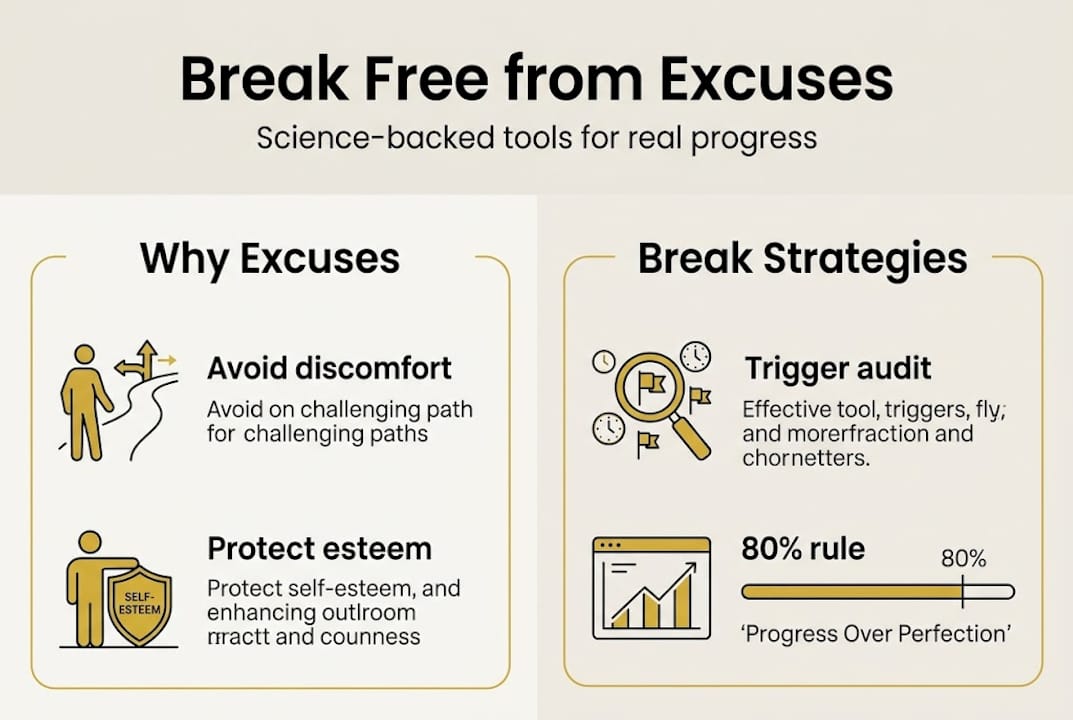
Pro Tip: Set a weekly 10-minute self-sabotage audit. Review what you avoided, what excuse you used, and what the real trigger was. This practice alone catches patterns before they solidify into identity.
A new perspective: Why making excuses signals an opportunity for growth
Most men treat their excuses as evidence of failure. We'd argue they're the opposite. An excuse is a signal. It tells you exactly where your growth edge is, because you only protect yourself from the things that matter.
If you're making excuses around your health, your relationships, or your career, that's not proof you're broken. That's a map. The resistance as growth signal framework flips the script: instead of beating yourself up for avoiding something, you get curious about why that specific thing triggers your defense system.
Here's the contrarian take: before you chase discipline hacks, fix your foundations. Sleep deprivation alone tanks prefrontal cortex function, which is the part of your brain responsible for impulse control and long-term thinking. Poor nutrition does the same. You cannot white-knuckle your way to consistency when your biology is working against you.
Using self-reflection with structure turns excuses from shame triggers into diagnostic tools. The man who learns to read his own resistance patterns will always outperform the man who just tries harder.
Take the next step—end excuses for good
You now understand what excuses actually are, why your brain generates them, and what science-backed strategies can dismantle them. That's more clarity than most men ever get. But clarity without structure fades fast.
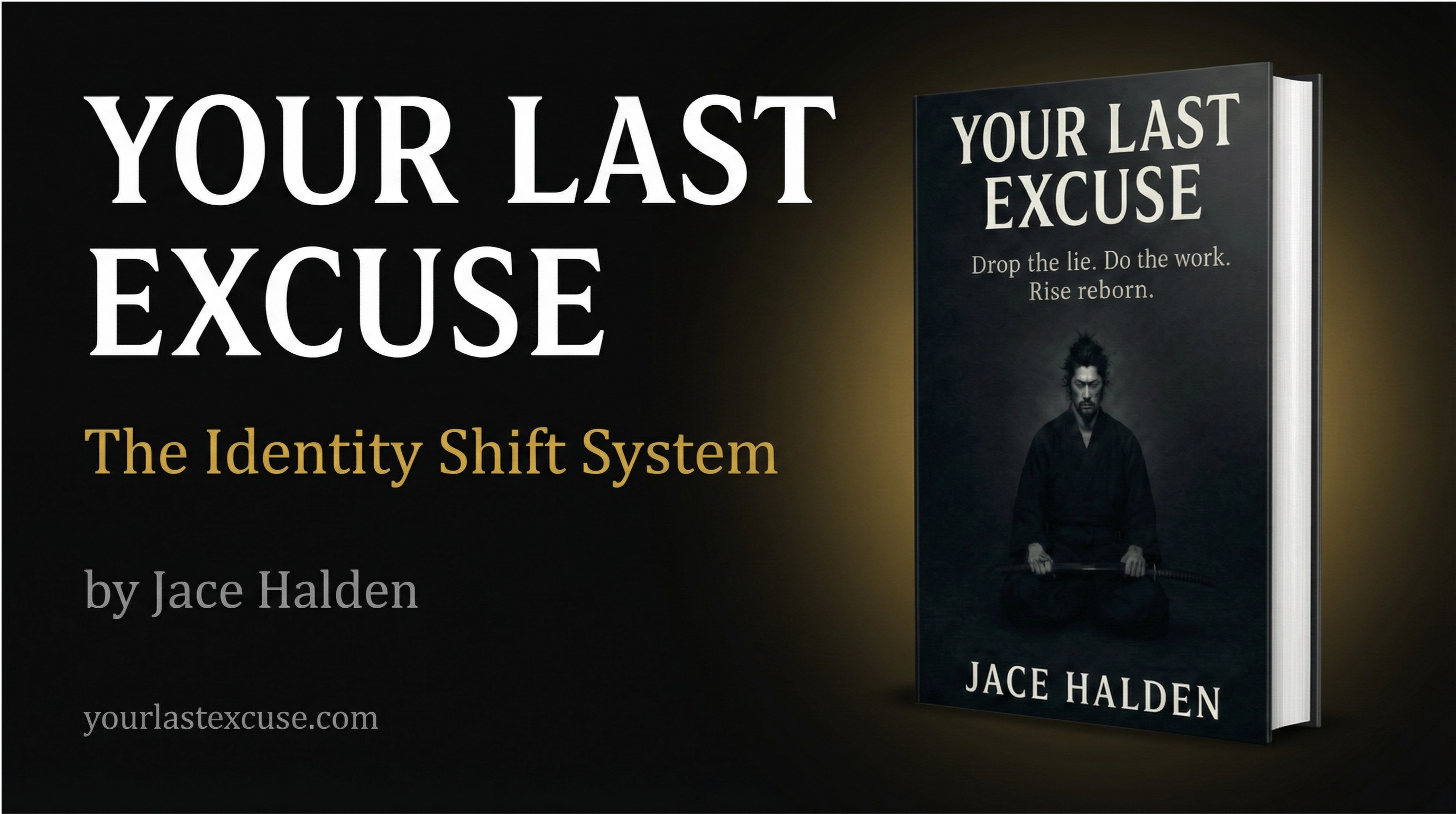
Your Last Excuse is built specifically for men who are done cycling through motivation and collapse. The Identity Shift System gives you the psychological framework, the tools, and the accountability structure to make this change permanent, not just temporary. If you're ready to go deeper, the step-by-step self-discipline guide is the place to start. The work is real, the results are real, and the excuses stop here.
Frequently asked questions
Why do I keep making excuses even when I want to change?
Excuses protect your self-esteem from the fear of failure through self-handicapping mechanisms, shifting blame to external factors so your identity stays intact even when outcomes disappoint.
What's the fastest way to stop making excuses?
Start by tracking your triggers, then commit to routines with 80% adherence and add external accountability to raise the social cost of backing out.
Are excuses just a sign of laziness?
No. Research shows excuses function as emotion regulation and self-protection mechanisms, offering short-term mood relief at the cost of long-term growth, which is a far more complex process than simple laziness.
Does having more discipline mean I'll stop making excuses?
Discipline helps, but eliminating excuses requires changing your mindset, habits, and emotional triggers at the root level, not just pushing harder through willpower alone.