TL;DR:
- Motivation alone is unreliable; structured systems outperform willpower for lasting change.
- Tools like habit tracking, environmental cues, and self-monitoring create automatic discipline.
- Consistent, imperfect action over time builds identity and sustainable habits beyond motivation.
You've started over more times than you can count. New workout plan, new morning routine, new commitment to stop wasting evenings, and two weeks later you're back where you started, feeling worse about yourself than before. The problem isn't that you lack effort or desire. The real issue is that you're using the wrong operating system. Willpower alone is a broken strategy, and the popular advice about just "staying motivated" is keeping you stuck. This article breaks down a research-backed self-mastery workflow that addresses how your brain actually forms lasting change, so you can stop the cycle for good.
Table of Contents
- Why most men fail: The myth of motivation and willpower
- Preparation: The right tools and mindset for self-mastery
- Step-by-step workflow: Building your self-mastery system
- Overcoming roadblocks: Common traps and adjustment strategies
- Measuring real progress: What to expect and how to adapt
- The uncomfortable truth: Why radical consistency outperforms perfect motivation
- Ready to execute your workflow? Start your breakthrough now
- Frequently asked questions
Key Takeaways
| Point | Details |
|---|---|
| Systems outperform motivation | A structured workflow beats willpower for building lasting discipline. |
| Plan for setbacks | Missing once is not failure—success comes from getting back on track quickly. |
| Science over myths | Sustainable self-mastery requires at least 66 days of consistent practice, not just three weeks. |
| Micro-habits drive results | Start with small, reliable actions tied to stable cues for the most effective change. |
Why most men fail: The myth of motivation and willpower
With the challenge defined, let's uncover why traditional motivation-focused approaches keep failing.
Most men treat motivation like fuel. When the tank is full after a big decision or a rough Monday, they go hard. When it runs out, everything stalls. The trouble is that motivation is an emotion, not a resource you can reliably replenish on demand. Emotions are unpredictable. Building your entire discipline strategy on them is like constructing a house on sand.
The 21-day habit myth makes this worse. You've probably heard that it takes three weeks to lock in a new behavior. That number has been repeated so often it feels like fact. It isn't. The origin traces back loosely to a 1960s plastic surgery observation, not behavioral science. Real research shows habit formation varies dramatically from person to person and behavior to behavior, taking anywhere from 18 to 254 days depending on complexity.
Research confirms that motivation alone is insufficient for lasting behavior change and that structured systems consistently outperform willpower as a long-term strategy. That single finding should change how you approach every self-improvement effort you make going forward.
The deeper issue is that motivation-based approaches ignore the architecture of self-sabotage. Understanding why men self-sabotage reveals patterns that go well beyond laziness or lack of commitment. Common patterns include:
- All-or-nothing thinking: One missed workout means the whole week is ruined.
- Identity mismatch: Believing deep down that you're "not the kind of guy" who does this.
- Reward imbalance: The brain prioritizes immediate comfort over long-term gain.
- Friction accumulation: Small obstacles that stack up until the behavior collapses.
"The biggest enemy of discipline isn't laziness. It's the story you tell yourself about what missing one day means."
Systems replace the need for constant motivation. When your environment, your cues, and your tracking mechanisms are set up correctly, discipline stops being a daily battle of willpower and becomes something you execute automatically. That shift is the whole game.
Preparation: The right tools and mindset for self-mastery
Now that you understand the myths, here's what you need in place to set up for true change.

Before you run through any workflow, you need the right foundation. Starting without it is why most attempts collapse in the first two weeks. Think of preparation as loading the software before trying to run the program.
The minimum toolkit you need includes:
- A tracking method (a simple spreadsheet, a habit app like Habitica or Streaks, or even a paper calendar)
- Stable environmental cues (a consistent time, place, or trigger that signals your habit)
- A commitment to self-monitoring without judgment (you're collecting data, not grading yourself)
Mindset preparation is equally important. One of the most damaging beliefs men carry into behavior change is the idea that they need to be perfect to make progress. That belief guarantees failure. Perfection isn't the standard. Consistency over time is.
CBT-based self-help tools give you a concrete framework here. CBT is structured, short-term, and action-oriented, typically running 8 to 12 weeks with homework, behavioral activation strategies, and techniques for identifying distorted thinking. It appeals directly to the logical, problem-solving mindset most men already have. You're not asked to "feel your feelings." You're given a method, a schedule, and measurable goals.
ACT, or Acceptance and Commitment Therapy, adds another layer by helping you clarify your values and commit to action even when discomfort is present. Where CBT challenges negative thoughts directly, ACT teaches you to observe them without being controlled by them. Both approaches are highly effective, and combining principles from each gives you a robust internal toolkit.
| Tool | Purpose | Time investment |
|---|---|---|
| Habit tracker | Visual accountability | 2 minutes per day |
| CBT thought journal | Identify distorted thinking | 5 minutes per day |
| Weekly review sheet | Adjust and spot trends | 15 minutes per week |
| Environmental design checklist | Remove friction from cues | One-time setup |
Using self-reflection structure alongside tracking ensures you're not just logging data but actually interpreting it for course corrections.
Pro Tip: Start with no more than two habits at once. Research consistently shows that stacking too many new behaviors simultaneously tanks your success rate. Master two, then add more.
Step-by-step workflow: Building your self-mastery system
With tools and a prepared mindset, you're ready to follow a proven workflow for daily progress.
This is where preparation becomes action. The workflow below is built on implementation intentions, micro-habit science, and behavioral feedback loops. Each step is designed to reduce decision fatigue and make discipline feel less like a battle.
- Identify your anchor habit. Choose one core behavior that has the highest leverage in your life right now. Not the easiest, not the most dramatic. The one that, if consistent, creates the most downstream momentum.
- Attach an if-then plan. Write it out explicitly: "If [stable cue], then I will [specific behavior] for [time or quantity]." For example: "If I pour my morning coffee, then I will open my journal and write for five minutes." Implementation intentions and micro-habits dramatically reduce the gap between intention and action by removing the need to decide in the moment.
- Design your environment. Put your running shoes by the door. Remove junk food from eye level. Keep your journal on your desk, not in a drawer. Every friction point you eliminate increases follow-through. Every added friction point decreases the bad habit.
- Execute at minimum threshold. On hard days, do the smallest possible version. Five-minute workout counts. One paragraph journaled counts. The goal is to protect the identity of being someone who shows up, not to always perform at peak.
- Apply the "never miss twice" rule. Miss a day? Fine. Miss two? Now you're building a new pattern. The data backs this up: missing one day is low risk, but consecutive misses start to rewire the automaticity you've built.
- Track and debrief weekly. Every Sunday, review your tracking sheet. Note what worked, what didn't, and what adjustment you'll make. This turns failure into data instead of evidence of inadequacy.
Compare the two primary psychological frameworks for this workflow:
| Factor | CBT approach | ACT approach |
|---|---|---|
| Core method | Challenge and reframe negative thoughts | Observe thoughts without acting on them |
| Best for | Specific distorted beliefs blocking habits | Avoidance behaviors driven by discomfort |
| Homework style | Structured logs, thought records | Mindfulness exercises, values clarification |
| Result | Changed thought patterns | Flexible, values-driven action |
Use your self-discipline skills workflow to layer these frameworks into daily practice. Both approaches work better together than alone, which is exactly what the build discipline fast research-backed routines demonstrate.
Pro Tip: Schedule your weekly review the same time each week and treat it like a mandatory meeting with yourself. Consistency in reflection produces faster adaptation than any motivational technique.
Overcoming roadblocks: Common traps and adjustment strategies
With your workflow in motion, here's how to handle obstacles without losing progress.
Even a well-designed system hits walls. Expect it. The men who build lasting discipline aren't the ones who never struggle. They're the ones who have a clear plan for what to do when things go sideways.
The most common roadblocks include:
- Streak obsession: Treating the tracker as the goal instead of the behavior. When the streak ends, they quit entirely.
- All-or-nothing relapse: One bad week triggers the thought "I've already ruined it," leading to full abandonment.
- Motivation drought: The initial excitement fades around weeks 3 to 5, and there's no system to carry you through.
- Negative self-talk spiral: Internal criticism gets so loud it becomes easier to avoid the behavior than face the shame.
- Life event disruption: Travel, illness, work stress, or relationship strain breaks the routine without a recovery plan.
Self-monitoring and replacement habits are two of the most evidence-backed tools for breaking the automaticity of counterproductive patterns and stopping relapses before they solidify. Self-monitoring means staying aware of your behavioral patterns without judgment. Replacement habits mean having a pre-planned, smaller version of the behavior ready for high-friction days.
"You don't need to protect your streak. You need to protect your identity as someone who doesn't quit."
When negative self-talk hits, the CBT approach is to write down the thought and challenge it with three factual counter-statements. The ACT approach is to name the thought without engaging it: "I notice I'm having the thought that I'm a failure." Both reduce the emotional charge that drives avoidance.
Structured adjustment is not the same as making excuses. Adjusting the intensity, duration, or frequency of a habit to match your current reality is smart system management. Use break self-sabotage for good strategies to know the difference between genuine adaptation and caving to resistance. Apply science-backed steps for men to build in recovery protocols from day one, not as an afterthought when things fall apart.
Measuring real progress: What to expect and how to adapt
Finally, let's cover how to track your results and know when your workflow is truly working.
Progress in self-mastery doesn't look like a smooth upward line. It looks like variability with an overall upward trend. Expecting anything else sets you up for unnecessary frustration. Real progress includes plateaus, dips, and occasional full stops followed by restarts.
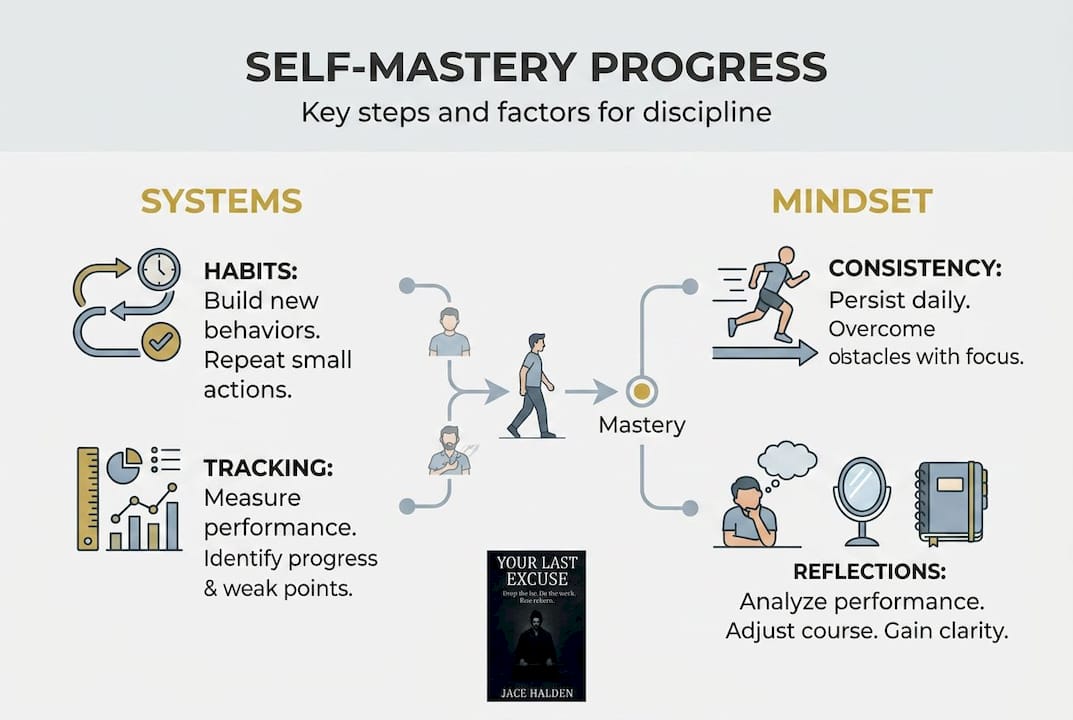
The research is clear: track for at least 66 days, expecting variability throughout, and adjust without harsh self-judgment for sustainable habit formation. That 66-day minimum isn't arbitrary. It reflects the lower bound of what actual behavioral science says about automaticity forming in real human subjects.
Signs of real, sustainable progress include:
- The habit requires less mental effort to initiate than it did in week one
- You notice discomfort when you skip, not relief
- Your internal narrative around the behavior has shifted from "I should" to "this is what I do"
- Recovery from a bad day gets faster over time
- You start applying the same system thinking to other areas of your life
Weekly reflection prompts you can use to assess your progress:
- What did I execute on consistently this week?
- Where did friction show up and what caused it?
- What is one adjustment that would reduce that friction next week?
- Did my self-talk support or undermine my actions?
Identity-based strategies tie these reflections to something more durable than goal outcomes. When the system is connected to who you're becoming, not just what you're trying to accomplish, motivation becomes almost irrelevant. You do it because it reflects who you are. Combine this with the frameworks in lasting behavioral change and you have a complete system that compounds over months and years, not weeks.
The uncomfortable truth: Why radical consistency outperforms perfect motivation
Stepping back, here's an honest take many guides overlook about what really drives self-mastery.
Here's what most self-improvement content won't tell you: perfection is the enemy of actual progress. Men abandon their systems not because the systems failed, but because their performance on any given day didn't match some imaginary standard they set in a moment of peak motivation. Then they wait for that feeling to come back before they'll try again.
That wait is where self-mastery goes to die.
The men who actually transform their lives aren't executing flawlessly. They're showing up poorly, adjusting, showing up again, course correcting, and staying honest with their tracking data even when it's uncomfortable to look at. That ugly, imperfect consistency compounds into something remarkable over 6 to 12 months.
Lasting identity change is built through exactly this process. Not through inspiration. Through repeated, flawed, honest action that gradually reshapes the story you tell yourself about who you are. Radical consistency beats motivation every time because it doesn't depend on how you feel on any given Tuesday morning.
Ready to execute your workflow? Start your breakthrough now
If you're ready to solidify what you've learned, tap into hands-on support.
You now have the framework. The myths are cleared, the tools are identified, the workflow is mapped, and the roadblocks have recovery plans. But knowledge without execution is just more information that doesn't change your life. The next step is applying it with structured support designed specifically for men who are serious about breaking the cycle.

The Your Last Excuse program gives you the Identity Shift System, a step-by-step protocol built on the same behavioral psychology principles covered in this article. It goes deeper into the subconscious patterns that keep the Fluctuation Cycle running and gives you The Forge Protocol to break it permanently. Pair that with digital self-help solutions for additional tools you can put to work immediately. The system is in place. Your move.
Frequently asked questions
How long does it really take to build self-discipline?
Science shows it takes at least 66 days of consistent practice, not the 21 days often claimed, and results vary significantly based on the complexity of the behavior.
What makes CBT and ACT effective for men's self-mastery?
They focus on structured action, practical habit design, and thought pattern correction rather than relying on fleeting willpower, making CBT highly action-oriented and directly applicable to real behavioral change.
Is missing a day of my routine a failure?
Missing one day is not a failure. The critical rule is never miss twice, because repeated consecutive misses start forming new unwanted patterns that undermine your system.
What should I do when I lose motivation?
Rely on your pre-built system and workflow, not your emotional state. Research confirms that structured systems outperform willpower as a long-term behavior change strategy, so the system carries you when motivation fades.