
TL;DR:
- Short-lived motivation is driven by fleeting dopamine spikes and external rewards that undermine intrinsic drives.
- Our brain's comfort systems and failure detectors like the habenula trigger avoidance and self-sabotage cycles.
- Lasting discipline relies on small habits, environmental design, and intrinsic goals, not on relying solely on motivation or willpower.
You feel it every time. A podcast fires you up, a motivational clip hits different, or you hit a new low that makes you swear this time will be different. For a few days, maybe even a week, you're unstoppable. Then something shifts. The energy drains out quietly, the excuses creep back in, and you're left wondering what's wrong with you. Nothing is wrong with you. The problem is that you've been relying on a system your brain never designed for sustained effort, and understanding exactly why that system breaks down is the first real step toward building something that actually holds.
Table of Contents
- The science behind instant motivation and why it's so short-lived
- How the brain's comfort systems trigger self-sabotage cycles
- Why discipline fails: The myth (and reality) of 'ego depletion'
- Building sustainable discipline: Tiny habits, systems, and self-efficacy
- The uncomfortable truth about lasting motivation: What men need to know
- Take your next steps toward real change
- Frequently asked questions
Key Takeaways
| Point | Details |
|---|---|
| Instant motivation is fleeting | Dopamine-driven excitement fades fast, leaving most people stuck in the same patterns. |
| Brains resist discomfort | Self-sabotage is built on your brain’s hardwired need for comfort and avoidance of perceived failure. |
| Willpower is not the whole story | Your beliefs about motivation matter more than the myth of willpower depletion. |
| Small habits enable change | Tiny, values-based habits and environment tweaks can break self-sabotage cycles for good. |
The science behind instant motivation and why it's so short-lived
Let's start by peeling back the science behind those bursts of motivation, and why they never seem to stick.
Every time you get fired up by a new goal, your brain floods with dopamine. Dopamine is not a "happiness chemical" in the simple sense. It's a signal of anticipated reward. Your brain lights up when it predicts something good is coming, not necessarily when it arrives. That surge feels incredible. It creates a sense of urgency, clarity, and invincibility. The problem is that dopamine spikes are biological in nature, which means they're designed to fade. They exist to get you moving, not to keep you moving indefinitely.
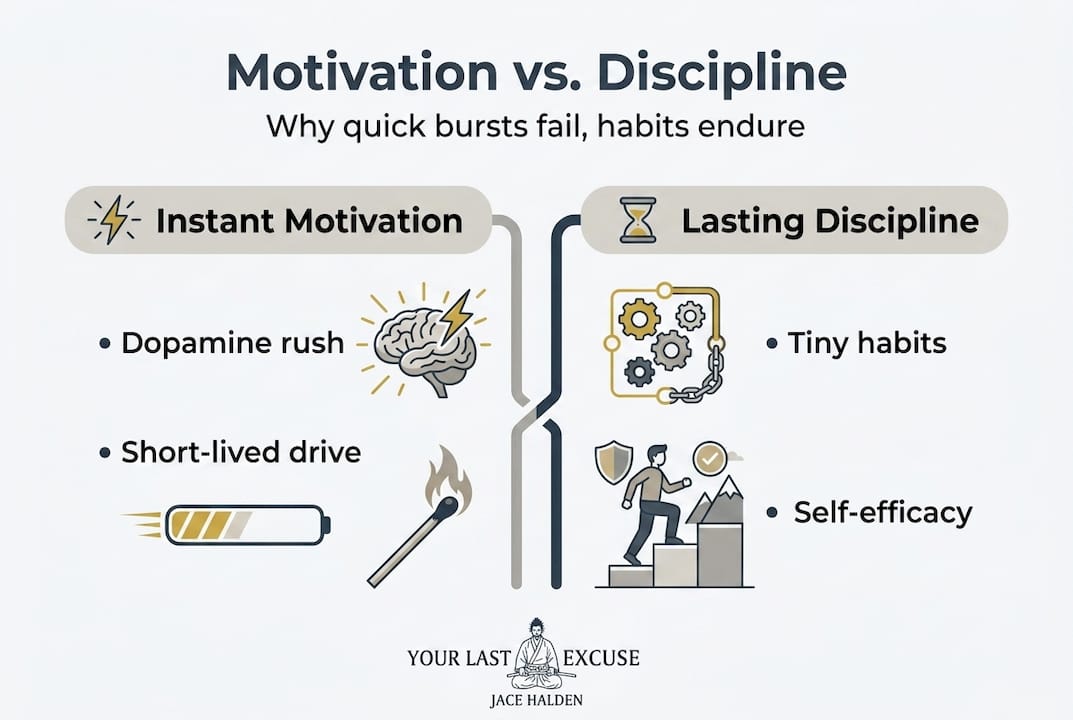
This is where self-determination theory (SDT), developed by psychologists Edward Deci and Richard Ryan, becomes critical to understand. SDT identifies two fundamental categories of motivation: intrinsic and extrinsic. Intrinsic motivation comes from inside. You do something because it aligns with your values, creates genuine meaning, or produces a sense of mastery. Extrinsic motivation comes from outside pressure, like rewards, social validation, or fear of consequences. Most men stuck in self-sabotage cycles are almost entirely operating on extrinsic fuel.
Here's the core problem: external rewards undermine intrinsic motivation for enjoyable tasks, creating a reliance on fleeting boosts that fade the moment those external conditions disappear. This is called the overjustification effect. When you're motivated to go to the gym only because someone complimented your progress, or because you're trying to impress someone, that motivation collapses the second the external trigger is removed.
The data backs this up clearly. Autonomous motivation predicts better persistence and well-being than controlled extrinsic motivation, according to SDT's empirical benchmarks. In simple terms: men who do things because it genuinely matters to them stick with it. Men who do things for external reasons quit.
| Motivator type | Source | Durability | Common example |
|---|---|---|---|
| Intrinsic | Internal values, meaning, mastery | High | Training because you respect your body |
| Extrinsic (controlled) | Rewards, pressure, shame | Low | Going to the gym to impress someone |
| Extrinsic (internalized) | External value you've made your own | Medium-High | Eating well because health matters to you |
"Chasing the feeling of motivation is like chasing weather. You can't control when it shows up. But you can build a roof."
This table makes clear that the issue isn't effort. Most men in self-sabotage patterns work hard when they're fired up. The issue is what's fueling the effort, and how sustainable that fuel source actually is.
Key indicators that your motivation is extrinsic and vulnerable:
- You need a new podcast or video to get going every week
- Your effort spikes after social comparison and crashes afterward
- You feel deflated when no one notices your progress
- You can't explain why you want the goal beyond "it would look good" or "people would respect me"
If that list resonates, you're not broken. You're just running on the wrong fuel.
How the brain's comfort systems trigger self-sabotage cycles
Understanding the temporary nature of motivation leads us straight into why our brains are wired to resist tough changes.
Your brain's primary job is not to make you successful. It's to keep you alive and conserve energy. Sustained change, especially the kind that demands discomfort, reads as a threat to your nervous system. That's not metaphor. That's neurobiology. The brain's preference for comfort and predictability is a core driver of avoidance, and self-sabotage cycles arise from this comfort-seeking combined with a specific brain structure called the habenula.

The habenula is a tiny region deep in the brain that functions like a failure detector. When you attempt a behavior and the outcome doesn't match your expectation, the habenula activates and suppresses dopamine production. In practical terms, this means every time you feel like you've "failed" at your routine, your brain chemically discourages you from trying again. It triggers shame, frustration, and a pull toward avoidance. This is why one missed gym session can unravel an entire week.
This cycle becomes even more intense for men who struggle with emotional dysregulation, which is the difficulty in managing strong negative emotions without acting impulsively. Men with ADHD, for example, experience dopamine dysregulation that makes ending self-sabotage significantly harder because the brain chases dopamine spikes aggressively and crashes just as hard. Even without a clinical diagnosis, most men stuck in sabotage cycles show similar emotional reactivity around failure.
| Brain response | Trigger | Effect on behavior |
|---|---|---|
| Habenula activation | Perceived failure or unmet expectation | Suppresses dopamine, increases avoidance |
| Comfort-seeking | Sustained discomfort or effort | Pulls toward old, familiar patterns |
| Shame loop | Repeated failures | Reduces motivation to try again |
Pro Tip: When you notice the urge to quit after a minor slip, that's the habenula at work. Name it out loud. Literally say "that's my brain's failure detector firing." It sounds strange, but psychological labeling reduces the emotional intensity of the response and gives you a moment to choose differently.
Here's a step-by-step approach to interrupt the cycle when it starts:
- Catch the trigger early. Identify the specific situation that precedes your collapse, whether it's a tough conversation, a bad day at work, or missing one workout.
- Create a "minimum viable action." Instead of all or nothing, plan the smallest version of your habit so the habenula can't register it as a failure.
- Reframe the narrative immediately. A slip is data, not identity. Write down what happened and what you'll adjust, not what you "are."
- Return to discipline-building routines within 24 hours, not next Monday, not after you "feel ready."
The brain's comfort system is powerful. But it's not smarter than your awareness. Once you know what's happening neurologically, you can stop treating it like a character flaw.
Why discipline fails: The myth (and reality) of 'ego depletion'
Once you recognize your brain's comfort traps, it's time to examine why even the hardest efforts at discipline seem to collapse, often blamed on willpower "depletion."
You've heard the idea. Willpower is like a muscle. Use it too much during the day and it runs out. Make decisions all morning and by evening you're making terrible ones. It's an appealing metaphor, and for years it dominated psychology textbooks and self-help culture. There's one substantial problem: the science doesn't hold up nearly as well as originally claimed.
Ego depletion theory suggests self-control is a limited resource that fatigues with use, but large-scale replications involving over 2,000 and then 3,500 participants found effect sizes near zero. The original "willpower is a muscle" premise essentially collapsed under rigorous examination. Some recent intensive studies do show modest effects under very demanding conditions, but the sweeping daily version of the theory lacks support.
"Your beliefs about willpower shape your behavior more powerfully than any actual biological limit on it."
This matters enormously for men who have been telling themselves "I just ran out of willpower today." That belief becomes a self-fulfilling cycle. Research on mindset and self-control consistently shows that men who believe willpower is unlimited maintain better evidence-based discipline strategies across demanding days. It's not about pretending fatigue doesn't exist. It's about not surrendering to a narrative that science hasn't confirmed.
Here's how to reframe discipline practically:
- Replace willpower with systems. The goal is to eliminate decisions, not to white-knuckle through them. Fewer choices mean less friction, not less character.
- Audit your belief about limits. If you tell yourself you're depleted, you will act depleted. Catch that story and replace it with "this is hard but I'm choosing."
- Schedule your most demanding tasks strategically, not because willpower runs out on a timer, but because your focus and attention genuinely fluctuate and can be optimized.
- Invest in lasting self-discipline through habit architecture, not heroic force of will.
The shift from "my willpower failed me" to "my system failed me" is not just semantic. It's the difference between blaming yourself and fixing the actual problem.
Building sustainable discipline: Tiny habits, systems, and self-efficacy
Now, it's time to move beyond what doesn't work and unlock what does for sustainable discipline, even if you've failed before.
Self-efficacy is the technical term for your belief in your own ability to execute a specific task or behavior. It's not general confidence. A man can feel confident in his career and have zero self-efficacy around his morning routine. Research consistently shows that self-efficacy is one of the strongest predictors of whether habits stick, not motivation, not intention. The good news: self-efficacy is built through evidence, not pep talks.
Tiny habits provide that evidence. When you do something small and succeed, your brain registers a win. Do it repeatedly, and you start to believe you're someone who follows through. That identity shift is the engine of habits for lasting motivation. The habit itself matters less than the psychological proof it creates. SDT supports this directly: building self-efficacy through tiny habits, environment design, and intrinsic goals tied to autonomy, competence, and relatedness outperforms extrinsic-driven approaches in sustaining real change.
Environment design, sometimes called choice architecture, is one of the most underused tools men have. Your environment is constantly making decisions for you. If junk food is visible, you eat it. If your workout gear is out the night before, you're more likely to train. Changing your physical and digital environment is not weakness. It's strategy.
Key tactics for building sustainable discipline:
- Anchor new habits to existing routines. "After I make coffee, I'll do five minutes of focused writing." This links the new behavior to an established trigger.
- Design friction into bad habits and out of good ones. Delete the apps that pull you into passive scrolling. Put your phone in another room at night.
- Choose intrinsic goals that connect to your actual values. Not "I want abs" but "I want to feel in control of my body and show my kids what discipline looks like."
- Track streaks with forgiveness built in. Miss one day, never two. The goal is consistency over perfection.
- Use positive habits as identity anchors, not just behaviors to check off.
Pro Tip: Write down the identity you're building, not the goal. Instead of "I want to exercise more," write "I am someone who moves his body daily." Read it every morning. Your habits will begin to align with who you believe you are, not what you feel like doing in the moment.
The men who build self-discipline skills that actually last don't rely on motivation. They build environments, beliefs, and identities that make discipline feel like the natural expression of who they are.
The uncomfortable truth about lasting motivation: What men need to know
Here's what years of watching men cycle through self-improvement attempts reveals: most are hunting for a better motivator when what they actually need is a better system and a different relationship with failure.
The popular narrative around transformation is built on intensity. The dramatic before-and-after. The rock-bottom moment. The 5 a.m. grind. None of that is wrong. But it creates a false impression that transformation runs on sustained emotional fire. It doesn't. Building lasting discipline runs on consistency during the days when you feel nothing. That's the work nobody posts about.
Resilience after setbacks is more predictive of long-term success than how motivated you feel on day one. Most men abandon their systems after the first major slip, not because they're weak, but because they've internalized the idea that any failure means the system failed. That's backwards. The system exists precisely for those days.
Transformation isn't an experience. It's a practice. It's boring meetings with yourself every morning, it's habits that don't feel heroic, and it's choosing the harder option when every signal says rest. That's what actually changes a man's life.
Take your next steps toward real change
If you're ready to break out of the instant motivation trap, here's how to keep moving forward.
Knowing the science is only the beginning. What separates men who transform from men who stay stuck is a structured framework that applies these principles daily, even when motivation is nowhere to be found. At Your Last Excuse, the Identity Shift System and Forge Protocol were built specifically for men who've tried and failed, who understand the theory but can't make it stick without a concrete system. The self-discipline guide is a strong starting point if you want to see the framework in action.
Real change is possible for you. Not because you'll find better motivation, but because you'll stop needing it. The right system makes discipline the default.
Frequently asked questions
Why does my motivation disappear so quickly after I get inspired?
Motivation sparked by external rewards or excitement fades quickly because it doesn't tap into deeper, intrinsic drives. External rewards undermine intrinsic motivation for enjoyable tasks, creating dependence on boosts that disappear without those external conditions.
Can willpower actually run out during the day?
Research shows willpower depletion is less predictable and depends more on mindset than a fixed biological limit. Ego depletion theory suggests self-control is limited, but large-scale replications have largely failed to confirm the effect in everyday scenarios.
How can I stop self-sabotaging my progress?
Use tiny, manageable habits and redesign your environment to reduce the friction around good behaviors. Building self-efficacy through tiny habits and intrinsic goals rooted in your actual values is the most evidence-backed path out of sabotage cycles.
Is it possible to make motivation last forever?
No single burst of motivation will last indefinitely, but building intrinsic goals and reliable systems creates discipline that doesn't depend on feeling fired up. Autonomous motivation predicts better persistence than controlled extrinsic motivation, meaning the goal is to internalize your reasons, not find bigger external rewards.